Shopping Cart



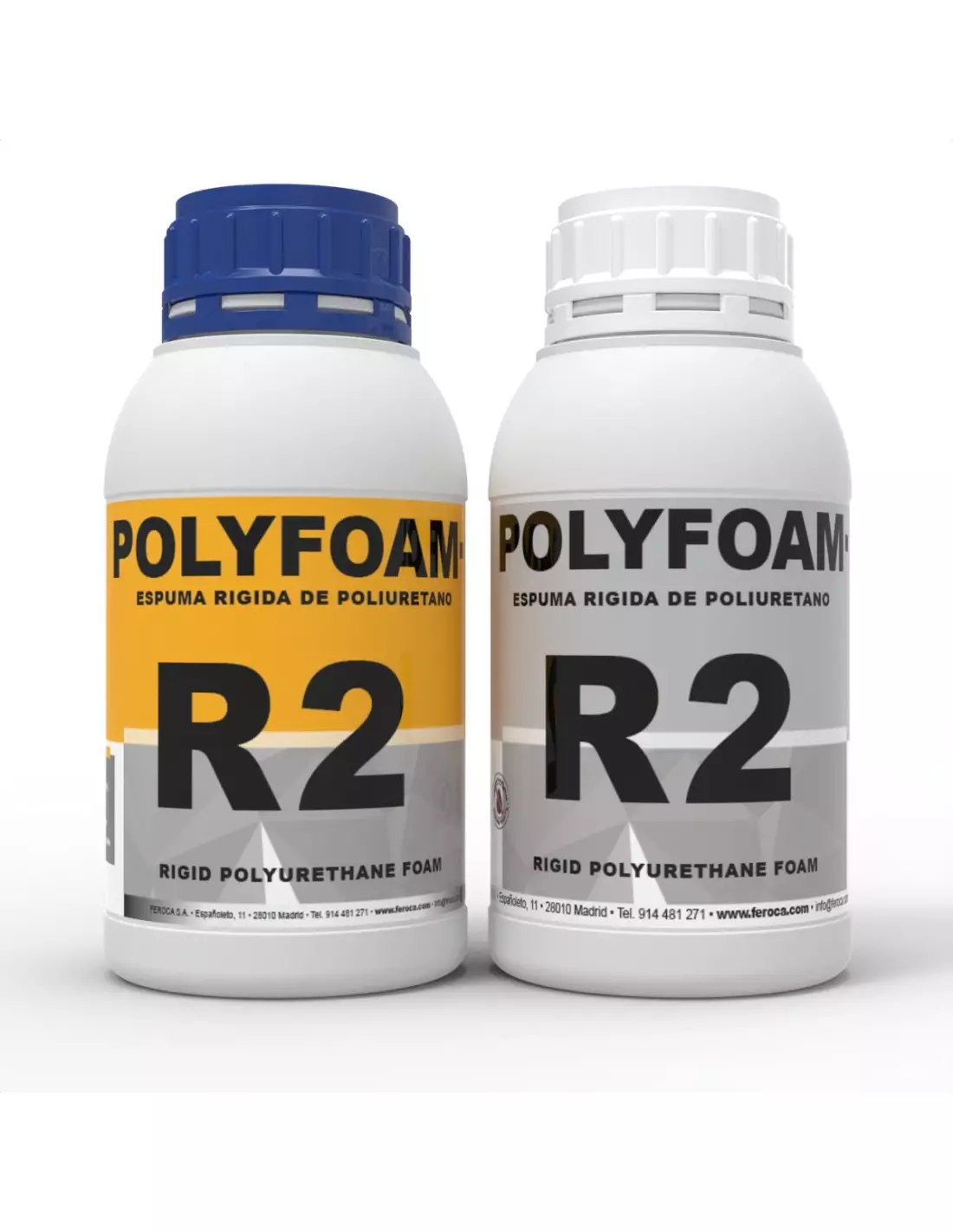
PolyFoam R2 -Rigid Polyurethane Foam-
433020101
€22.00
26,62 € Tax incl.
26,62 € Tax incl.
Two-component rigid polyurethane foam. Moulded density 64–128 kg/m³, expansion 8–15x, 1:1 mix ratio, demould in 30 min.
PolyFoam R2 is a two-component rigid polyurethane foam with a volumetric expansion of between 8 and 15 times its initial volume. Formulated without TDI, MOCA, heavy metals or HCFC, it is virtually odourless and offers an excellent level of surface detail. Ideal for lightweight fills, prototypes and part series when you need a rigid, precise and easy-to-use foam.
Technical specifications
| Parameter | Value |
|---|---|
| Type | Rigid polyurethane foam, two components |
| Mix ratio by weight | 100A : 100B |
| Mix ratio by volume | 100A : 100B |
| Mixed viscosity | ~500 cP |
| Cream time | 30 seconds |
| Foam rise time | ~3 minutes |
| Tack-free time | ~10 minutes |
| Demould time | 30 minutes |
| Volumetric expansion | 8 — 15 times |
| Free rise density | ~40 kg/m³ |
| Moulded density | 64 — 128 kg/m³ |
| Composition | Free of TDI, MOCA, heavy metals and HCFC |
What it is used for
PolyFoam R2 is designed for applications where a rigid, lightweight structure with good detail reproduction is needed. Its low free rise density and excellent fill capacity make it a go-to choice for the production of decorative parts and technical models:
- Filling hollow parts to add rigidity without excessive added weight
- Decorative objects, props and set pieces
- Lightweight mother moulds for reinforcing silicone moulds
- Series production of parts from polyurethane resin moulds
- Low-density models and prototypes
- Duplicating masters and patterns
- Internal structures for articulated figures or special effects props
How to use it
- Prepare the mould. Make sure the mould — preferably platinum silicone or polyurethane rubber — is clean, dry and properly closed. Apply a Release agent if the mould material requires it.
- Condition the components. Bring components A and B to working temperature (between 20–25 °C). Stir each component separately before mixing, as component A may settle.
- Weigh or measure in a 1:1 ratio. Mix equal parts by weight or by volume. Use a precision scale or graduated containers.
- Mix vigorously for 20–30 seconds. Scrape the sides and bottom of the container thoroughly. The mix will begin to cream almost immediately — you have approximately 30 seconds of usable working time.
- Pour into the mould immediately. Given the very short cream time, pour as soon as the mixture is homogeneous. For closed parts, fill only the required volume by calculating the expected expansion (8–15x).
- Close the mould and clamp it. The expansion pressure can be considerable. Use clamps, G-clamps or clamping systems to prevent the mould from opening during the process.
- Allow to cure for 30 minutes before demoulding. At room temperature, the part reaches sufficient hardness for demoulding in 30 minutes. Full cure continues over the following hours.
Important notice — Polyurethane reactivity: Component B (isocyanate) reacts with moisture in the air and in the mould. Always keep components tightly closed when not in use. Wet moulds or moulds with water residue will cause defects (bubbles, incorrect cure). In addition, the foaming reaction is moderately exothermic: in large volumes, the heat generated can be significant. Work in ventilated spaces and consult the safety data sheets for parts A and B before handling the product.
Usage tips
Calculate the fill volume carefully
The foam can expand up to 15 times its initial volume. If you overfill a closed mould, the expansion pressure can damage the mould or cause leaks. As a reference, for a moulded density of 64 kg/m³ starting from a free rise density of 40 kg/m³, you will need to calculate the cavity volume and the actual expansion factor based on the mould restriction. Run tests with small amounts before producing in series.
Recommended moulds and release agents
Platinum silicone moulds are the preferred option for PolyFoam R2: in most cases they require no Release agent thanks to their non-stick nature. However, the foam is self-adhesive on many substrates (wood, cardboard, existing foam, fabrics), which is advantageous when the goal is permanent fill of a part. If you use resin or plaster moulds, always apply a Release agent in a thin, even layer to facilitate demoulding without damaging the surface.
Ambient temperature and humidity
Temperature is the factor that most affects reaction speed. Above 25 °C, cream time shortens even further and expansion is faster. Below 18 °C, cure slows down and surface problems may appear. Always work at a stable temperature between 20 and 25 °C. High humidity can introduce extra CO₂ into the mix and slightly increase surface porosity; in very humid environments, condition the mould before pouring.
Frequently asked questions
How much does this foam expand when the two components are mixed?
PolyFoam R2 has a volumetric expansion of between 8 and 15 times. In free rise (without mould restriction) it reaches a density of approximately 40 kg/m³. When moulded in a closed space, the final density rises to the 64–128 kg/m³ range depending on the degree of confinement.
Can it be used in moulds other than silicone?
Yes. PolyFoam R2 works well in polyurethane rubber moulds and also in rigid moulds (resin, plaster, wood), provided you apply a suitable Release agent. Platinum silicone moulds are the most recommended because they require no Release agent and facilitate demoulding of parts with complex geometries.
How much working time do I have once the components are mixed?
The cream time is approximately 30 seconds. This is a very short time, so you must have the mould prepared and ready to receive the mix before you start combining the components. Mix quickly, thoroughly, and pour immediately.
Can the cured foam be sanded, painted or machined?
Yes. Once cured, PolyFoam R2 can be sanded, milled, drilled and painted without difficulty. Its rigidity and moulded density (up to 128 kg/m³) make it suitable for surface finishing with primers and water- or solvent-based paints. For drilling and anchoring screws under significant structural load, bear in mind that the load-bearing capacity is limited; it is more suited to light or positioning loads.
Is it suitable for thermal insulation applications?
No. PolyFoam R2 is formulated for detail reproduction, part filling and model making, not for thermal or acoustic insulation in construction. Insulation uses require specific foams with certified thermal conductivities, which are not the purpose of this product family.
Does it contain solvents or toxic components?
PolyFoam R2 does not contain TDI (toluene diisocyanate), MOCA, heavy metals or HCFC, making it one of the safest formulations in its category. It is virtually odourless. Even so, component B contains isocyanates and must be handled with adequate ventilation, gloves and eye protection. Always consult the safety data sheets for each part.
What happens if I pour too much foam into a closed mould?
If the amount of mix is excessive for the cavity volume, the expansion pressure can force the mould open, deform the walls or cause leaks at the joints. Always calculate the required amount based on the part volume and the target moulded density. Start with small-format tests to dial in the dosage before running production series.
Can it be combined with other polyurethane foams or resins?
PolyFoam R2 is self-adhesive on many substrates, including other polyurethane foams and porous substrates. It can be used as a fill after a skin layer obtained with SKINFOAM 350, or in combination with rigid polyurethane resin parts as support structures. Make sure bonding surfaces are clean, dry and free of Release agent if you want a permanent bond.
- Working Time
- 30seg
- Curing Time
- 30min
- Volume Mixing Ratio
- 100A:100B
- Mixed Weight Ratio
- 100A:100B
- Growth
- 8/15 times
No reviews
Tap to zoom