Shopping Cart



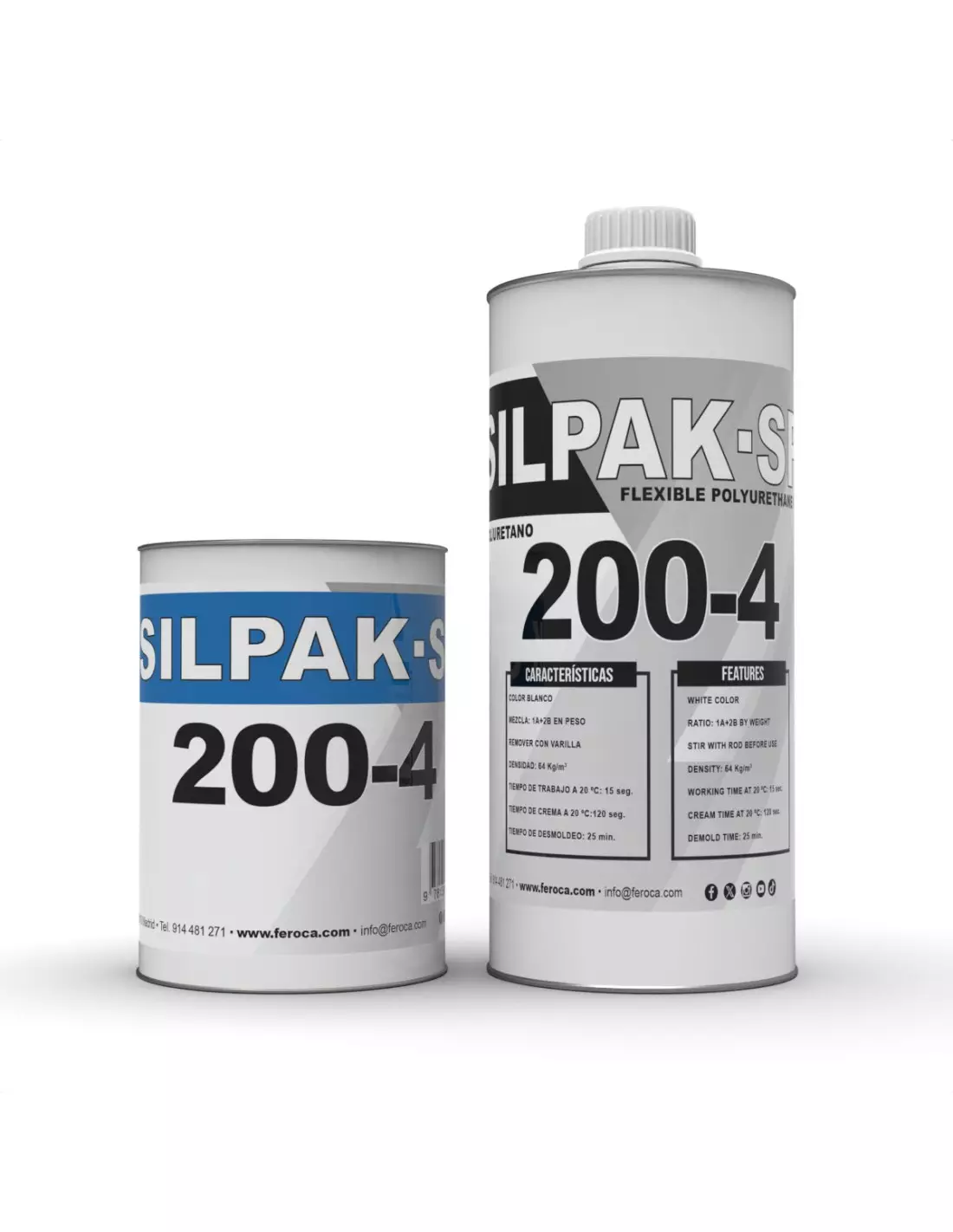
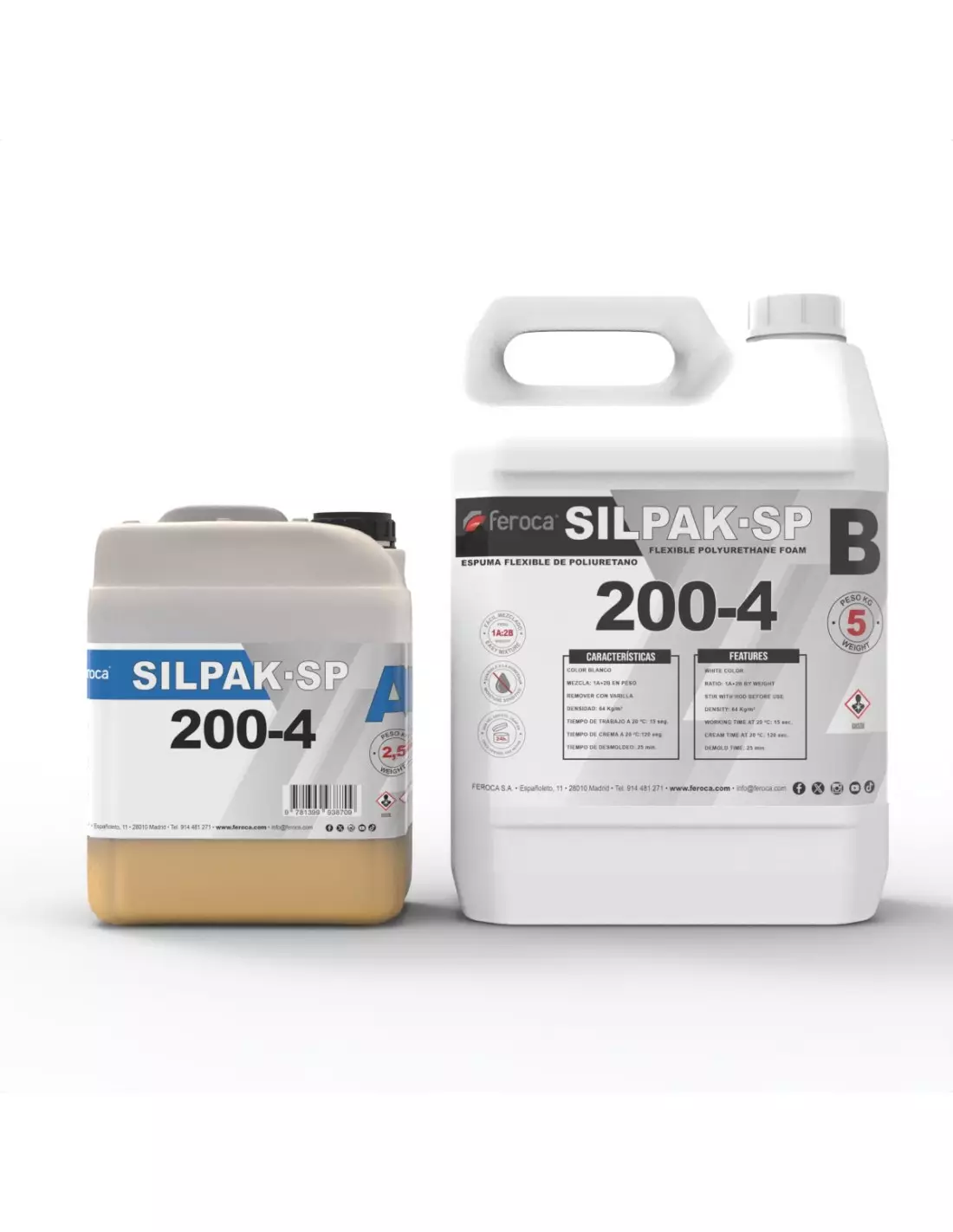
SilPak SP 200-4 Flexible foam
433023001
€40.00
48,40 € Tax incl.
48,40 € Tax incl.
Two-component flexible polyurethane foam, 1A:2B mix ratio by weight. Density 64 kg/m³, expands 8–10×, demould in 25 min. With self-skinning effect.
The SilPak SP 200-4 is a two-component, CFC-free flexible polyurethane foam formulated to produce lightweight, soft parts with a firm integral skin. With an expansion of 8 to 10 times its volume and a demould time of just 25 minutes, it is a solid option for series production or prototypes requiring a soft texture and good detail reproduction.
Technical specifications
| Parameter | Value |
|---|---|
| Material type | Flexible polyurethane foam |
| Components | Two (Part A + Part B) |
| Mix ratio | 1A : 2B by weight |
| Colour (mixed) | White |
| Density | 64 kg/m³ |
| Expansion | 8–10 times the initial volume |
| Cream time | ≈ 60 s |
| Rise time | ≈ 90–120 s |
| Working time | ≈ 15 s |
| Demould time | ≈ 25 min |
| Viscosity Part A | ≈ 600 cP at 25 °C |
| Viscosity Part B | ≈ 1,740 cP at 25 °C |
| Self-skinning effect | Yes — firm integral skin |
| CFC-free | Yes |
What it is used for
The SP 200-4 is designed for applications where a lightweight, flexible fill with a finished surface is required. The integral skin it generates in contact with the mould allows sanding, painting or applying effects directly onto the part without aggressive pre-treatments.
- Armrests, headrests and interior panels
- Prop parts and special effects for film and television
- Puppets, articulated figures and animatronics
- Product prototypes with soft fill
- Decorative parts with a soft-to-the-touch texture
- Filling rigid moulds where final flexibility is required
- Lightweight scale models and industrial mockups
How to use it
- Bring both components to 20–25 °C. Temperature directly affects cream time and final expansion.
- Apply release agent to all mould surfaces and allow to dry before pouring. This is essential to demould without damaging the part or the mould.
- Weigh the components in the correct ratio: 1 part A to 2 parts B by weight. An error in the ratio will directly affect hardness, expansion and cure.
- Mix by hand with a stick for approximately 10–15 seconds, making sure to scrape the sides and bottom of the container. Do not use a high-speed electric mixer: it would introduce unwanted air.
- Pour the mixture into the mould immediately. Working time is only 15 seconds, so have the mould ready before you start mixing.
- Close the mould if necessary and allow the foam to expand freely or under the pressure of a closed mould depending on the desired finish.
- Wait for the full demould time (≈ 25 min) before opening the mould. Demoulding early can permanently deform the part.
- Once demoulded, leave the part to rest for at least 1 hour before any post-treatment (sanding, painting, etc.).
Warning: SP 200-4 is a polyurethane foam. Avoid contact with moisture during mixing and pouring: ambient humidity or moisture in the mould can cause surface bubbles and alter expansion. Work in a dry environment and keep components tightly closed when not in use. Consult the product safety data sheet before handling: wear gloves and work in a ventilated area.
Usage tips
Control mould and component temperature
The performance of SP 200-4 is highly sensitive to temperature. Below 18 °C the cream time slows down and expansion may be incomplete. Above 30 °C working time is reduced even further and the expansion front may close before the foam has properly filled the mould. The ideal working range is between 22 and 26 °C for both the components and the mould.
Calculate the right amount before pouring
The foam grows 8 to 10 times its initial volume. Before preparing the mix, calculate the usable volume of the mould and divide by 9 as a starting point. If the mould is open, take into account the fill level you want to achieve. Pouring too much generates excess pressure that can deform soft moulds or force joins apart. If the mould is closed, always leave a small vent channel for the displaced air to escape.
Release agent is mandatory, not optional
SP 200-4 has significant adhesion to porous surfaces and to many plastics. Always apply release agent in thin, even coats, allowing to dry between passes. With silicone moulds, release agent is usually not necessary for the first casting, but is recommended from the second casting onwards to maintain mould life. With resin, plaster or wood moulds it is always essential. If you want to explore compatible mould options, SKINFOAM 350 and EASYFLEX 60 follow the same release agent recommendations.
Frequently asked questions
How much does this foam expand?
SP 200-4 expands 8 to 10 times its initial volume. That means if you pour 100 g of mixed material into an open mould, you will get a foam block with a volume of approximately 800–1,000 cm³, depending on temperature and ambient conditions.
Can it be used in silicone moulds?
Yes. Silicone moulds are one of the most common options for foams like SP 200-4. For the first casting you generally do not need release agent, but from the second or third casting onwards it is advisable to apply it to extend mould life and ease demoulding.
Can this foam be pigmented?
Yes, you can add polyurethane-compatible pigments directly into the mix before pouring. Bear in mind that since it is a white-base foam, the resulting colours will be pastel or low-saturation. For intense colour finishes, it is more effective to paint the surface once the part has cured.
How long do you have to wait before demoulding?
The minimum demould time for SP 200-4 is approximately 25 minutes. This time may vary if the mould or ambient temperature is low. Demoulding early can cause permanent deformation of the part, as the core has not yet finished curing.
Is it flexible once cured?
Yes. SP 200-4 is a flexible polyurethane foam with a density of 64 kg/m³ and a soft-to-the-touch texture. It is not rigid like a structural foam. If you need a rigid foam for filling or construction, see the EASYFOAM 300.
What is the self-skinning effect and what is it for?
The self-skinning effect means the foam generates a denser, firmer surface skin in contact with the mould walls, while the interior remains cellular and soft. This makes sanding, painting and post-treatment of the part easier without needing to apply primer coats or prior reinforcement. It is especially useful for special effects and prop parts.
Can I pour the mix into a closed mould?
Yes, but you must provide a vent channel for the displaced air to escape during expansion. If the mould is completely closed and sealed, the pressure generated can deform it or prevent the foam from properly filling all areas. Calculate the amount to pour carefully so as not to exceed the usable volume of the mould.
What is the difference between this foam and other flexible foams in the catalogue?
SP 200-4 stands out for its density of 64 kg/m³, its self-skinning effect and its 8–10× expansion, making it ideal for moulded parts with a surface finish. EASYFLEX 60 is another flexible foam in the Feroca catalogue with different characteristics, and SKINFOAM 350 is also self-skinning but with a lower expansion (approximately 3 times its volume).
No reviews
Tap to zoom