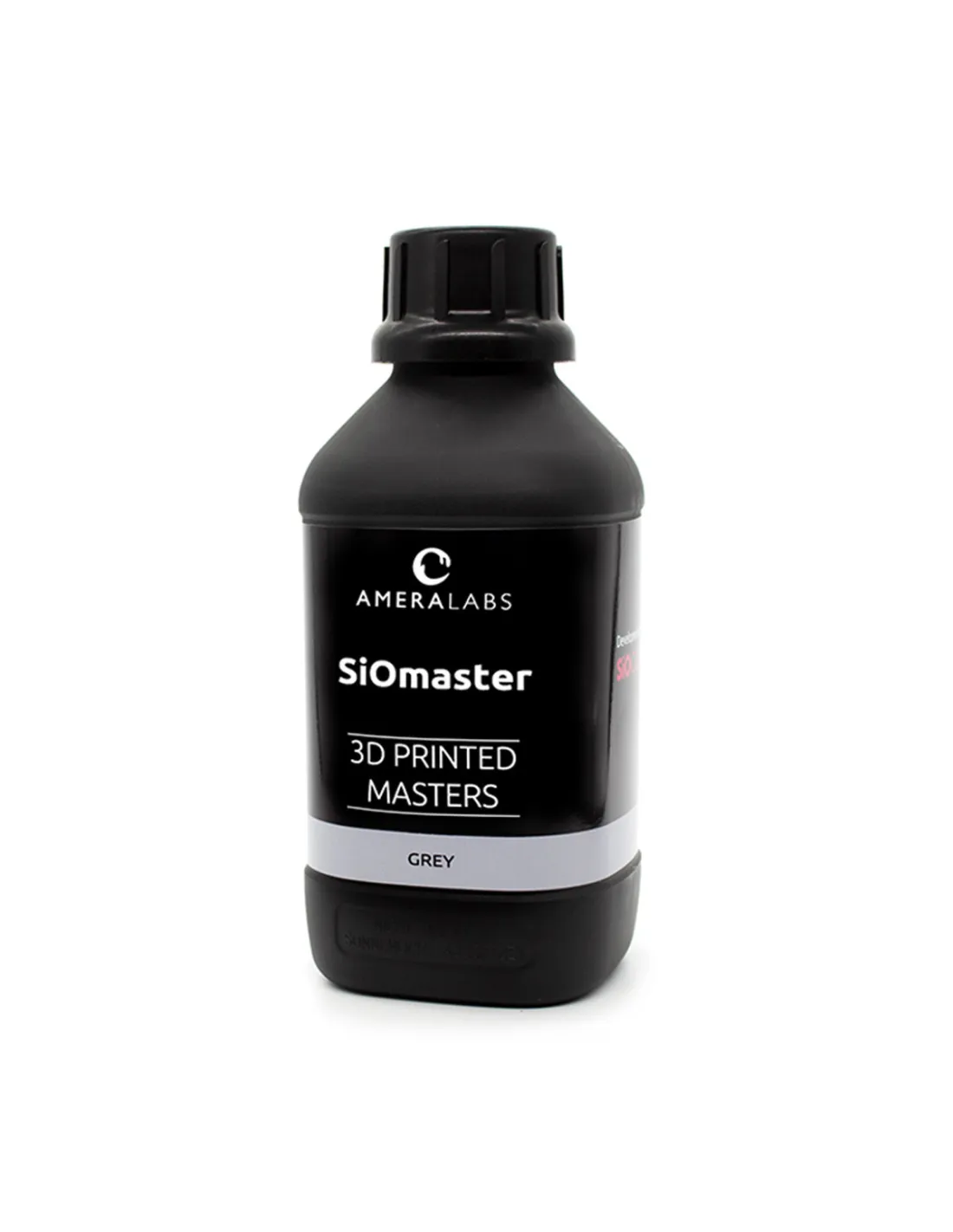
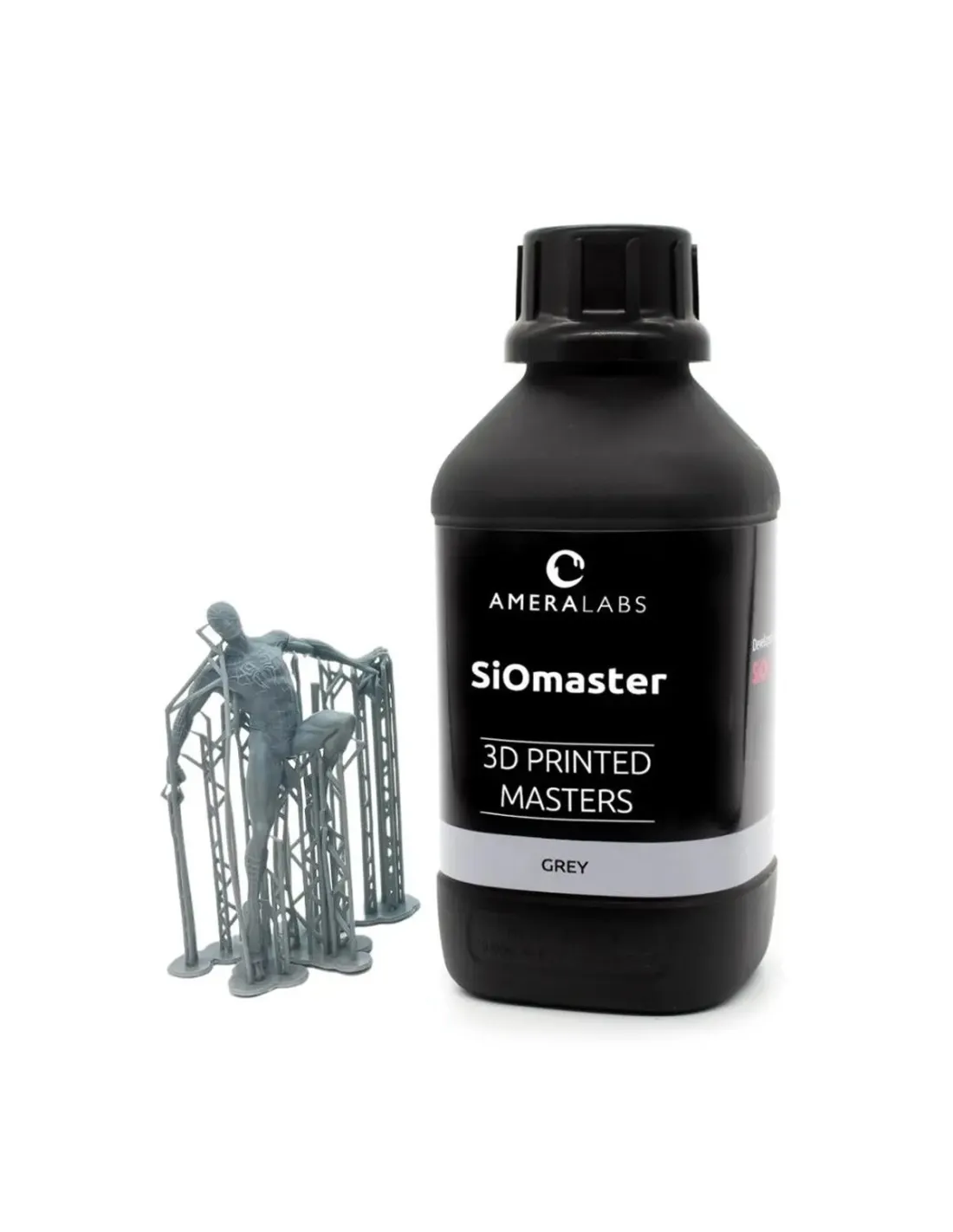
The Ameralabs SiOmaster Grey 3D Resin is a high-definition photopolymer resin specifically designed for the manufacture of master models in jewellery and injection casting. Its special formulation allows it to withstand rubber vulcanisation processes up to 180°C, making it a professional solution for obtaining multiple reusable moulds from a single printed model.
Technical specifications
| Parameter |
Value |
| Colour |
Grey |
| Maximum vulcanisation temperature |
180°C |
| Resin type |
Photopolymer (MSLA/LCD/DLP) |
| Main application |
Jewellery, casting, injection moulding |
| Definition |
High definition |
| Master model reuse |
Yes — compatible with multiple vulcanisation cycles |
What it's used for
SiOmaster Grey is designed for jewellery professionals and industrial moulding specialists who need 3D-printed master models capable of surviving the rubber vulcanisation process. Unlike standard resins, it does not warp or collapse under the pressure and temperature of the vulcaniser. This allows the creation of high-fidelity rubber moulds directly from the digital file, eliminating intermediate sculpting or machining steps.
- Manufacture of master models for rubber mould vulcanisation
- Serial production of jewellery pieces by wax injection moulding
- High-definition prototypes for design review before production
- Reusable models to obtain multiple moulds from a single master
- Lost-wax casting with a digital starting point
- Small-format pieces requiring extreme detail (textures, filigree, lettering)
How to use it
- Prepare the 3D file with the necessary tolerances to compensate for vulcanisation rubber shrinkage.
- Load SiOmaster Grey resin into your MSLA or DLP printer and configure the exposure parameters recommended by Ameralabs for this material.
- Print the master model with the minimum supports needed to maintain the integrity of visible surfaces.
- Remove the supports carefully and wash the piece in 99.9% isopropyl alcohol for the indicated time, agitating to remove uncured resin.
- Cure the piece under UV light or in a curing station following the manufacturer's instructions until the surface is no longer tacky.
- Sand lightly if necessary to remove support marks. Apply a suitable release agent before vulcanisation to facilitate rubber demoulding.
- Place the model in the raw rubber inside the vulcaniser and apply the vulcanisation cycle at the corresponding temperature and pressure (up to 180°C).
- Once the mould is vulcanised, carefully remove the master model. If the condition of the piece allows, it can be reused in subsequent cycles.
- Inject wax into the rubber mould obtained to produce serial casting models.
Usage tips
Print settings
Exposure parameters vary depending on your printer's light source and resolution. It is essential to run a calibration test with SiOmaster Grey before printing final pieces, as overexposure can bloat fine details and compromise dimensional accuracy. Always use the values Ameralabs publishes for each printer in their official profile database.
Washing and post-curing
Insufficient washing leaves uncured resin on the surface, which can negatively interfere with the rubber vulcanisation process. Make sure to wash the piece in two baths of 99.9% isopropyl alcohol — the first removes the bulk of the resin, the second refines the cleaning. Post-curing must be completed before placing the model in the vulcaniser.
Resin storage
Keep the bottle tightly sealed, away from direct light and between 15–25°C. If the resin has not been used for a while, shake it gently before pouring it into the printer tank to homogenise the pigments and components. Filter any leftover resin from the tank before storing it to remove cured particles that could ruin future prints.
Frequently asked questions
What sets a jewellery resin apart from a standard resin?
Standard resins are not formulated to withstand high vulcanisation temperatures and tend to warp or be destroyed in the vulcaniser. SiOmaster Grey is specifically designed to hold up to 180°C without losing its shape, allowing it to be used directly as a master model for vulcanising rubber moulds and obtaining wax copies for casting.
How many times can the master model be reused?
It depends on the conditions of each vulcanisation cycle (pressure, exact temperature, rubber type) and the care taken during demoulding. Under controlled conditions, SiOmaster Grey allows multiple rubber moulds to be obtained from the same master model, making the cost of each print more economical. It is advisable to inspect the piece after each cycle before reusing it.
Is it compatible with any resin printer?
SiOmaster Grey is compatible with MSLA (matrix LCD) and DLP printers with standard wavelengths in the 385–405nm range. For best results, look up the specific exposure profile for your printer in Ameralabs' documentation. If no profile is available for your model, start from the values of a similarly hard grey resin and adjust via a calibration test. The Phrozen Sonic MEGA 8K V2 3D Printer is a high-resolution option compatible with this type of resin.
What solvent is used to clean pieces before curing?
The recommended solvent for washing photopolymer resin prints is 99.9% isopropyl alcohol. Avoid lower concentrations as the water present in less pure alcohols can leave milky residues on the surface. Ultrasonic cleaning improves results on pieces with cavities or deep details.
Can this resin be used directly for lost-wax casting?
SiOmaster Grey is not designed to be burned out in the casting furnace directly (as castable resins do). Its function is to serve as the master model for vulcanising rubber moulds, and those moulds are then used to inject wax. The resulting wax pieces are what go into the flask for lost-wax casting.
What release agent is recommended before vulcanisation?
Before placing the model in the vulcaniser with the raw rubber, it is advisable to apply a rubber-specific release agent to the model's surface. This facilitates opening the mould without damaging the master model or distorting the rubber. Check with your vulcanisation rubber supplier which type of release agent is compatible.
What other grey resins are available if I need one for a different use?
What is the maximum temperature it can withstand during vulcanisation?
The Ameralabs SiOmaster Grey 3D Resin withstands rubber vulcanisation processes up to 180°C. This figure is key to confirming compatibility with your usual vulcanisation cycle. If your process requires higher temperatures, consult Feroca before purchasing.