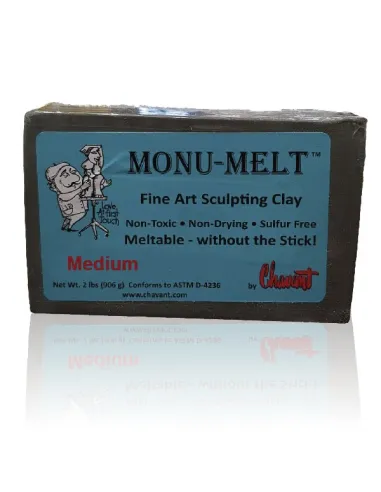
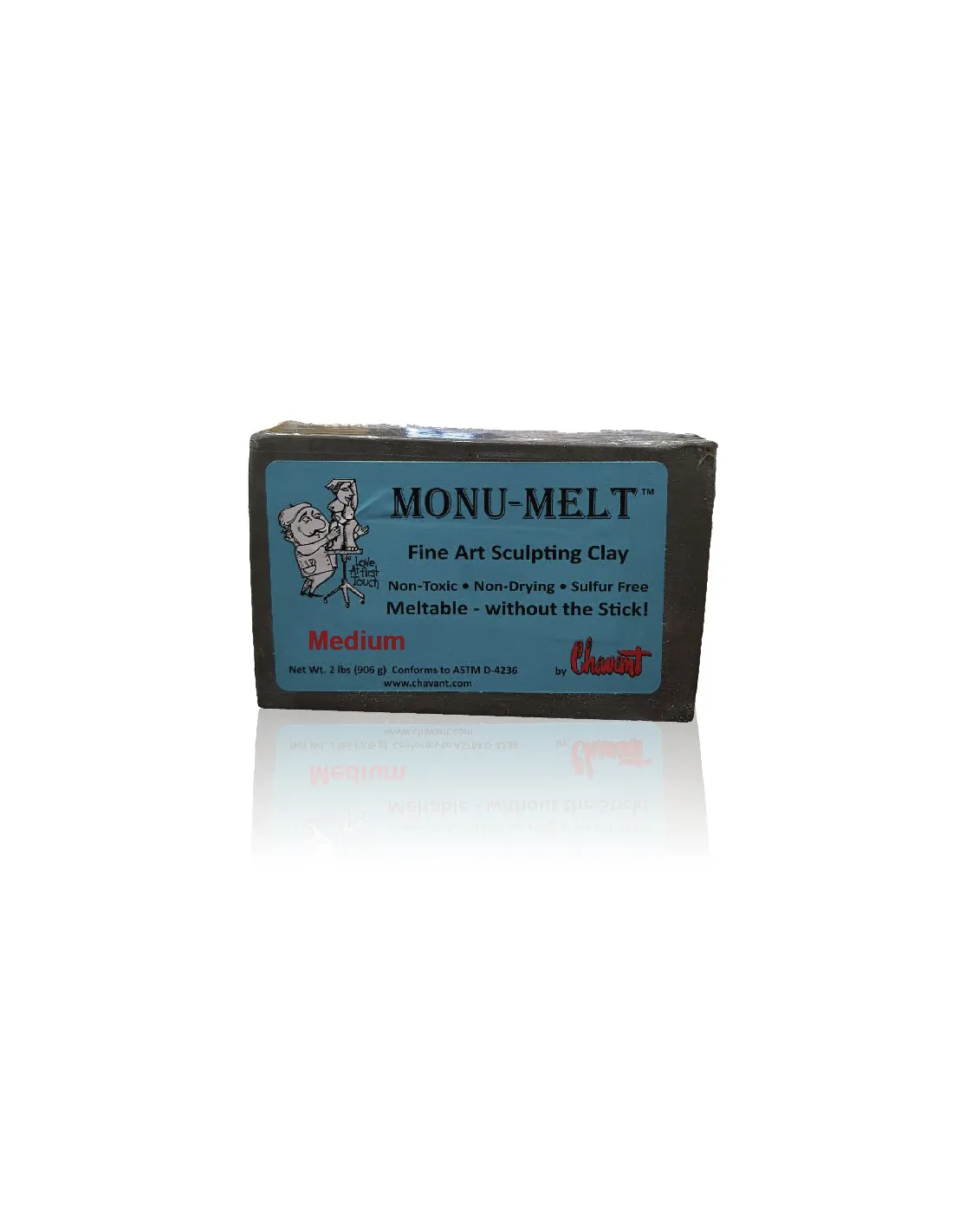
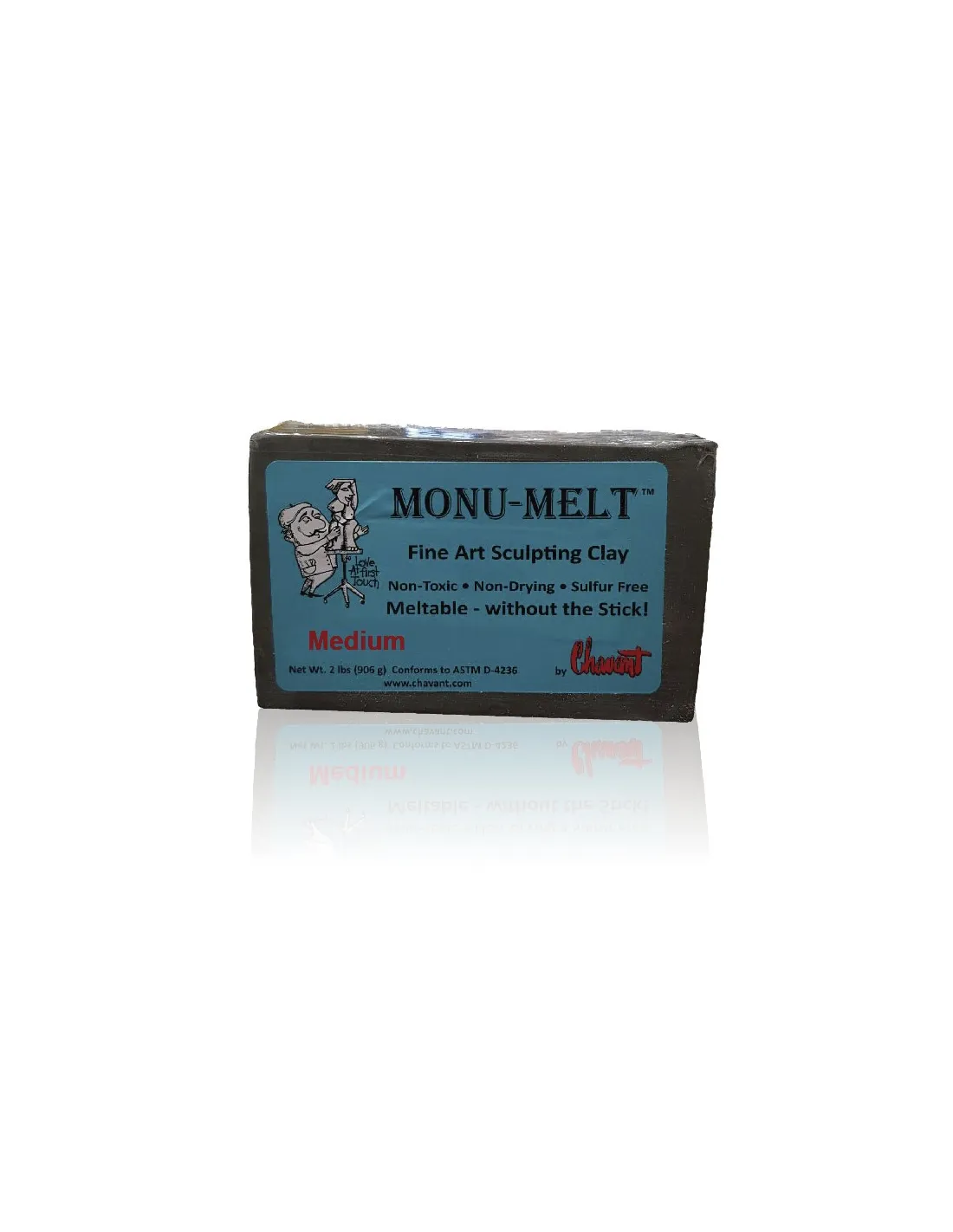
Monu-Melt Medium by Chavant is a professional clay formulated to melt by heat and be applied with a brush over armatures and volumetric structures. Sulfur-free, it is fully compatible with platinum silicones and withstands unlimited heating and cooling cycles without degrading.
Technical specifications
| Feature |
Detail |
| Brand / Line | Chavant — Monu-Melt |
| Hardness | Medium |
| Color | Grey |
| Format | 906 g block |
| Recommended melting temperature | 80 °C – 95 °C |
| Maximum temperature (bubble-free) | 95 °C |
| Sulfur-free | Yes |
| Air dries | No |
| Odour | Odourless |
| Tackiness | Non-tacky |
| Reusable | Yes, unlimited cycles |
| Toxicity | Non-toxic |
What it is used for
Monu-Melt Medium is the preferred choice when you need to quickly cover large volumes or complex surfaces with melted clay, building a solid base on which to later work fine detail. It is the reference material in special effects studios, industrial prototyping and professional sculpture.
- Coating foam armatures or CNC-cut structures prior to detail sculpting
- Sculpting characters, creatures and maquettes for film and special effects
- Prototyping industrial design and automotive parts
- Modelling busts, heads and full-body figures
- Creating masters for platinum silicone mould making
- Building volumetric bases for FX prosthetics
How to use it
- Prepare the armature or base structure — cut foam, a CNC part or any rigid support that will receive the melted clay.
- Melt the clay — heat the block in a metal container at a controlled temperature, between 80 °C and 95 °C. Do not exceed 95 °C to avoid surface bubbles.
- Apply with a brush — work in layers, applying the melted clay over the armature. The first layers seal the surface; subsequent ones build up volume.
- Allow to cool between layers — wait for each layer to solidify before adding the next to maintain volume control and avoid deformation.
- Sculpt the detail cold — once the desired volume is reached and the clay is at room temperature, work the surface with your usual sculpting tools.
- Take the silicone mould — being sulfur-free, you can pour platinum silicone directly over the finished master with no risk of inhibition.
- Reuse offcuts — leftover clay can be reheated and reused with no loss of properties.
Tips and advice
Temperature control during melting
Use an infrared or probe thermometer to keep the material between 80 °C and 95 °C. Below 80 °C the clay may be too viscous and difficult to brush on; above 95 °C bubbles can form and compromise surface quality. A controlled-temperature water bath is the most precise solution for continuous production workshops.
Layer-by-layer build-up for large-volume pieces
On large pieces, first apply a thin sealing layer over the armature to anchor the material. Then build up volume with thicker layers, allowing cooling between applications. This method reduces the risk of the weight of the melted material deforming the lower layers before they solidify.
Compatibility with platinum silicones
Being sulfur-free, Monu-Melt Medium does not inhibit the cure of addition (platinum) silicones. Even so, it is good practice to wipe the master surface with a dry cloth before pouring the silicone, to remove any dust or dirt residue that could affect the cure or detail reproduction.
Frequently asked questions
At what temperature does this clay melt for brush application?
Monu-Melt Medium melts correctly between 80 °C and 95 °C. This is the optimal range to achieve a fluid viscosity that allows brush application without bubbles forming on the surface.
Can it be used directly on foam?
Yes. Monu-Melt is designed specifically to coat foam armatures. When applied melted with a brush, the clay penetrates slightly into the porous foam surface and creates a firm bond. It does not damage foam at the recommended working temperatures.
Is it compatible with platinum silicones?
Yes. Monu-Melt Medium is sulfur-free, so it does not inhibit the cure of addition (platinum) silicones. You can pour platinum silicone directly over the master without any intermediate sealer, although it is always advisable to clean the surface thoroughly before moulding.
How many times can it be reheated without degrading?
Monu-Melt withstands unlimited heating and cooling cycles without losing its properties. Offcuts and leftover material can be recovered, remelted and reused without any problem.
What is the difference between Monu-Melt and a conventional modelling clay?
Conventional modelling clays are worked directly by hand and with tools cold or slightly warmed. Monu-Melt is specifically formulated to melt and be applied with a brush, allowing large volumes and complex geometries to be covered quickly — something not feasible with a standard modelling clay. If you are looking for a clay to work directly by hand at medium hardness, see the Chavant Medium modelling clay.
Can it be carved or sanded once cold?
Yes. Once cooled to room temperature, Monu-Melt Medium has a medium-hardness consistency that allows it to be carved, scraped and worked with conventional sculpting tools. It does not reach the rigidity of a resin, but offers enough resistance to define fine details.
Is it safe to work with indoors?
Yes. Monu-Melt Medium is non-toxic and odourless. It can be used indoors with standard workshop ventilation. It is recommended not to exceed 95 °C during melting to avoid unnecessary fume generation.
What tools are used to apply it melted?
Medium-to-large natural or synthetic bristle brushes are the most common for applying volume layers. For hard-to-reach areas or detail work, finer brushes can be used. Tools should be cleaned while the material is still hot; once cold it is harder to remove.