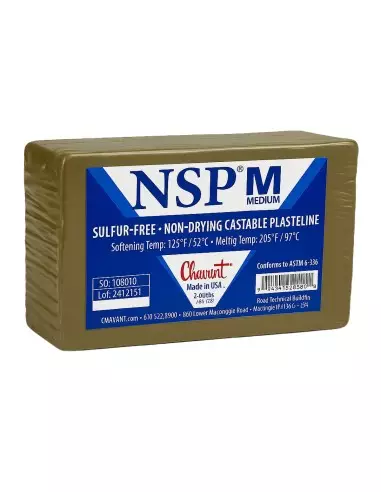
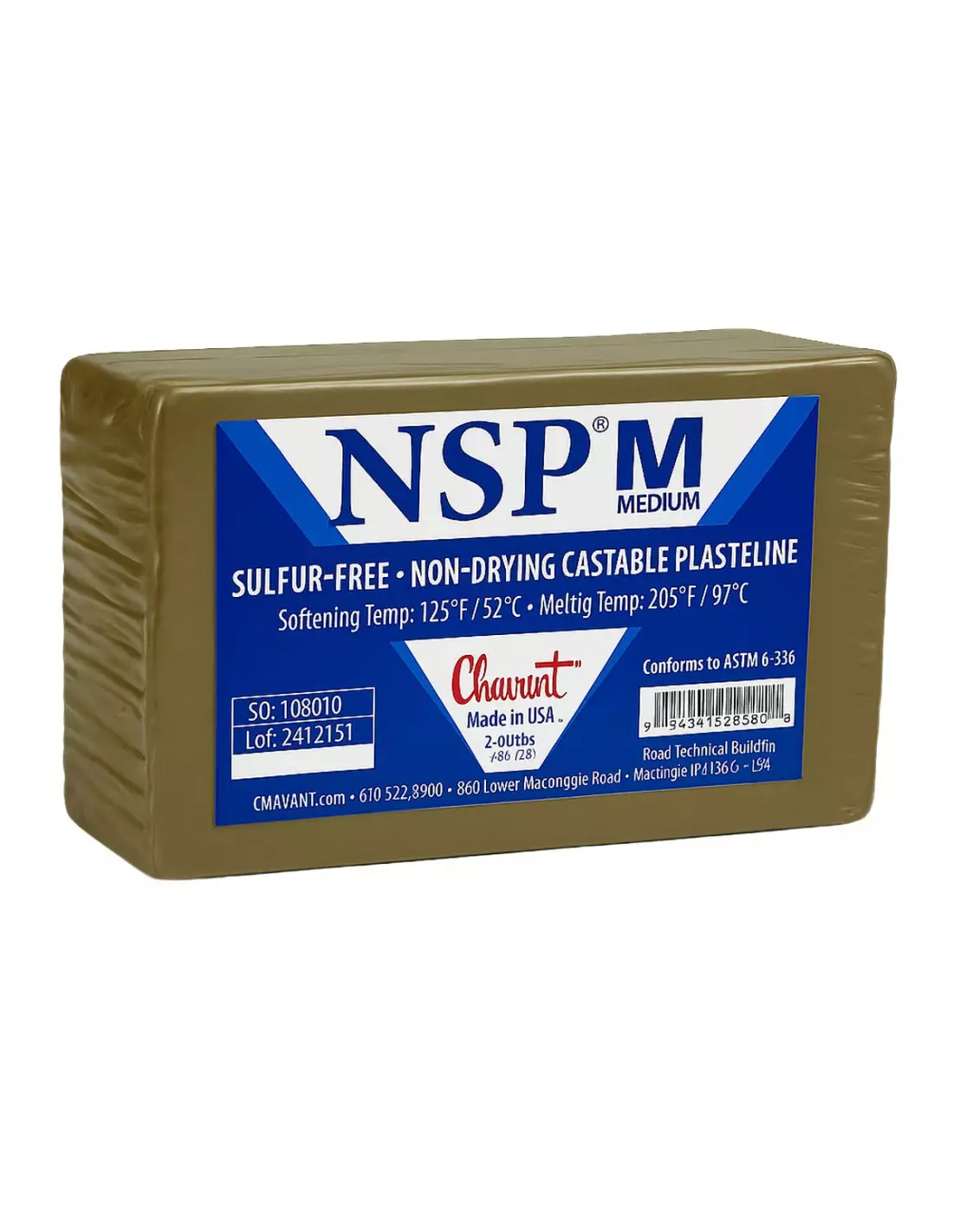
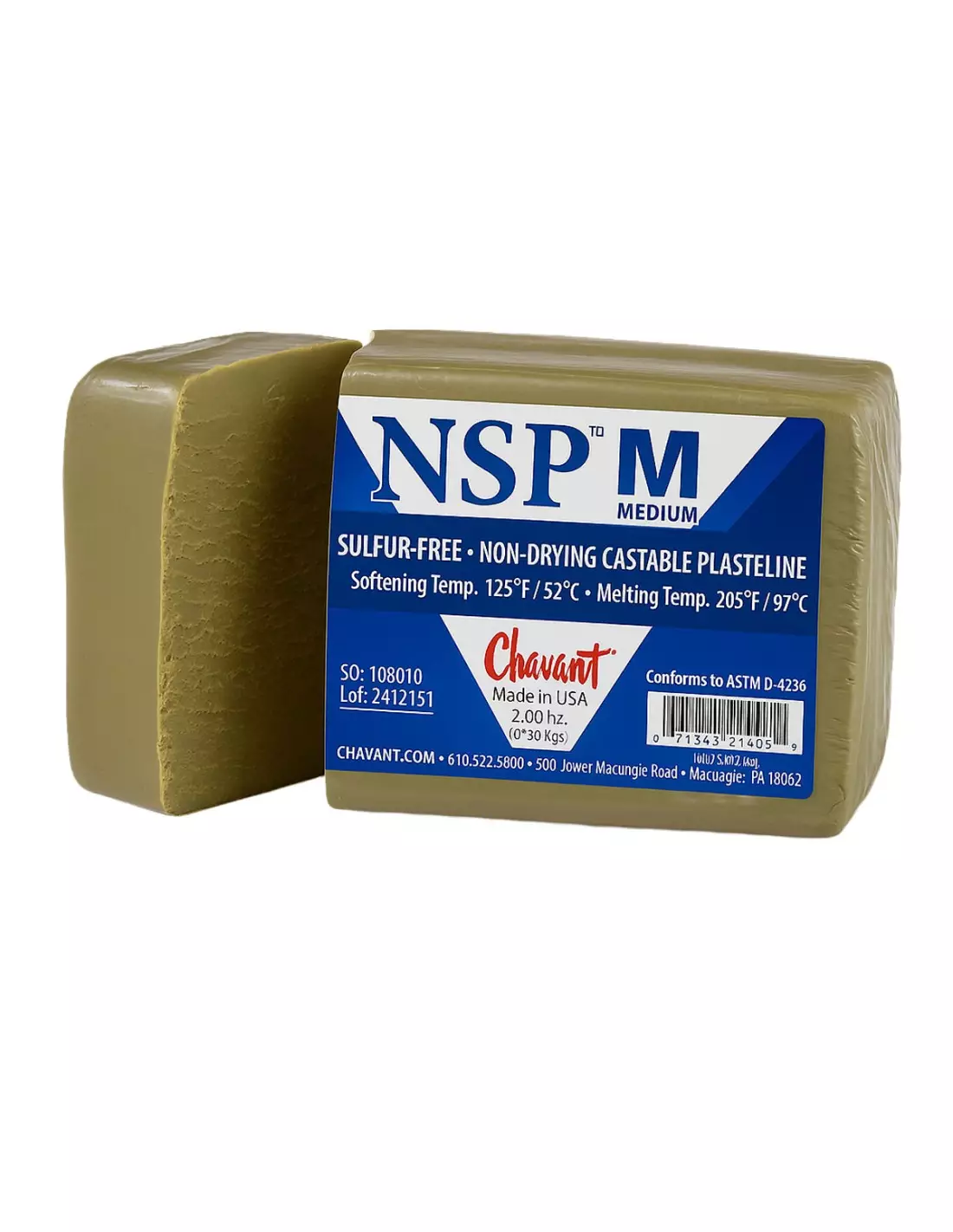
Chavant Medium is a professional medium-hardness clay formulated without sulfur compounds, making it fully compatible with both platinum and tin silicones with no risk of inhibition. It is the reference material in special effects workshops, industrial design and professional sculpture: it holds fine detail, does not crack, bonds without visible seams and can be reused indefinitely.
Technical specifications
| Property | Value |
|---|
| Hardness | Medium |
| Colour | Green |
| Weight per block | 906 g |
| Softening temperature | Approx. 85 °C |
| Sulfur content | Sulfur compound-free |
| Toxicity | Non-toxic, no dust generation |
| Reusable | Yes (by heating to semi-liquid state) |
| Machining compatibility | CNC milling, 3D scanning, carving, extruding |
| Silicone compatibility | Platinum and tin with no inhibition |
What it is used for
Chavant Medium is a versatile tool for any discipline where high-precision modelling is essential. Its medium hardness allows fine detail work without the material yielding excessively under tools, while remaining malleable enough to build up large volumes quickly.
- Modelling originals for casting in silicone or plaster
- Clay beds for two-part moulds (countermoulds)
- Prototyping and mock-up of industrial products
- Sculpting characters and creatures for special effects (FX)
- CNC milling on clay blocks
- 3D scanning of hand-sculpted originals
- Carving and extruding complex shapes
- Fill-ins and corrections on moulds or prototypes
- Registration beds in bi-material silicone moulds
How to use it
- Condition the material: at room temperature, Chavant Medium has a firm consistency. For hand modelling, warm it gently with a hot air gun or in a low-temperature oven (40–50 °C) until it becomes malleable. For large blocks, use an oven or electric slow cooker at around 85 °C until it reaches a semi-liquid state that can be poured or spread.
- Build the base shape: construct the main volume by adding mass and shaping with your hands or with modelling tools and loop tools. The medium hardness allows clean additions and subtractions.
- Work the detail: with the material at workshop temperature (20–25 °C), refine textures and shapes. For very fine details, spot-heat the area with the hot air gun without overheating the whole piece.
- Prepare the mould bed (if applicable): spread Chavant Medium on a flat board or support surface up to the parting line of the original. Press the piece in and smooth the seam to eliminate flash before applying the moulding material.
- Apply Release agent if needed: although clay does not usually stick to silicones, for plaster or resin moulds apply a coat of PVA Release agent over the clay surface before pouring the moulding material.
- Demould and recover the material: once the mould has cured, remove the clay, clean off any residue and store it for future use. It can be reused indefinitely.
Tips and tricks
Temperature control for best results
Temperature is the most important variable with Chavant Medium. At 20–25 °C it is firm and holds detail precisely; between 35–50 °C it becomes malleable for hand modelling; above 85 °C it flows and can be poured into moulds or onto supports. Always work in a workshop with a stable temperature: sudden changes create internal stresses that distort delicate shapes. If you need to quickly harden a zone before adding detail on top, apply a few seconds of cold air with the hot air gun.
Integration with digital workflows and CNC
Chavant Medium is a standard material in studios that combine traditional sculpture with digital technology. You can 3D scan a hand-sculpted original with millimetre precision, or mill a preheated block of Chavant on a CNC machine to create complex base shapes that you then refine by hand. For milling, heat the block to around 60 °C to reduce cutting stress and avoid chipping on deep passes.
Seamless corrections and joins
To join two pieces of Chavant or repair damaged areas, lightly heat both contact surfaces with the hot air gun, press together and smooth with a pre-heated modelling tool or metal spatula. The material fuses without leaving a visible seam. If you need to add structural rigidity to a large model before moulding, reinforce the core with wire or polystyrene foam and cover with Chavant; this reduces total weight and material consumption. For areas that require a harder, permanent base, epoxy filler is an ideal complement as a structural substrate.
Frequently asked questions
What is the difference between soft, medium and hard hardness in a professional clay?
Hardness determines how the material behaves under tools and hands. A soft clay is ideal for quick modelling, organic shapes and working at room temperature without pre-heating. Medium hardness, like Chavant Medium, balances malleability and detail retention: it responds well to fine tools without deforming from the heat of your hands. Hard clay requires more heating but holds up better in warm environments and allows very precise detailing over large surfaces.
Does this clay inhibit platinum silicones?
No. Chavant Medium is formulated without sulfur compounds, which are the main cause of inhibition in platinum (addition-cure) silicones. You can use it directly as a mould bed or as an original onto which to pour platinum silicone without any special pre-treatment, as long as you have not contaminated the surface with other inhibiting materials (latex, cyanoacrylate adhesives, freshly mixed epoxy, etc.).
How do you correctly warm it up for hand modelling?
The most controlled method is to use a hot air gun at medium distance, heating the surface of the block in short passes until it starts to yield to the touch. You can also place the block in an oven at 40–50 °C for a few minutes. Avoid microwaves: heating is uneven and can cause internal bubbles. For large quantities, a temperature-controlled electric slow cooker at 70–85 °C allows you to melt the material and pour it directly.
Can the surface be painted or sealed before moulding?
Clay is non-porous, so in most cases no sealing is needed for silicone moulding. For plaster or polyester resin moulds, apply a thin coat of PVA Release agent to aid separation. If you want to paint the original before moulding (for example, to check textures), use diluted water-based paints, which do not affect the surface.
Can the material be reused after moulding?
Yes, this is one of the great advantages of Chavant Medium. Once removed from the mould, clean the clay of any silicone or plaster residue, heat it up and model again. It does not degrade through heating and cooling cycles, retains its original properties and does not harden or dry out over time if stored correctly (in an airtight bag or wrapped in cling film).
What tools are best suited for working with it?
Stainless steel modelling tools and loop tools are the most widely used for defining shapes and removing mass. Slightly heated metal tools glide more smoothly over the surface and leave cleaner finishes. For large smooth surfaces, a silicone spatula or a cotton cloth dampened with mineral spirits (white spirit) works well for smoothing without leaving marks.
Is it compatible with other professional clays in the catalogue?
Yes, you can combine Chavant Medium with other sulfur-free clays. For example, use Monster Clay Soft for quick work and large volumes, and Chavant Medium for fine-detail areas on the same model. Make sure that all clays used in contact with platinum silicone are sulfur-free.
How much material is needed to sculpt a life-size head?
For a life-size head with no internal core, between 4 and 6 kg of clay is needed depending on the thickness of the sculpt. If built over a foam or plaster core, 2–3 kg may be enough for the outer sculpting layer. Each block of Chavant Medium weighs 906 g, so an order of 5–7 blocks comfortably covers a complete head with part of the neck.