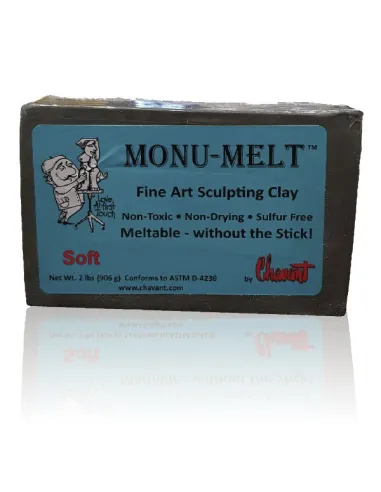
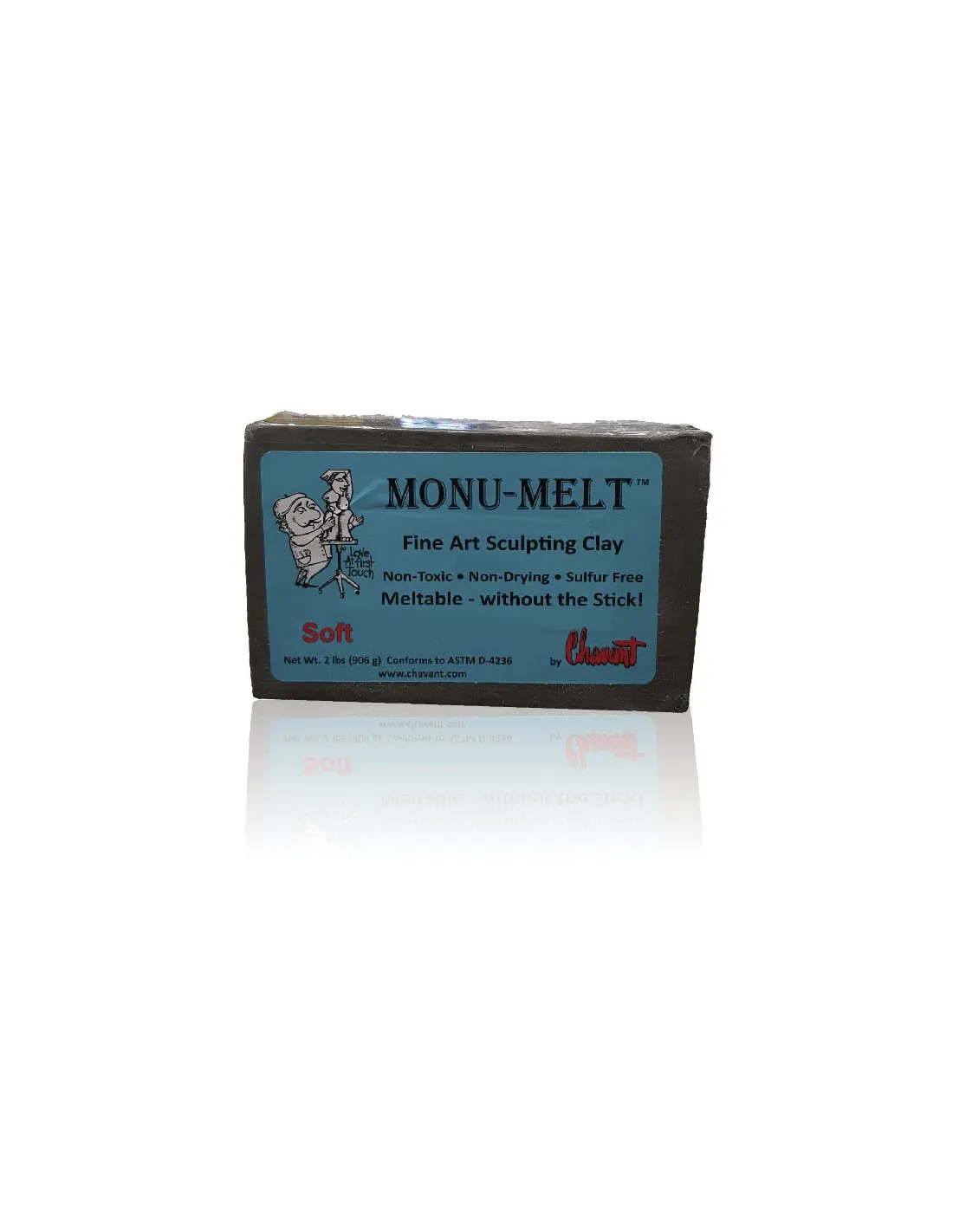
Monu-Melt Soft by Chavant is a professional clay formulated to melt and apply hot over armatures and existing structures. Its completely sulfur-free composition makes it compatible with platinum silicones, and its soft hardness facilitates fine detail sculpting once solidified. Ideal for large-format projects in film, television, industrial prototyping and sculpture.
Technical specifications
| Parameter | Value |
|---|
| Presentation | Individually wrapped 906 g block |
| Color | Grey |
| Hardness | Soft |
| Melting temperature | 80 °C – 95 °C |
| Sulfur-free | Yes — compatible with platinum silicones |
| Toxic | No |
| Odor | No significant odor |
| Dries out | No |
| Stickiness | Non-sticky once cool |
| Reusable | Yes — heats and cools indefinitely without altering properties |
| Family | Chavant (Monu-Melt) |
What it is used for
Monu-Melt Soft is designed for processes where molten material needs to be applied over an existing support before working the detail. By melting at low temperature and being applied with a brush, it allows complex geometries — even with undercuts — to be coated quickly and evenly. Its absence of sulfur makes it the natural choice when the process includes mold making with addition (platinum) silicones.
- Coating of polystyrene foam or CNC-cut foam armatures
- Sculpting characters, creatures and busts for film and television
- Industrial prototyping and concept models
- Figure and sculpture modelling in Fine Arts
- Applying layers of material over metal or resin structures
- Corrections and additions to existing sculptures
How to use it
- Prepare the armature: make sure the support structure (polystyrene foam, foam, metal, resin) is clean, dry and stable.
- Melt the material: place the block or fragments of Monu-Melt Soft in a heat-safe container. Heat in a bain-marie, in a low-temperature oven or with a heat gun until reaching 80–95 °C. The material should become completely liquid and fluid.
- Apply with a brush: use a natural or synthetic heat-resistant brush. Apply the first thin layer over the armature with quick strokes. Allow to solidify for a few minutes.
- Build up layers: repeat the application until the desired thickness is reached (generally 1–3 cm depending on the project). Each layer must solidify before applying the next.
- Sculpt the detail: once cool, work the surface with standard sculpting tools. The soft hardness allows fine details to be marked with pointed tools.
- Re-melt to correct: any area can be heated locally with a heat gun to re-melt, correct or add new material.
- Prepare for the mold: once the sculpture is finished, you can apply platinum silicone directly without any sealer, thanks to the absence of sulfur.
Tips for use
Temperature control
Keep the molten material between 80 and 95 °C. Above 100 °C the material may slightly degrade and darken. If using a bain-marie, monitor the water temperature with a kitchen thermometer. For studio or on-site applications without a bain-marie, a slow cooker on its lowest setting is a practical and safe solution.
Compatibility with platinum silicones
Monu-Melt Soft contains no sulfur in its formulation, so you can pour or apply platinum silicones directly onto the finished sculpture without risk of inhibition. Even so, always carry out a cure test on a discreet area before tackling the full mold, especially if the sculpture has been in contact with other materials during the process.
Tools and cleaning
Brushes and tools clean up easily while the material is still hot, simply by wiping with a cloth or paper. Once cool, the solidified material can be removed by hand from most surfaces. If you need to compare hardnesses for your project, Chavant is also available in medium hardness and hard hardness for hand modelling with greater firmness.
Frequently asked questions
Can I use platinum silicone directly over a sculpture made with this clay?
Yes. Monu-Melt Soft is formulated without sulfur, the main inhibiting agent of platinum silicones. You can apply addition silicone directly onto the finished sculpture. Always carry out a small prior test if you have used other materials on the piece during the process.
How do you melt this type of clay in the studio?
The most controlled method is a bain-marie: place fragments of the material in a metal or glass container inside hot water at 80–95 °C. You can also use a slow cooker on its lowest setting or a low-temperature oven. Avoid the microwave: it heats unevenly and can locally overheat the material.
What is the difference between the Soft version and the Medium or Hard versions?
Hardness determines the firmness of the material once cool and, therefore, the type of detail you can work. Soft is the softest: ideal for large volumes and projects where it is applied molten. Medium and Hard are used primarily for direct hand modelling and accept finer tool detail.
Does the material deteriorate if melted and solidified multiple times?
No. Monu-Melt Soft can be heated and cooled indefinitely without altering its physical properties or its compatibility with silicones. This reusable behaviour is precisely what makes it efficient in the studio: leftover material from each session is stored and re-melted in the next.
What type of armature does it work best with?
Monu-Melt Soft adheres well to high-density polystyrene foam, polyethylene foam, metal structures and resin parts. For low-density polystyrene foam, apply a very thin first coat at a temperature no higher than 85 °C to prevent the heat from deforming the support before the material solidifies.
Can it be mixed with other clays or modelling materials?
Mixing with sulfur-containing clays is not recommended, as this would compromise compatibility with platinum silicones. You can mix different hardnesses within the same Chavant family (Soft + Medium) to achieve an intermediate firmness without losing sulfur-free properties.
Is it suitable for direct hand modelling or only for brush application when molten?
Although its primary design is brush application when molten, once solidified the Soft version can be worked by hand in warm studio environments. For intensive direct modelling without melting, the Medium and Hard versions offer better tool response.
How much do I need to cover a human head-sized piece?
For a life-size head with an average thickness of 1.5–2 cm over an armature, one 906 g block is usually sufficient for the base volume. If you need extra thickness in certain areas or want material in reserve for corrections, calculate two blocks. For full busts up to the shoulders, plan for three or four blocks depending on the final thickness required.