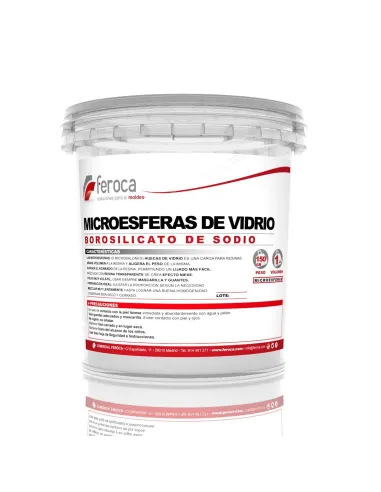
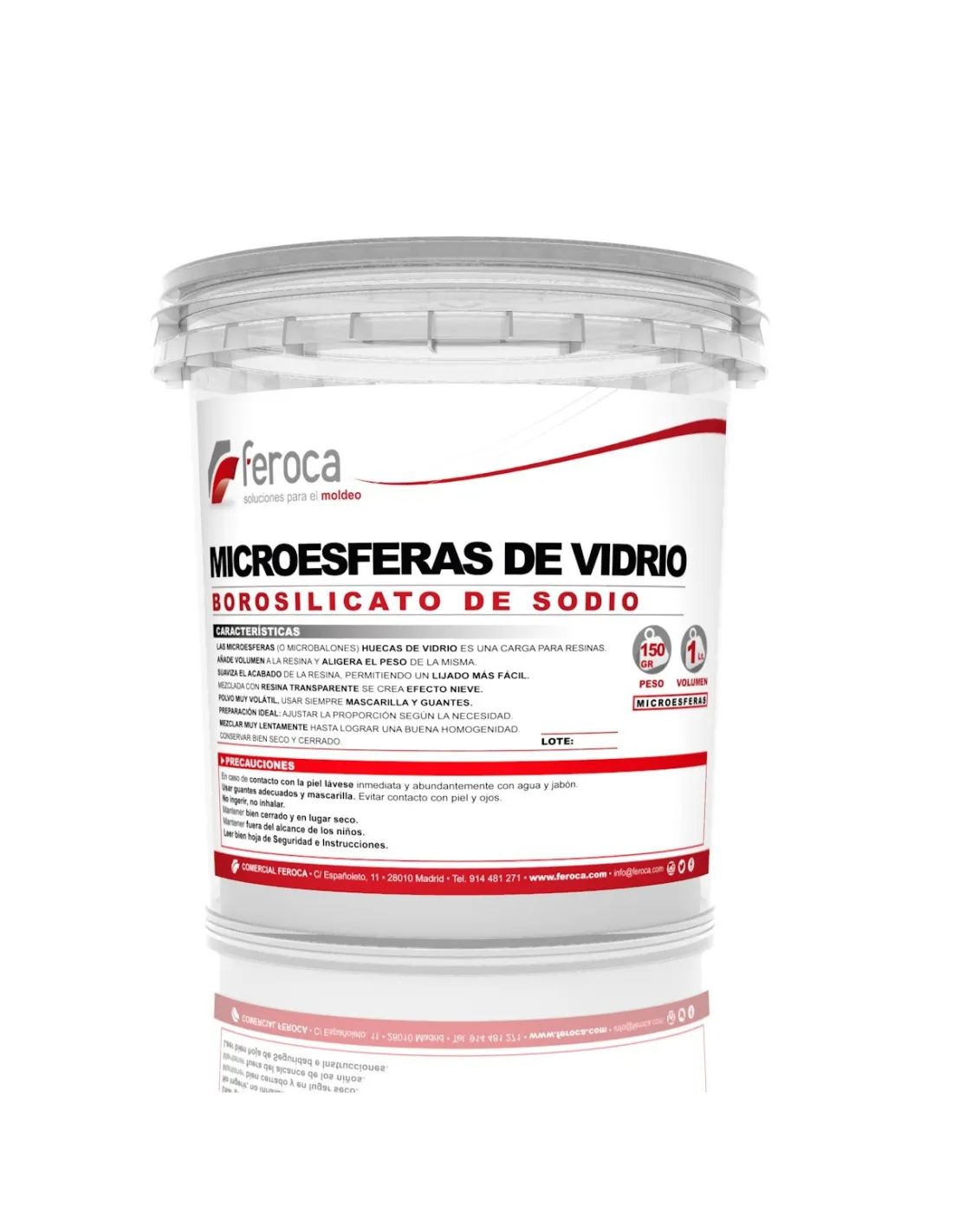
Glass hollow microspheres are a white inert filler made up of microscopic hollow glass spheres. They are added to polyester, epoxy or polyurethane resins to reduce the weight of the part, increase volume, improve workability and make sanding of the cured material easier.
Technical specifications
| Appearance |
White powder |
| Form |
Microscopic hollow spheres |
| Base material |
Borosilicate glass |
| Colour |
White |
| Effect on resin |
Reduces weight, increases volume, reduces shrinkage, facilitates sanding |
| Compatibility |
Polyester, epoxy and polyurethane resins |
| Chemical behaviour |
Inert material — does not interfere with curing |
| Usage ratio |
Variable depending on application and desired result |
What it is used for
Glass hollow microspheres are a widely used filler in composites workshops, marine, modelling and special effects. Their chemical neutrality and low specific weight make them the most effective filler for lightening parts without compromising the structure of the cured material. They also smooth the resulting surface and improve abrasion resistance.
- Weight reduction in laminates and castings of epoxy or polyester resin
- Production of lightweight, easy-to-sand fillers for structural repairs
- Marine construction and repair: boat hulls, surfboards
- Aeromodelling: lightweight parts with a good surface finish
- Modelling: creating a snow effect by mixing with transparent epoxy resins
- Resin fillers and putties for levelling surfaces before painting
- Shrinkage reduction in large-volume parts
- Surface finish smoothing in cast parts
How to use it
- Prepare the base resin (polyester, epoxy or polyurethane) following the manufacturer's instructions. Mix the components thoroughly before adding the filler.
- Gradually incorporate the glass hollow microspheres into the already-mixed resin, stirring gently and steadily with a spatula.
- Adjust the filler ratio according to the result you need: the more microspheres, the greater the volume, the lower the weight and the easier the sanding, but also the lower the mechanical strength.
- Check the homogeneity of the mixture. There should be no lumps or areas without evenly distributed filler.
- Apply the mixture with a spatula or pour it into the mould or repair area according to the process you are following.
- Allow to cure for the time indicated by the resin used. The microspheres do not modify the curing time as they are an inert material.
- Once cured, sand and work the surface as normal. The presence of microspheres makes sanding noticeably easier.
Usage tips
Indicative ratios by application
There is no universal ratio: for lightweight, easy-to-sand putties you can add up to 30–40% by volume. To reduce weight in castings while maintaining some strength, start with 10–15% and increase according to results. Always run a small test before working with large batches.
Handling and storage
Microspheres are very lightweight and can easily become airborne during handling. Work in a well-ventilated space and wear an FFP2 or higher respiratory mask to avoid inhaling the fine dust. Store the container tightly closed in a dry place, protected from moisture. Moisture can cause the powder to clump and make it harder to incorporate into the resin.
Compatibility and limitations
Being an inert material, glass hollow microspheres are compatible with virtually all resins on the market. They neither accelerate nor delay curing. Bear in mind that the higher the filler ratio, the lower the final mechanical strength: for demanding structural applications, use low ratios. If you need a filler that adds weight rather than reducing it, there are other options in the Feroca filler catalogue such as bronze powder or copper powder.
Frequently asked questions
How much filler can I add to the resin?
The ratio is variable and depends on the result you are looking for. Glass hollow microspheres allow you to adjust the amount according to the application: from 5–10% by volume to lighten castings, up to 30–40% to obtain very lightweight, easy-to-sand putties. Start with low ratios, test the result and adjust. The more microspheres, the lower the mechanical strength of the final part.
Does this filler affect the catalysation or curing time of the resin?
No. Glass hollow microspheres are an inert material that does not interfere with the chemical reaction of the resin. They neither accelerate nor delay curing, and they do not affect the catalyst ratio you need to use. You can use them with complete confidence without modifying the working parameters of your usual resin.
What types of resin are they compatible with?
They are compatible with polyester, epoxy and polyurethane resins. Their chemical inertness makes them suitable for virtually any resin system. At Feroca they are frequently used alongside epoxy resins such as Epofer EX401+E432 for both castings and putties.
Can I use them to create a snow effect in modelling?
Yes. Mixed with a transparent epoxy resin at a high ratio, glass hollow microspheres create a very convincing snow effect thanks to their white colour and granular-spongy appearance. It is a common technique in terrain modelling and dioramas.
Are they suitable for marine repairs?
Yes, it is one of their most classic applications. Their white colour, low weight and ease of sanding make them ideal for producing repair putties for boat hulls, surfboards and other marine applications. They are mixed with polyester or epoxy resin until the desired putty consistency is achieved.
Are there any precautions to take when handling them?
Yes. As a very fine and lightweight powder, microspheres can easily become airborne during handling. Work in a ventilated space and wear an FFP2 or higher respiratory protection mask. Also avoid prolonged contact with eyes and skin. Keep the container tightly closed to prevent moisture from clumping the product.
How do they differ from other fillers such as marble powder or silica gel?
Each filler has a different effect on the resin. Glass hollow microspheres reduce weight and make sanding easier. Marmolina adds body and opacity without reducing weight as much. Silica gel AT2 acts primarily as a thixotropic agent to thicken the resin and prevent sagging. The choice depends on the effect you need for your project.
Can I combine microspheres with other fillers?
Yes. It is common to combine hollow microspheres with silica gel AT2 to obtain putties that are both lightweight and thixotropic, preventing the mixture from sagging when applied vertically. Combining fillers allows you to fine-tune the behaviour of the mixture to suit the needs of each application.