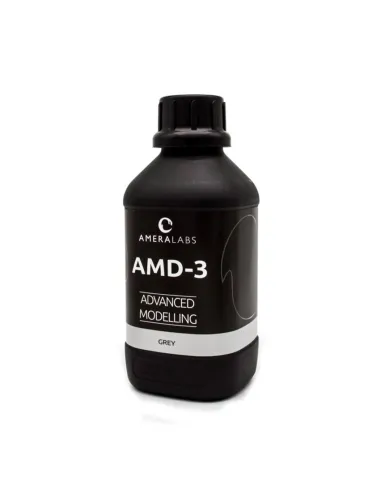
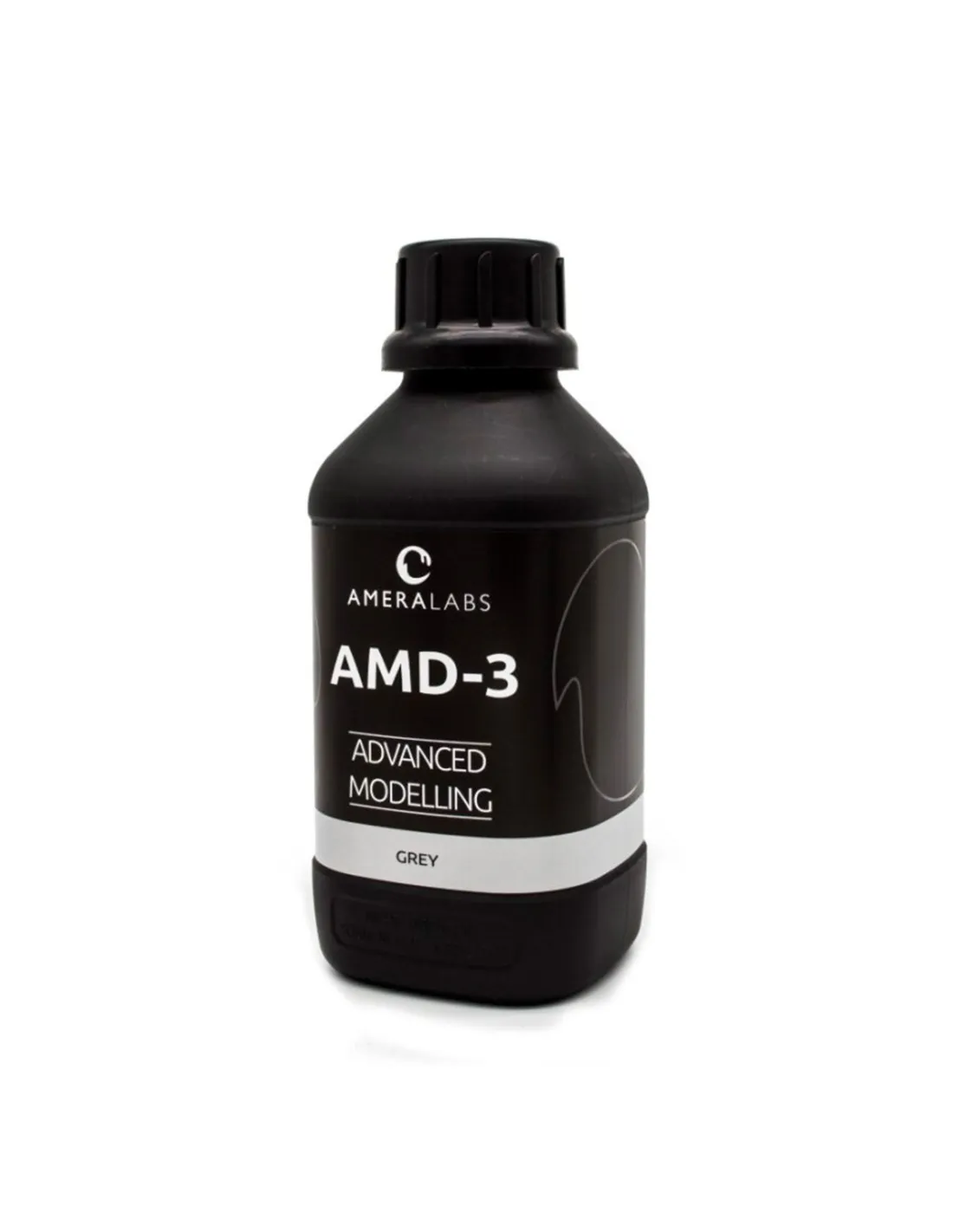
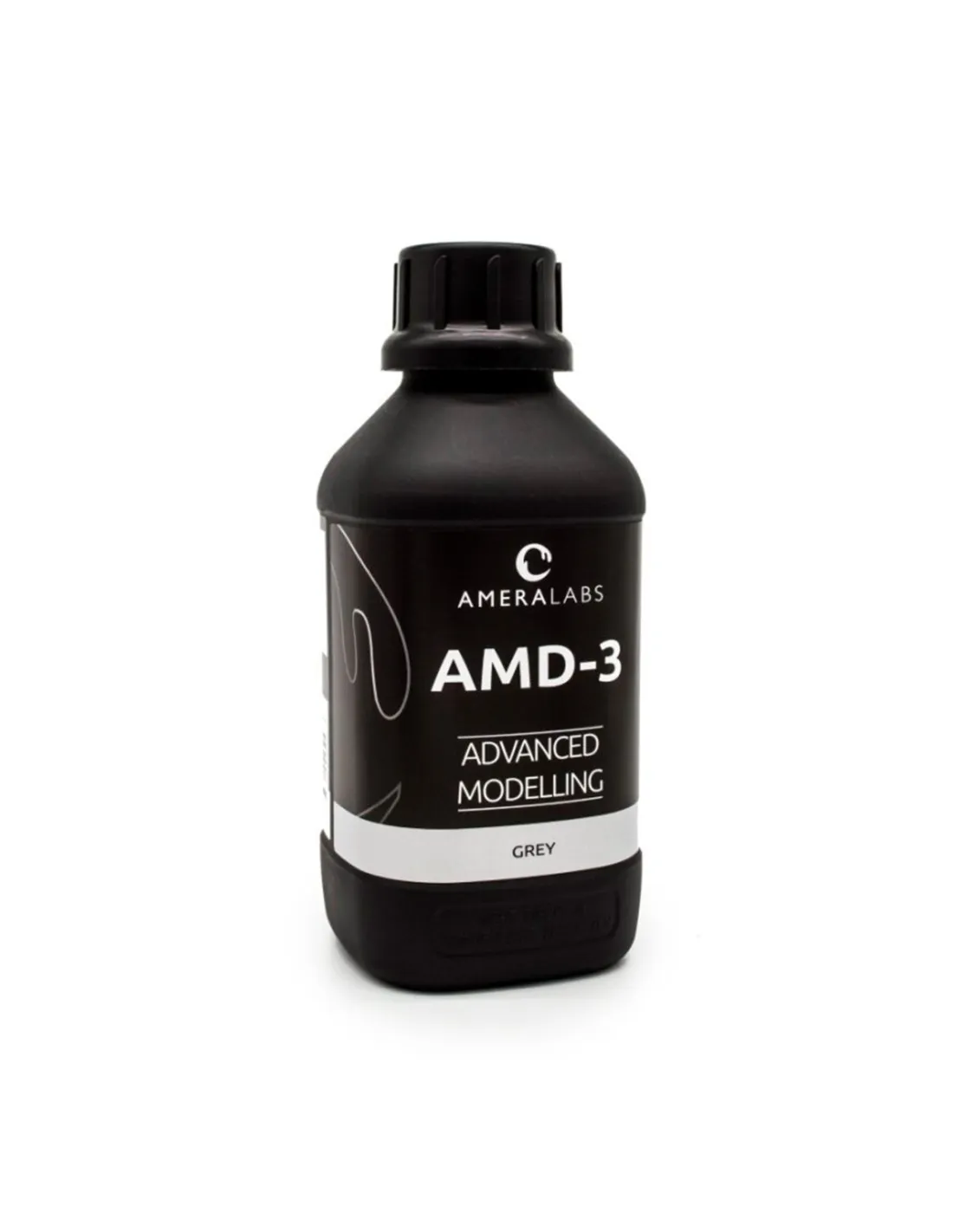
The Ameralabs AMD-3 Grey 3D Resin is an engineering-grade photopolymer resin designed for LCD/MSLA and DLP resin printing, aimed at functional prototypes and high-demand technical parts. Its fast-cure formulation offers low shrinkage, low odour and outstanding resistance to chemicals and moisture, with the key advantage of not inhibiting platinum addition silicones — making it an ideal choice for workflows that combine 3D printing and silicone moulding.
Technical specifications
| Parameter |
Value |
| Colour |
Grey |
| Resin type |
UV photopolymer (LCD/MSLA and DLP) |
| Classification |
High definition / High resistance |
| Cure shrinkage |
Low |
| Odour level |
Low |
| Chemical resistance |
High |
| Moisture resistance |
High |
| Platinum silicone inhibition |
Does not inhibit |
| Main application |
Engineering, functional prototypes, masters for moulding |
What it is used for
The AMD-3 Grey is designed for professionals and workshops that need technical parts with high dimensional accuracy and good mechanical properties. Its compatibility with platinum silicones makes it especially valuable in reproduction moulding processes, where the printed part acts as a master.
- Functional engineering prototypes requiring tight tolerances
- Masters for platinum silicone moulding without risk of inhibition
- Technical parts exposed to moisture or chemical agents
- High-definition presentation models and mock-ups
- Components for special effects and durable props
- Jigs, fixtures and workshop tooling with strict dimensional requirements
- Replacement parts and small-format components for short-run production
How to use it
- Shake the resin bottle thoroughly before pouring it into the printer vat, for at least 30–60 seconds, to homogenise the components.
- Set the exposure parameters on your LCD/MSLA or DLP printer according to Ameralabs' recommendations for the AMD-3 and the chosen layer thickness (refer to the manufacturer's official profiles).
- Start the print and monitor the first layers adhering to the build platform.
- Once printing is complete, carefully remove the part and remove any excess liquid resin.
- Wash the part in isopropyl alcohol 99.9% for the recommended time (usually 2–5 minutes with agitation), making sure to reach internal areas and recesses.
- Allow the alcohol to evaporate completely before final curing (the part must be dry to the touch).
- Post-cure under UV light with the appropriate time and power to achieve the final mechanical properties.
- If you are going to use the part as a master for platinum silicone moulds, make sure post-curing is complete. A specific inhibition-preventing release agent is not required, although applying one is recommended to ease demoulding.
Usage tips
Print parameters and exposure profiles
Optimal exposure times vary depending on the printer, light source and layer thickness. Always refer to Ameralabs' validated profiles for the AMD-3 and run a calibration test (exposure test) before printing production parts. Overexposure causes loss of detail and difficulty removing supports; underexposure causes brittleness and poor inter-layer adhesion.
Proper washing and post-curing
Incomplete washing leaves uncured resin on the surface, which can compromise the finish and, when using the part as a master, contaminate the mould. Use isopropyl alcohol 99.9% in two consecutive baths for greater effectiveness. Complete post-curing is essential: without it, the part retains inferior mechanical properties and may feel tacky to the touch.
Using as a master for platinum silicone moulding
One of the key advantages of the AMD-3 Grey is that it does not contain compounds that inhibit addition silicones. Even so, to ensure optimal results, the master must be fully post-cured and free from any liquid resin or alcohol residue. If you want to maximise mould detail and ease demoulding, apply a thin layer of compatible release agent before pouring the silicone.
Frequently asked questions
Is this resin compatible with any LCD or DLP resin printer?
Yes, the AMD-3 Grey is compatible with the standard LCD/MSLA and DLP printers that use UV light at 385–405 nm, which is the common market range. Verify that your printer operates in that range and adjust the exposure profiles to your specific model. The Phrozen Sonic MEGA 8K V2 3D Printer is a high-resolution option compatible with this type of resin.
Can I use this resin to make masters for platinum silicone moulding without inhibition?
Yes. The AMD-3 Grey Resin is formulated not to inhibit addition (platinum) silicones. It is essential that the part is fully post-cured and thoroughly washed before using it as a master. If traces of uncured resin or washing solvent residue remain, surface issues may appear in the mould.
What liquid is used to wash uncured resin from the printed part?
The most recommended solvent for cleaning photopolymer resin printed parts is isopropyl alcohol 99.9%. It effectively removes liquid resin without attacking the cured part. Avoid lower concentrations (with water) as they reduce washing effectiveness and can leave whitish residue.
What is the difference between a high-definition resin and a standard resin?
High-definition resins, such as the AMD-3 Grey, are optimised to capture fine details with less light scatter during curing, resulting in greater dimensional accuracy, sharper edges and cleaner surfaces. Standard resins prioritise speed or cost over surface precision.
Is this resin suitable for parts exposed to water or cleaning products?
Yes. The AMD-3 Grey offers high resistance to moisture and chemicals, making it suitable for environments where the part may come into occasional contact with water, mild detergents or other agents. For continuous exposure to aggressive solvents, consult the manufacturer's full technical data sheet.
How long does it take to cure and what post-curing equipment do I need?
Curing inside the printer is very fast (seconds per layer), but final post-curing requires a UV station or Cure Lamp emitting in the 385–405 nm range. Post-curing time varies depending on the equipment's power and the part's volume; generally between 2 and 10 minutes. Insufficient post-curing leaves the part with reduced mechanical properties and possibly tacky to the touch.
Can I mix this resin with other resins to modify its properties?
Mixing resins from different manufacturers or formulations without prior validation is not recommended. Photopolymer resins have different spectral sensitivities, viscosities and cure times, and mixing can lead to unpredictable results in terms of mechanical properties, surface finish and printer behaviour.
Is there an alternative if I need a high-strength grey resin with different characteristics?