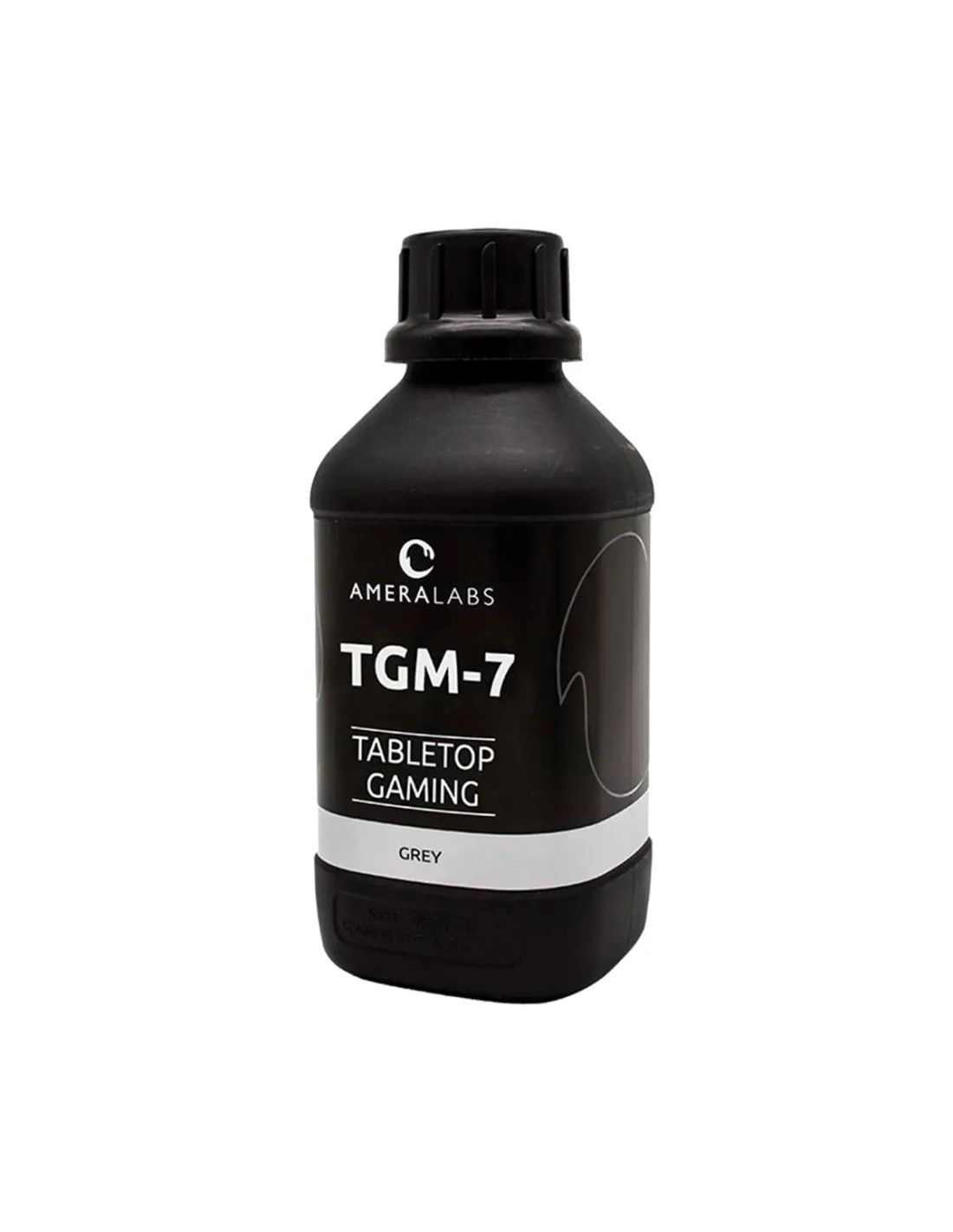
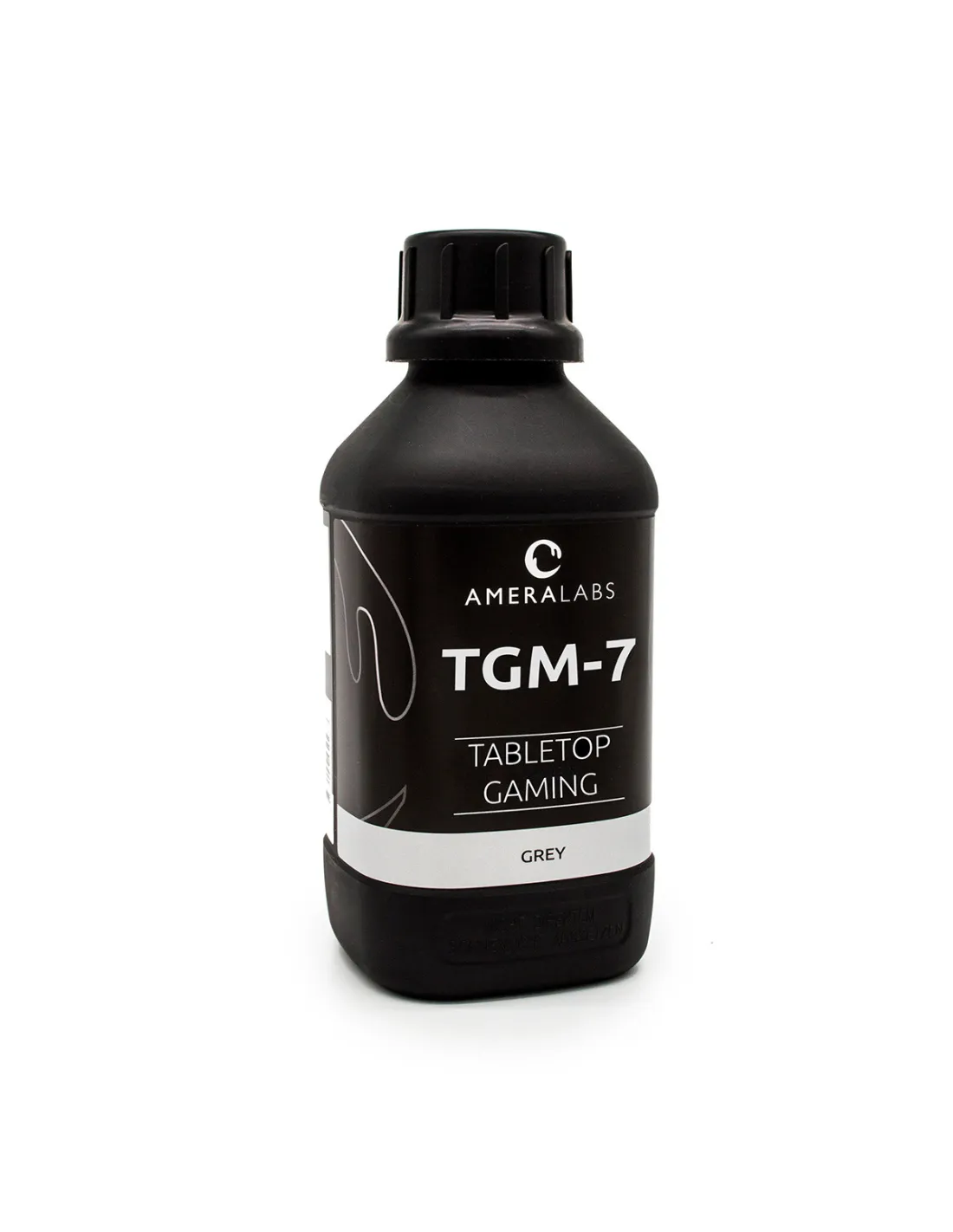
Ameralabs TGM-7 Grey is a grey photopolymer resin specifically formulated for printing tabletop game miniatures and fine-detail figures. Its balance between rigidity and flexibility makes it especially resistant to breakage in small and thin parts, while its low odour and fast cure improve working conditions in the workshop or studio.
Technical specifications
| Property |
Value |
| Colour |
Grey |
| Type |
Flexible-rigid photopolymer resin |
| Printing technology |
LCD / MSLA |
| Main application |
Tabletop game miniatures, detail figures |
| Odour |
Low |
| Surface |
Paintable |
| Cure |
Fast (UV / visible light depending on printer) |
What it is used for
TGM-7 Grey is optimised for applications where surface detail and part durability are the priority. The neutral grey colour makes it easy to spot details before painting and is ideal for visual inspection of print quality.
- Tabletop game miniatures (infantry, vehicles, scenery)
- Collector figures and detailed scale models
- Artistic prototypes and digital sculptures
- Decorative parts intended for subsequent painting with acrylics
- Series production of small parts with high-resolution LCD printers
How to use it
- Shake the bottle well for at least 1–2 minutes before pouring the resin into the printer vat to ensure a homogeneous mix.
- Pour the required amount into the vat of your LCD/MSLA printer. Avoid exposing the resin to direct sunlight or ambient light during the process.
- Set the exposure parameters on your printer according to Ameralabs' recommendations for TGM-7 (consult the official parameter sheet for each printer model).
- Start the print and monitor the first layers to ensure good adhesion to the build plate.
- Once printing is complete, carefully remove the part and remove excess uncured resin with 99.9% isopropyl alcohol. Carry out two or three successive washes for a clean result.
- Allow the part to air dry and post-cure using a UV chamber or curing station for the time recommended by the manufacturer.
- Once post-cured, the part is ready for sanding, priming and painting.
Safety warning: Uncured resin is irritating to skin and eyes. Always work with nitrile gloves and in a well-ventilated space. Avoid direct skin contact. In case of eye contact, rinse thoroughly with water and consult a specialist. Keep the resin away from light until the moment of use.
Usage tips
Exposure parameters and calibration
Exposure parameters vary depending on the printer model and firmware version. Always consult the latest Ameralabs parameter table for TGM-7, available on their official website. An exposure time that is too high causes loss of detail due to overexposure; too low generates incomplete layers and adhesion failures. Run a calibration test (such as the community standard exposure test) before printing final parts.
Cleaning and post-curing
Use 99.9% isopropyl alcohol for cleaning parts and the vat. Lower-purity isopropanol leaves residues that can affect the final finish. Post-cure under UV after complete drying: curing a part that is still wet with isopropanol can result in a sticky or whitish surface. For parts with complex geometries, rotate the part during post-curing to ensure uniform curing at all angles.
Storage and vat handling
If you are not going to print for several days, filter the resin back into the original container using a fine mesh filter to prevent cured particles from contaminating the vat. Seal the container tightly and store it in a cool, dark place. Do not mix resins from different brands or formulations in the same vat without cleaning it completely first.
Frequently asked questions
What type of printer do I need to use this resin?
Ameralabs TGM-7 Grey is compatible with resin printers using LCD/MSLA technology (light masking screen). It is suitable for most resin printers on the market with a UV light source. If you are looking for a large-format, high-resolution option, the Phrozen Sonic MEGA 8K V2 3D Printer is a reference compatible with this type of resin.
Is it suitable for printing miniatures with very thin bases or fine spears and swords?
Yes. TGM-7 Grey is formulated with a balance between rigidity and flexibility that makes it especially suitable for parts with fragile geometries such as weapons, thin legs or banners. It significantly reduces breakage compared to purely rigid resins.
Can you paint directly on the printed part?
Yes, the surface of TGM-7 Grey is paintable. It is recommended to apply a primer coat before painting with acrylics to improve adhesion and colour uniformity. The grey base colour makes it easier to visualise details and apply paint layers.
What product should I use to clean the parts and the vat?
The recommended product for cleaning parts and the vat is 99.9% Isopropyl Alcohol. Use successive washes and agitate the parts to properly remove uncured resin from complex geometries.
What is the shelf life once the container has been opened?
Shelf life depends on storage conditions. Keep the container tightly sealed, in a cool place away from light. Under optimal conditions, the resin maintains its properties for several months after opening. If you notice lumps, persistent phase separation after shaking, or a change in viscosity, the resin may have degraded.
Can I mix this resin with other resins to modify its properties?
Mixing resins from different formulations or brands without prior knowledge of their chemical compatibility is not recommended. Mixing can alter exposure parameters, cure results and final mechanical properties. If you need a different rigidity or flexibility profile, check other catalogue options such as the Resina M3DUSA Titan-Tech Grey.
Is this resin available in other colours?
What happens if I leave uncured resin in the vat for days?
Prolonged exposure to ambient light can start a partial cure of the resin in the vat, forming solid particles that damage the FEP film and can ruin subsequent prints. If you are not going to use the printer, filter the resin back into the container and store it properly sealed.