Shopping Cart



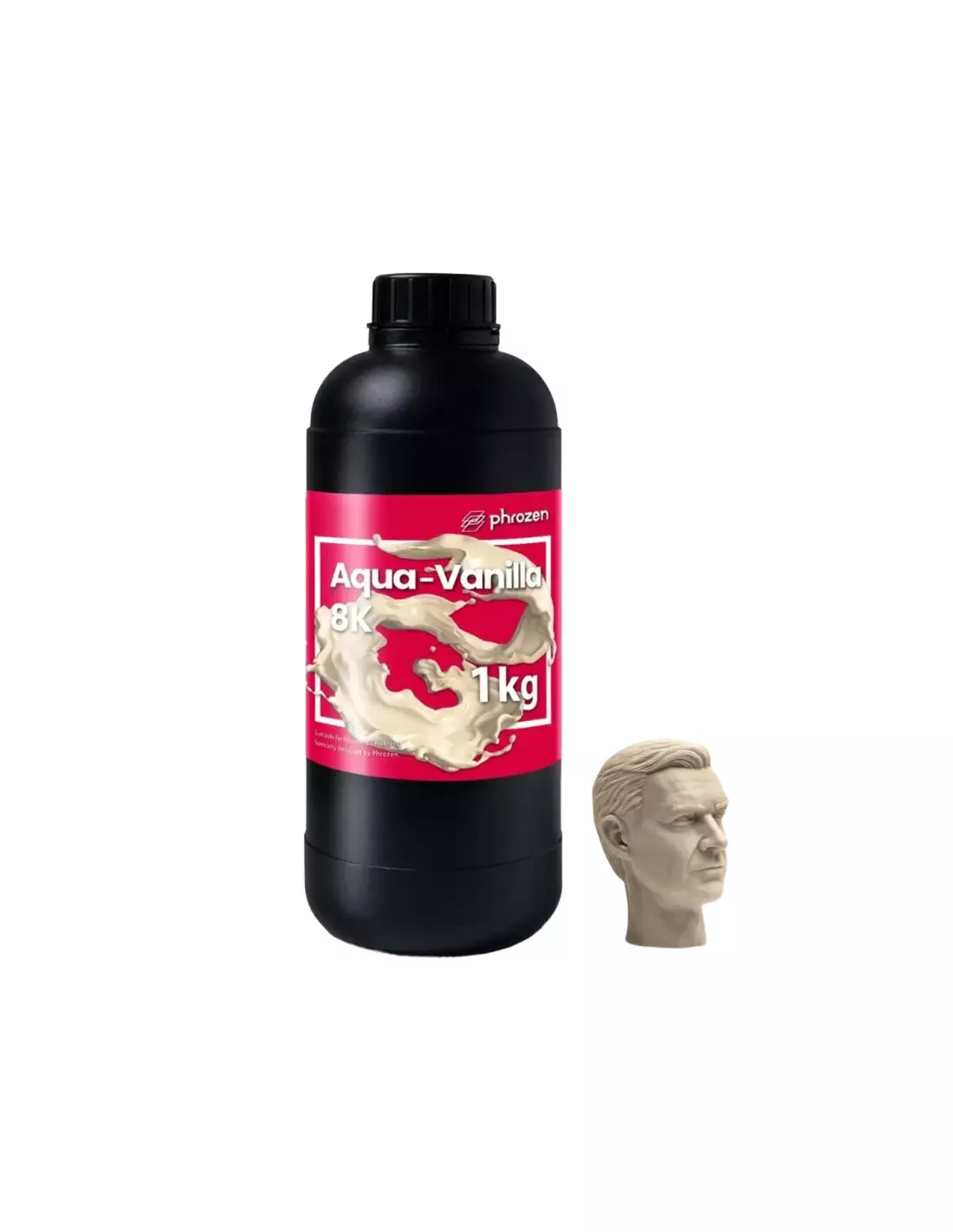
3D Resin Phrozen Aqua Vanilla 8K
220110360
Temporarily out of stock
€60.00
72,60 € Tax incl.
72,60 € Tax incl.
Phrozen Aqua Vanilla 8K photopolymer 3D resin. Very low odour, minimal shrinkage, 82 Shore D hardness. 1 kg bottle.
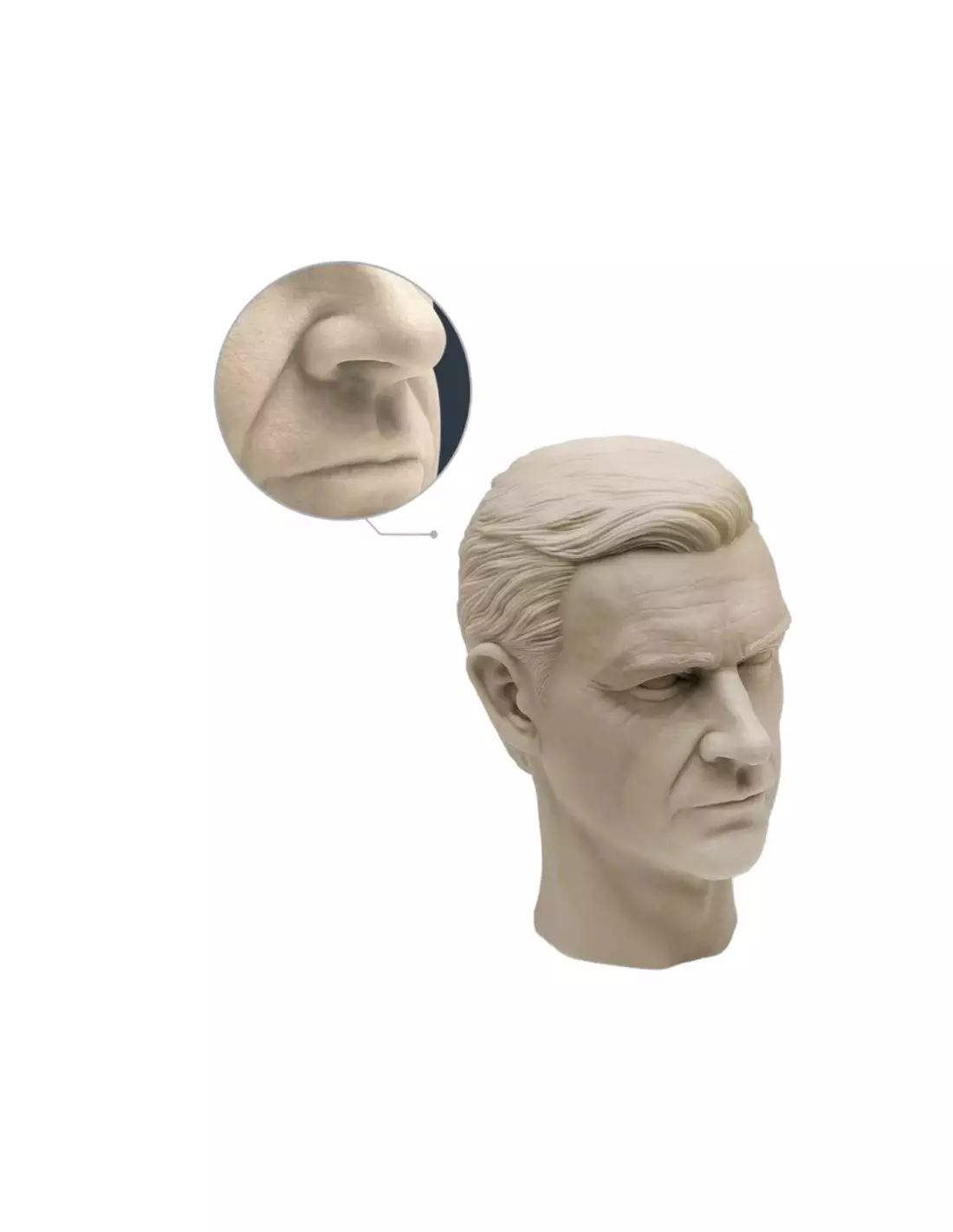
Phrozen Aqua Vanilla 8K is a high-resolution photopolymer resin formulated to get the most out of 8K MSLA printers. With low viscosity, minimal shrinkage and a surface hardness of 82 Shore D, it is the go-to choice for modellers, jewellers, industrial designers and special effects studios that need ultra-fine detail without sacrificing dimensional stability.
Technical specifications
| Parameter | Value |
|---|---|
| Format | 1 kg bottle |
| Density | 1.1 g/cm³ |
| Viscosity | 280 – 380 cps |
| Surface hardness | 82 Shore D |
| Tensile strength (UTS) | 43 MPa |
| Tensile modulus | 1730 MPa |
| Elongation at break (EAB) | 8 % |
| Flexural strength | 43 MPa |
| Izod impact resistance (notched) | 10 J/m |
| HDT @ 0.45 MPa | 77 °C |
| Print resolution | 8K |
| Odour | Very low |
What it is used for
It is a versatile resin aimed at projects where detail and dimensional accuracy are a priority. Its balance between rigidity and slight flexibility (8% elongation) makes it suitable for both decorative parts and functional prototypes:
- Collectible figures and miniatures for wargames or dioramas
- Jewellery and costume jewellery pieces for micro-casting or direct use
- Industrial and mechanical prototypes requiring high dimensional stability
- Dental and orthopaedic study models (not for direct clinical use)
- Props and special effects elements with ultra-fine textures
- Masters and positives for subsequent silicone moulding
- Scaled architectural pieces with ornamental details
How to use it
- Shake the bottle well before pouring it into the printer vat to homogenise the pigment.
- Set the recommended exposure parameters for your 8K printer and the desired layer thickness (0.05 – 0.1 mm is typical).
- Run a test print with a small part to validate exposure times and platform adhesion.
- Once the part is printed, remove it carefully and eliminate the excess liquid resin with 95% or higher isopropyl alcohol (or water if you have a compatible resin washer).
- Allow to drain and dry the part with compressed air or a paper towel without rubbing.
- Perform the final cure in a UV chamber (405 nm) for the time recommended by Phrozen, according to the size of the part.
- After curing, sand, paint or post-process the part according to the project requirements.
Safety warning: Liquid resin is irritating to skin and eyes. Always work with nitrile gloves, safety glasses and adequate ventilation. Avoid skin contact before curing. Cured resin is inert and can be handled without special precautions.
Usage tips
Exposure parameter adjustment
Aqua Vanilla 8K is sensitive to correct exposure. Over-exposure on the base layers can cause elephant foot (widening at the base) and loss of definition in fine details. Start with Phrozen's official profiles and adjust in small increments. With 0.05 mm layers you will achieve the highest possible definition for miniatures or jewellery.
Working temperature
Optimal viscosity is reached between 25 °C and 30 °C. If you work in a cold workshop (below 20 °C), the resin thickens and can cause adhesion problems on the first layers or lines on the surface. Warm the bottle briefly in a warm water bath (not microwave) before pouring it into the vat.
Storage and shelf life
Store the bottle closed, away from direct light and between 10 °C and 25 °C. Once opened, unused resin can remain in the vat if the printer has an opaque lid, but it is advisable to return the surplus to the original bottle. Avoid mixing resins from different brands or formulations in the same vat: they may precipitate or not cure correctly.
Frequently asked questions
What type of printers are compatible with this resin?
Phrozen Aqua Vanilla 8K resin is formulated for MSLA/LCD printers working at 405 nm. It is especially suitable for 8K resolution printers, although it also works on 4K and 2K units by adjusting exposure times. Phrozen provides pre-configured profiles for their own models.
Can the part be sanded and painted after curing?
Yes. Once correctly cured, Aqua Vanilla 8K accepts progressive sanding from 220 grit up to fine polishing finishes. It accepts acrylic paints, modelling lacquers and spray primers without the need for a special primer, although a surfacer primer will reveal imperfections before painting.
Can this resin be used to make silicone moulds from the printed part?
Yes, and it is one of its most common workshop uses. The 8K cured part retains all surface details with sufficient fidelity to serve as a positive. If you are going to mould with platinum silicone (addition cure), make sure to apply a sealer or varnish over the part and that it is fully cured, as some components of uncured photopolymer resins can inhibit silicone curing.
How long does it take to cure in the printer?
The exposure time per layer varies depending on the printer, the power of the light source and the layer thickness. On Phrozen 8K printers with a 0.05 mm layer, typical times range between 1.5 and 3 seconds per layer. Always consult Phrozen's official profiles for your specific model and run an exposure test before production.
What liquid is used to clean the printed part?
The standard method is washing with 95% or higher isopropyl alcohol in a resin washer with agitation. You can also use technical-grade cleaning alcohol. The goal is to remove all uncured liquid resin before UV post-curing. Avoid leaving the part in the alcohol bath longer than necessary to avoid weakening the surface layer.
Is it safe to use indoors?
Aqua Vanilla 8K has a very low odour compared to conventional resins, but it is still a photopolymer resin that requires adequate ventilation during printing and washing. Work with extraction or cross ventilation, use nitrile gloves and avoid contact of liquid resin with skin or eyes.
Can it be used for functional parts or only decorative ones?
With 43 MPa tensile strength, 1730 MPa tensile modulus and a deflection temperature of 77 °C, Aqua Vanilla 8K has solid mechanical properties for functional prototypes and moderate-use parts. It is not designed for high continuous load applications or environments with temperatures above 70–75 °C.
What is the difference between this resin and ABS-Like or Water-Washable resins?
Aqua Vanilla 8K prioritises detail resolution and dimensional stability. ABS-Like resins offer greater toughness and impact resistance, making them more suitable for functional parts subjected to impacts. Water-Washable resins simplify the cleaning process with water, at the cost of slightly lower mechanical properties. The choice depends on the final use of the part.
No reviews
Tap to zoom