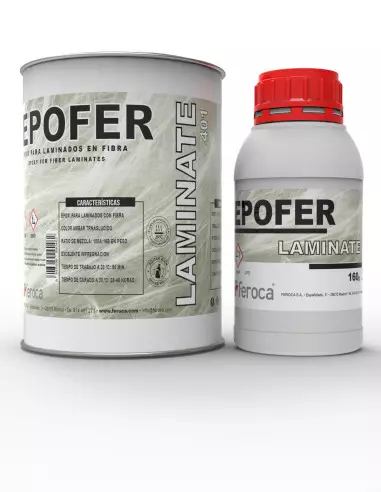
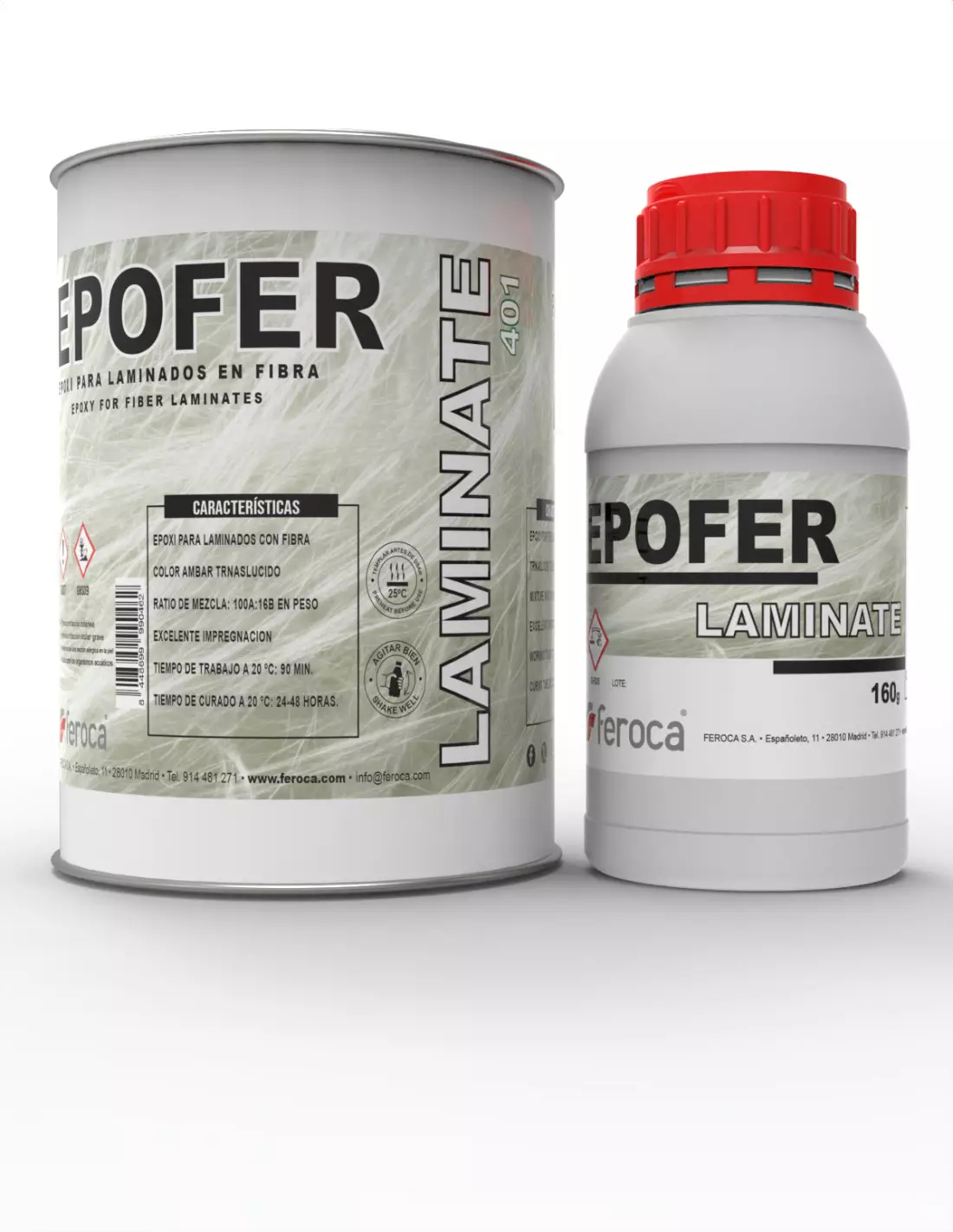
Epofer Laminate 401 is a low-viscosity epoxy resin specifically formulated for hand lamination and contact moulding processes. It effectively impregnates fibreglass, carbon fibre and other reinforcement fabrics, offering high mechanical strength, excellent adhesion and stability against moisture and chemical agents. If you need a reliable epoxy system for manufacturing lightweight, durable structural parts, this resin is the straightforward choice.
Technical specifications
| Parameter |
Value |
| Application |
Hand lamination / contact moulding |
| Mix ratio by weight |
100 parts resin (A) : 16 parts hardener (B) |
| Pot life (20 °C) |
90 minutes |
| Cure time (20 °C) |
24–48 hours |
| Colour |
Translucent amber |
| Pigmentable |
Yes |
What it is used for
Epofer Laminate 401 is designed for the manufacture and repair of composite parts where uniform impregnation of the reinforcement fabric and high final laminate strength are required. It is suitable for both professionals and advanced users working in workshop environments.
- Hand lamination with fibreglass mat for body panels, fairings and housings
- Manufacturing structural parts with carbon fibre fabric for marine, automotive and aerospace applications
- Reinforcement and repair of existing fibreglass or carbon fibre structures
- Production of panels and profiles for construction and high-performance sports industry
- Manufacturing lightweight moulds from reinforcement fabrics
- Applications requiring stability against temperature changes and moisture
How to use it
- Warm the resin before use. Place the Part A container in warm water (40–50 °C) for 15–20 minutes to reduce viscosity and ease impregnation. This is especially important in cold weather.
- Prepare the mould or surface. Clean the surface thoroughly and apply a release agent spray if you intend to demould the part. Allow the release agent to dry before proceeding.
- Weigh the components. Mix by weight 100 parts resin (A) to 16 parts hardener (B). Do not estimate by eye: a precision scale is essential for a correct cure.
- Mix thoroughly. Stir for at least 2–3 minutes, scraping the sides and bottom of the container carefully. Incomplete mixing creates uncured areas.
- Apply the first layer of resin onto the mould or surface using a laminating brush.
- Place the reinforcement fabric and saturate with more resin until the fabric is fully impregnated and translucent.
- Deair with a metal deairing roller to remove trapped air bubbles and consolidate the layers.
- Repeat the process layer by layer until the desired thickness is reached, always within the pot life (90 min at 20 °C).
- Allow to cure for 24 to 48 hours at room temperature (minimum 18 °C). At lower temperatures the cure slows down significantly.
- Clean tools immediately after use with acetone. Once cured, the resin cannot be dissolved.
Warning: The epoxy resin mixture is exothermic. In large volumes or small containers the heat generated can be considerable. Do not prepare more material than you will use in each pass and always work in a well-ventilated space. Avoid contact with skin and eyes; wear nitrile gloves and eye protection. In case of skin contact, wash with soap and water.
Usage tips
Working temperature: key for viscosity
Below 18 °C the resin becomes very viscous and fabric impregnation is poor. Always warm Part A before mixing: a warm water bath for 15–20 minutes is enough to make it flow easily. In summer, if workshop temperature exceeds 28–30 °C, prepare smaller batches to avoid running out of pot life before finishing the layer.
Exact mix ratio: do not improvise
The 100A:16B ratio is by weight, not by volume. A dosing error — even a small one — results in incomplete cure or tacky areas that more time will not fix. Use a digital scale with a resolution of at least 1 g. If the part requires a large amount of mix, prepare several smaller batches rather than one large one.
Successive layers and recoat window
To add additional layers, the ideal time is while the previous layer is in a gel state (tack-free but still slightly flexible). At that point interlaminar adhesion is at its maximum. If the previous layer has fully cured, sand with 80–120 grit sandpaper and degrease with acetone before applying the next layer. This ensures a correct mechanical bond between laminates.
Frequently asked questions
Can I use this epoxy resin for vacuum infusion or RTM?
No. Epofer Laminate 401 is formulated for hand lamination and contact moulding. Vacuum infusion or RTM processes require resins with viscosity and pot life specifically adapted to those processes, which differ from this product.
How many fabric layers can I laminate in a single session?
It depends on the thickness of each layer and the workshop temperature, but with a 90-minute pot life it is common to laminate between 3 and 6 fabric layers in a single session. Work efficiently and have the fabric cut and ready before you start mixing.
Can this resin be pigmented?
Yes. Epofer Laminate 401 accepts pigments compatible with epoxy systems. Add the pigment to Part A before mixing with the hardener and make sure it is completely homogeneous before adding Part B. Bear in mind that the translucent amber colour of the resin may influence the final shade, especially with light pigments.
What should I do if the part has tacky areas after curing?
Tacky areas usually indicate a mix ratio error or insufficient mixing. In that case, leaving it longer will not help: poorly mixed areas will not cure. If the affected area is small, remove it mechanically, sand the sound area and apply a new correctly dosed layer. For heavily affected parts, the safest option is to redo the laminate.
Can I use this resin outdoors?
Yes, provided conditions are suitable: minimum temperature of 18 °C, no rain and relative humidity preferably below 75 %. Excessive humidity can affect the surface cure of the epoxy and generate a whitish or tacky layer on the surface (blush effect). Work in stable conditions.
How do I clean tools and equipment?
Clean tools — brushes, rollers, containers — immediately after use with acetone. Once the resin has gelled or cured, it cannot be dissolved and the tools will be unusable.
Do I need to apply a release agent if I am working on existing fibreglass or carbon fibre?
Only if you want the part to be demoulded from the mould. If you are laminating over an existing structure to reinforce it (without demoulding), no release agent is needed; in fact, it would harm adhesion. The release agent spray is applied only on the mould surface from which you want to separate the part.
What is the minimum temperature at which I can work with this resin?
Working above 18 °C is recommended. Below that temperature viscosity increases significantly, fabric impregnation is poor and the cure may be incomplete or very slow. Always warm Part A before mixing if you are working in cold conditions.
How much product do I need?Calculate the exact amount before buying and avoid wasting material.
Go to the calculator →