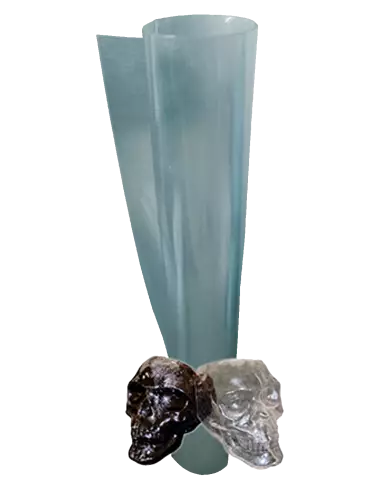
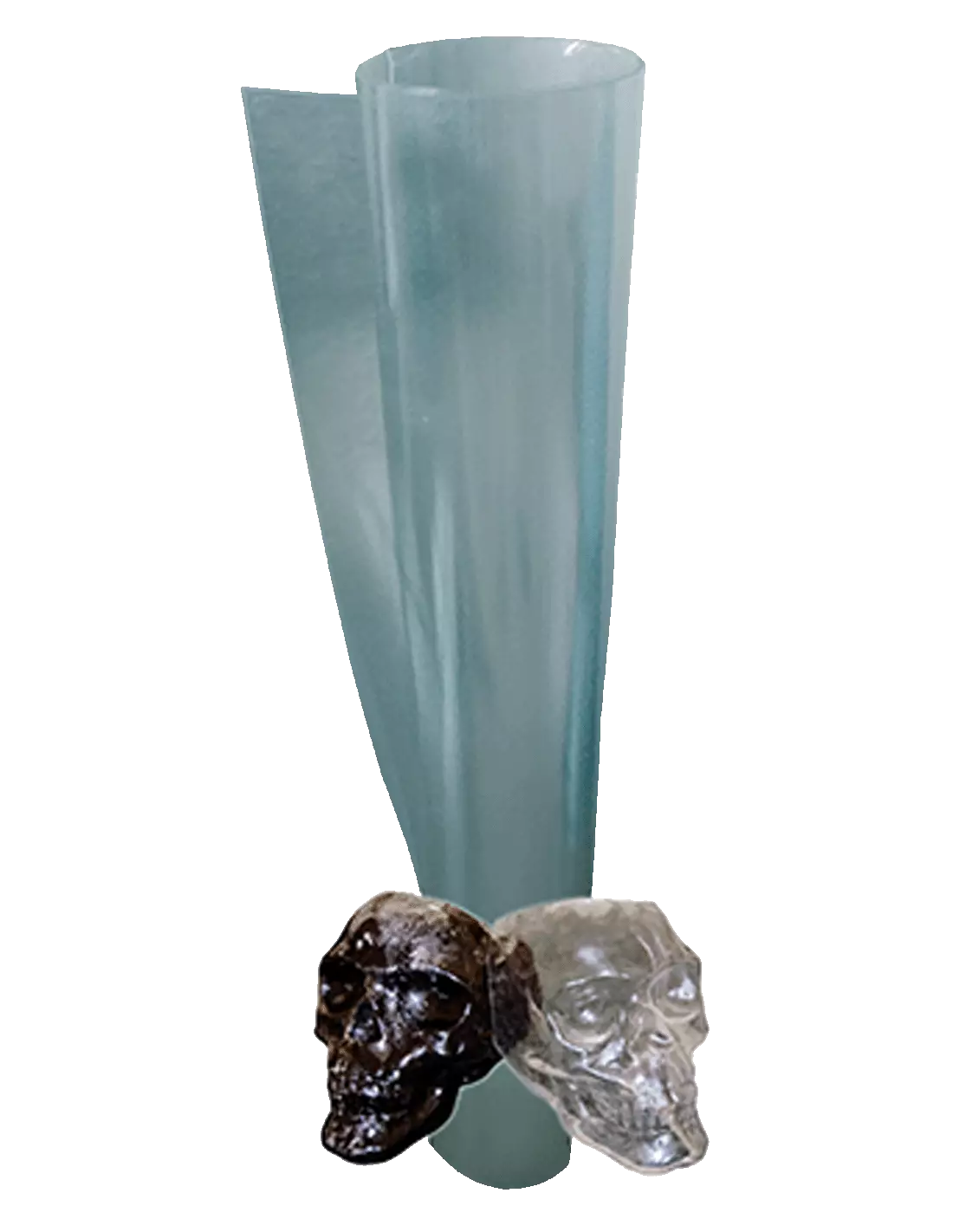
Worbla's Transpa Art is the transparent thermoplastic in the Worbla range: it activates from 120 °C, allows you to shape and reshape the piece as many times as you need without generating waste, and offers unique optical properties —transparency and translucency— that no other thermoplastic in the family can provide. If your project needs to let light through, simulate glass or create depth effects, Transpa Art is the right choice.
Technical specifications
| Parameter |
Value |
| Activation temperature |
≥ 120 °C |
| Sheet colour |
Transparent |
| Colour when kneaded |
May become milky / translucent |
| Presentation |
Thermoplastic sheets |
| Hardening |
Minutes at room temperature |
| Reusable |
Yes, unlimited times |
| Recyclable |
Yes, scraps can be blended and reused |
| Scrap compatibility |
Can be blended with scraps of the same reference |
What it is used for
Transpa Art is designed for applications where transparency or translucency is part of the final result. It is the go-to choice for cosplay professionals, set designers and special effects artists when the piece needs to interact with light, simulate glassy materials or blend visually with the surroundings.
- Visors and lenses for cosplay helmets and armour
- Blades, glass panels and ice elements with a translucent effect
- Invisible joints and overlaps between armour pieces
- Handcrafted diffusers and prisms for integrated LED lighting
- Gemstones and decorative gems with a depth effect
- Set design and props with a glass or crystal effect
- Rigid FX prosthetics with a transparent or pearlescent finish
- Flat and structural compositions where light is part of the design
How to use it
- Heat the sheet with a heat gun, convection oven or the A4 Thermoformer for Worbla until it reaches 120 °C. The material will become soft and flexible.
- Cut or trim the shape you need before or after heating. Scissors or a craft knife work perfectly when the material is cold; at temperature you can use moulds or your own hands with protective gloves.
- Shape the piece over the desired form: a mould, a last or directly over the body (with a protective layer). Press and adjust while the material is warm.
- Join layers or pieces by heating the contact edges: Transpa Art self-welds by heat fusion, with no additional adhesives.
- Allow to cool at room temperature. Within a few minutes the material regains its rigidity and holds its shape.
- Correct if needed: reheat the area you want to adjust. The process is reversible and unlimited.
- Finish and paint once cold. It accepts acrylic paints, sprays and varnishes. To maximise transparency, apply the minimum number of coats needed or work with transparent dyes.
Tips and tricks
Temperature control to maintain transparency
The biggest risk with Transpa Art is overheating it. If you significantly exceed 120 °C or keep it hot for too long, the material may yellow slightly or lose clarity. Work with the heat gun in continuous motion, never concentrating heat on a fixed point. The A4 Thermoformer enables even, controlled heating — ideal for flat pieces.
Kneading and the milky effect
When kneading scraps to reuse them, the material may become milky or translucent rather than fully transparent. This is not a defect: it is a characteristic you can take advantage of to create opaque ice effects, stones or aged crystals. If you need to recover maximum transparency, avoid excessive kneading and work directly from the original stretched sheet.
Combining with other Worbla products
Transpa Art can be structurally combined with Worbla's Finest Art or with Worbla's Black Art as a reinforcement base. A layer of Finest Art on the back adds extra rigidity and an opaque paintable surface, while the Transpa Art remains visible at the front. Scraps from each reference should be recycled separately: do not mix different Worbla families together.
Frequently asked questions
What temperature do I need to activate this thermoplastic?
Worbla's Transpa Art activates from 120 °C. A domestic or workshop heat gun is sufficient. You can also use a convection oven at a low temperature or the A4 Thermoformer for Worbla, which ensures uniform heating.
Can it be reused if I make a mistake?
Yes, unlimited times. Simply reheat the area or the entire piece to reshape it. Scraps can also be joined and reused, combining offcuts of the same reference so no material goes to waste.
Why does the material turn milky when I work with it?
When you repeatedly knead or fold Worbla's Transpa Art, the material traps micro air bubbles that give it a milky or translucent appearance. This is an inherent characteristic of the process, not a defect. For projects requiring maximum transparency, work from the original sheet without kneading and apply heat gently and evenly.
What finishes does it accept once cold?
It accepts acrylic paints, sprays and aerosol varnishes. To maintain the transparent effect, use translucent dyes or paints in thin coats. If you want an opaque effect in specific areas, you can apply layers of standard acrylic paint on the back.
Can I use it in direct contact with skin?
Once cold, Worbla's Transpa Art is safe in contact with skin. During heating, always work with heat-resistant gloves: the material reaches temperatures that can cause burns. Never apply freshly heated thermoplastic directly onto skin without an intermediate protective layer.
How does this product differ from the rest of the Worbla range?
The key difference is optical transparency. Worbla's Finest Art is brown and used as a structural base; Worbla's Black Art offers a smoother black surface; Worbla's Deco Art comes in micro-pellet form for filling and sculpting; and Worbla's Meshed Art incorporates a mesh for reinforcement. Transpa Art is the only one with optical properties that allow light to pass through.
Do I need special tools to work with it?
No complex tools are needed. With a heat gun, scissors, a craft knife and protective gloves you can work Worbla's Transpa Art. For flat, repeatable pieces, the A4 Thermoformer for Worbla greatly simplifies the process and improves heat control.
Can it be combined with other sculpting materials?
Yes. It works well as a complement to other Worbla thermoplastics when you need transparent areas in a larger piece. You can also use it alongside polymer clays to create originals that are later moulded or complemented with the Transpa Art. Do not mix scraps from different Worbla references together.