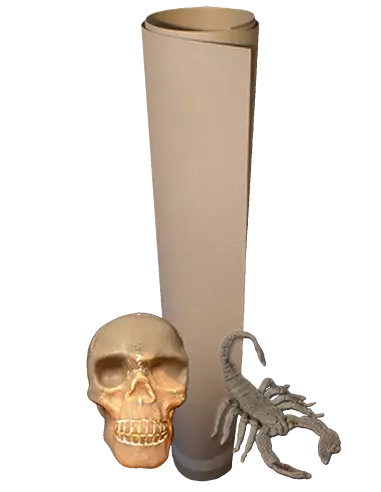
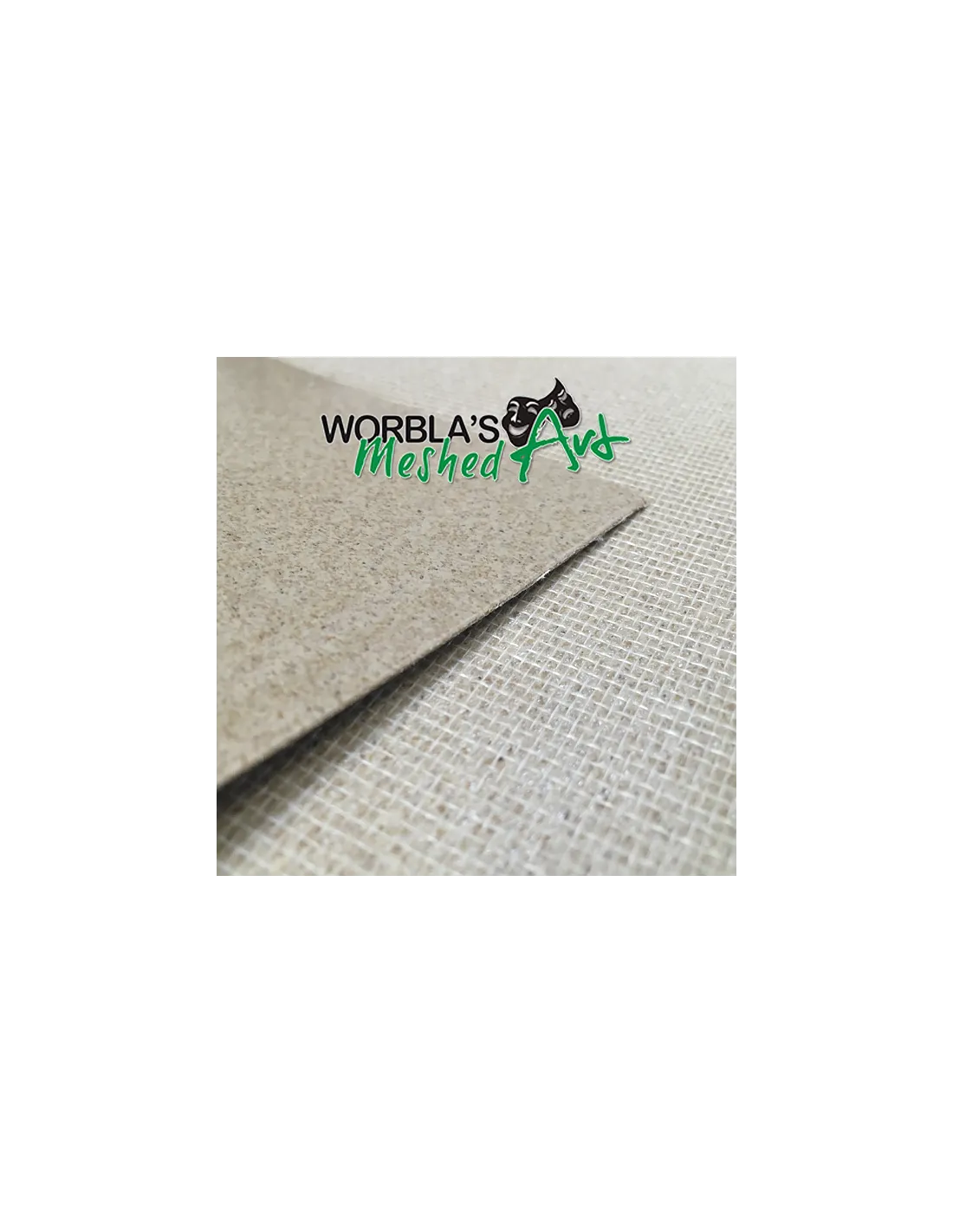
Worbla's Meshed Art is a high-quality thermoplastic with an integrated mesh layer on one side, providing superior tear resistance compared to other thermoplastics in its family and exceptional adhesion to fabrics, leather, and irregular surfaces. It activates from 80-90 °C, contains no solvents or toxic components, is fully reusable, and is partially manufactured with recycled rice husk: a robust and sustainable solution for cosplay professionals, set designers, and special effects artists.
Technical specifications
| Property |
Value |
| Activation temperature |
80-90 °C |
| Integrated mesh |
Yes (one side) |
| Built-in adhesive |
Yes, self-adhesive |
| Reusable |
Yes, indefinitely with heat |
| Toxicity |
Non-toxic, solvent-free |
| Sustainability |
Partially manufactured with recycled rice husk |
| Paint compatible |
Acrylic and spray (primer required) |
| Presentation |
Sheets |
What it is used for
Worbla's Meshed Art is the ideal choice when you need a thermoplastic that conforms to complex organic shapes, withstands tension without tearing, and bonds firmly to textile or leather materials. Its mesh makes it especially useful in projects where structural strength and integration with other materials are a priority.
- Fabrication of armour and cosplay pieces with pronounced curves: breastplates, pauldrons, greaves, helmets
- Reinforcement and structuring of combined work with leather or technical fabrics
- Creation of eyelets, studs, and three-dimensional decorative elements
- Set design and props: lightweight pieces with high handling resistance
- FX and soft contour prosthetics requiring internal reinforcement
- Repair and reinforcement of existing pieces made from other thermoplastics or rigid materials
- Educational and workshop projects involving controlled heat application
How to use it
- Cut the sheet to the desired shape with scissors or a craft knife before heating. It is easier to work cold for straight cuts or basic shapes.
- Apply even heat with a heat gun, industrial hair dryer, or thermoformer until the material becomes flexible and translucent (80-90 °C). The A4 Thermoformer for Worbla makes this step easier with uniform results.
- Shape and conform the material over the form or mannequin while it is hot. Work quickly: cooling begins as soon as you remove the heat.
- Join pieces by pressing the hot surfaces together. The built-in adhesive creates solid bonds without the need for additional glue. Orient the mesh side inward if you want a smoother outer surface.
- Add details with small offcuts of the same material, also heated. The mesh ensures that patches bond firmly.
- Allow to cool completely before handling the finished piece. The material regains its full rigidity upon returning to room temperature.
- Sand and prepare the surface before painting. Apply a suitable primer for thermoplastics; it will then accept acrylic and spray paints without issue.
- If you need to correct, apply heat again: the material softens and you can reshape or reuse it indefinitely.
Tips and tricks
Temperature control and tools
A heat gun is the most versatile tool for medium and large pieces. Keep the nozzle in constant motion to avoid hot spots that deform the mesh unevenly. For small pieces or fine details, a domestic hair dryer on a high setting is sufficient. If you are working with many pieces in series, the A4 Thermoformer for Worbla guarantees a uniform temperature and reduces working time.
Mesh orientation depending on the desired result
The mesh side offers greater mechanical grip: it is ideal for bonding to fabrics, leather, or foams, or for joining other thermoplastic pieces. If you want a smoother outer surface for painting, place the smooth side outward and the mesh toward the inside of the piece. On the other hand, if you want a visible texture or an industrial finish, exposing the mesh can be an interesting aesthetic choice.
Combining with other Worbla thermoplastics
Worbla's Meshed Art bonds perfectly with other thermoplastics from the same family when heated simultaneously. You can use it as a structural reinforcement layer over Worbla's Finest Art in high-stress areas, or combine it with Worbla's Pearly Art to achieve pearlescent finishes with internal reinforcement. Worbla's Transpa Art allows you to create translucent layers over the Meshed Art structure for integrated lighting effects.
Frequently asked questions
At what temperature does this thermoplastic activate?
Worbla's Meshed Art activates between 80 and 90 °C. At that temperature the material becomes flexible and mouldable. Below that range it remains rigid; above it, the material can flow excessively and lose the mesh shape. A heat gun at a moderate distance or a thermoformer are the best options to maintain that range in a controlled manner.
Can it be reused if I make a mistake while moulding?
Yes. Worbla's Meshed Art is fully reusable: simply apply heat again for the material to soften so you can reshape, correct, or recycle the offcuts. There is no limit to heating cycles, making it a very efficient workshop material, especially in long projects with many iterations.
What is the integrated mesh for compared to a smooth thermoplastic?
The mesh provides two main advantages: greater tear resistance under tension and superior mechanical adhesion to fabrics, leather, and foams. With a smooth thermoplastic, bonding to fabrics relies exclusively on contact adhesive; with the mesh, the material physically anchors to the substrate fibres, creating a much stronger and more durable bond.
How is this material painted?
Worbla's Meshed Art accepts acrylic and spray paints, but requires a primer beforehand so that the paint adheres correctly and does not flake. You can use spray plastic primers or apply several coats of diluted PVA glue to fill the surface texture before priming. Once primed, it accepts any standard painting technique used in cosplay and set design.
Is it safe to work with indoors?
Yes. Worbla's Meshed Art contains no solvents or toxic components. It does not emit hazardous fumes when heated within the normal working range (80-90 °C). Even so, it is recommended to work in a space with basic ventilation, as with any process involving heat, and to avoid overheating the material above 120-130 °C for extended periods.
What materials is it compatible with for direct bonding?
Thanks to its built-in adhesive and mesh, Worbla's Meshed Art bonds directly — with heat alone — to: other thermoplastics in the Worbla family, natural and synthetic leather, technical fabrics and heavy-weight fabrics, and EVA foam. For very porous surfaces or very smooth materials such as metals or cured resins, an additional contact adhesive or a bonding primer may be required.
What is the main difference compared to other thermoplastics in the same family?
The main difference is the integrated mesh, which is not present in Worbla's Finest Art or Worbla's Pearly Art. That mesh gives it greater tensile strength and better adhesion to fibrous substrates. The built-in adhesive is also stronger than that of other family members, enabling cleaner bonds between pieces without excessive material overlap.
Can I use it for large set design pieces?
Yes, although for very large pieces it is advisable to work in sections and join them while hot. Its tear resistance makes it especially suitable for set design elements that will be subject to mechanical stress (fastenings, hinges, anchor points). For large structures, using it as an outer layer over an EVA foam core is a common solution in professional props workshops.