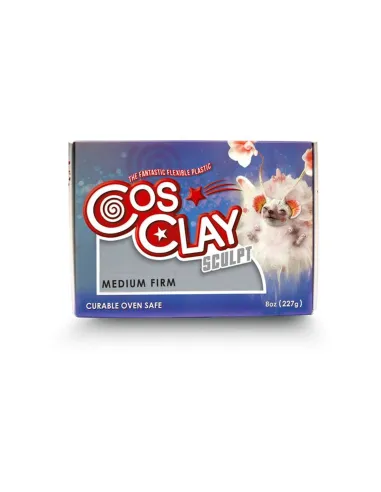
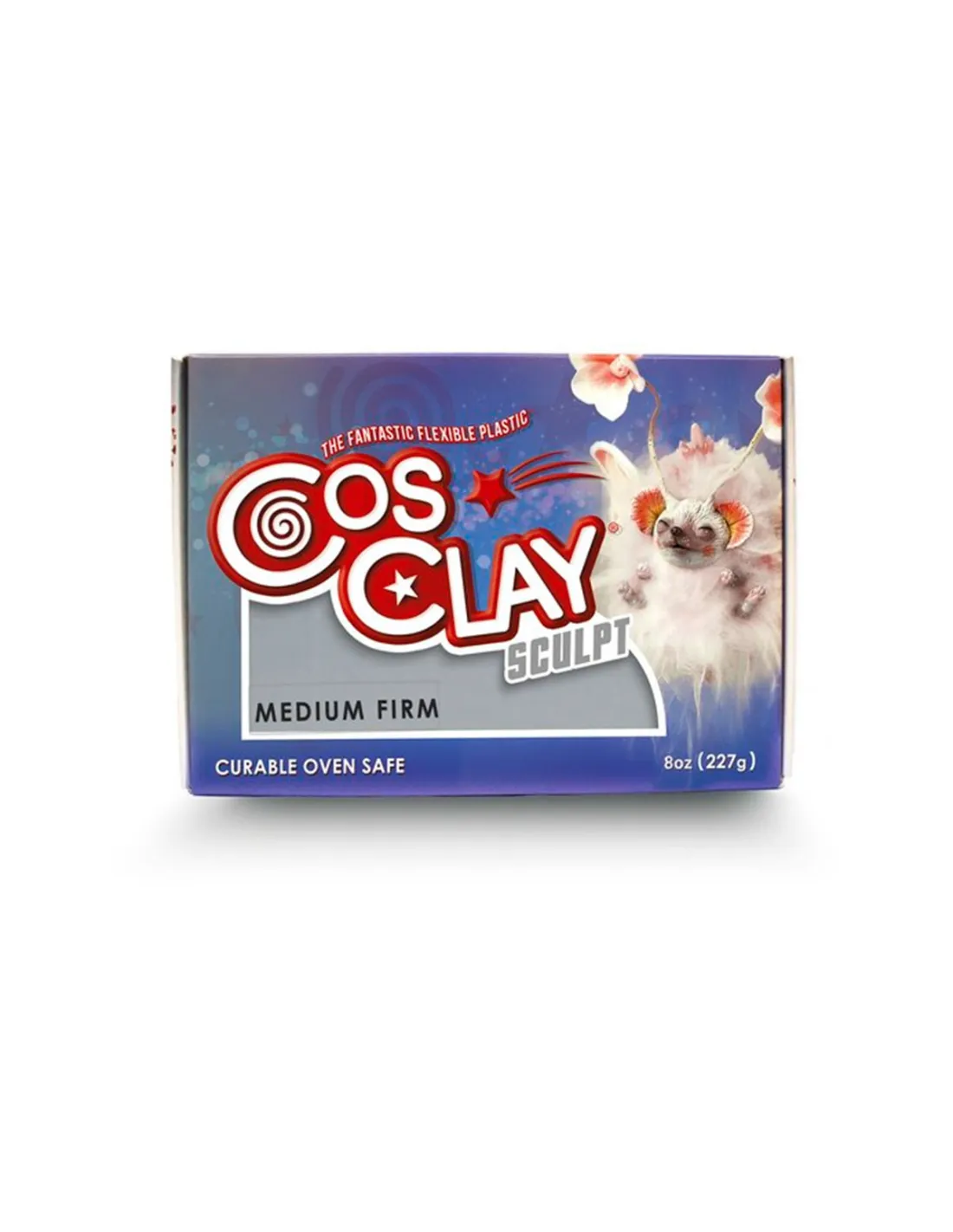
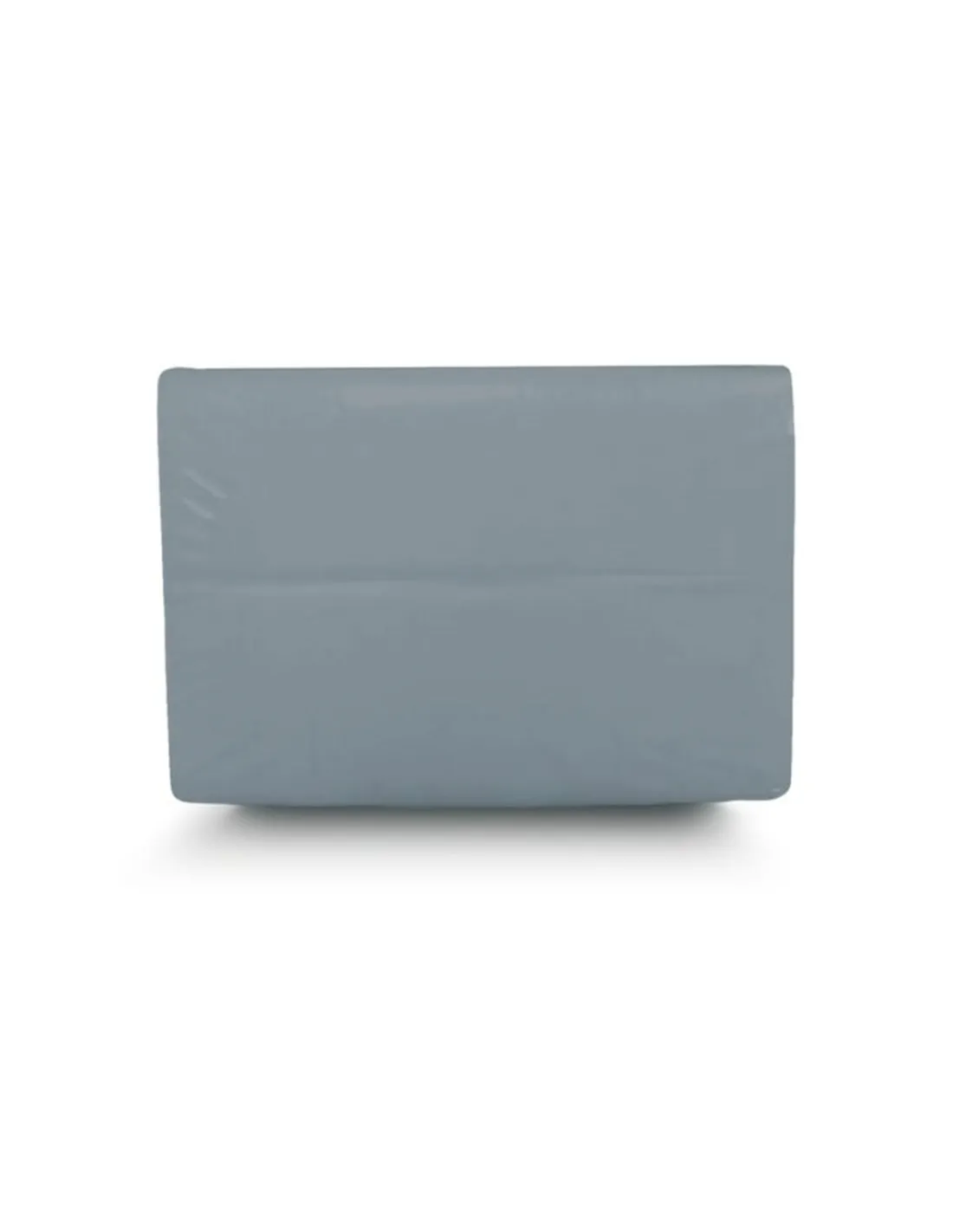
Cosclay Sculpt Medium Firm Gray is a hybrid plastic/rubber polymer clay that, once baked at 135 °C, remains flexible and resistant without becoming brittle. Unlike conventional polymer clays, cured pieces withstand continuous handling, impacts and fine details without breaking. The grey tone makes it easier to read volumes and textures during sculpting, making it the go-to tool for stop motion sculptors, articulated dolls and special effects.
Technical specifications
| Property |
Value |
| Family |
Flexible polymer clay (plastic/rubber hybrid) |
| Format |
227 g block |
| Color |
Medium grey |
| Firmness before curing |
Medium Firm |
| Cure temperature |
135 °C (conventional oven) |
| Result after curing |
Flexible and resistant, non-brittle |
| Shrinkage / expansion |
None (100% solid) |
| Oven resistance |
No warping or cracking |
| Supply state |
Ready to use, no pre-mixing required |
What it's used for
Cosclay Sculpt Medium Firm Gray is designed for sculptors and artists who need pieces with high detail definition that can withstand continuous handling without breaking. Its medium-firm consistency allows for precise work, while the flexible result after curing makes it indispensable for any project involving articulated, thin or mechanically stressed parts.
- Characters and puppets for stop motion with flexible joints
- Articulated figures and OOAK collector dolls
- Artistic sculptures with fine or delicate protruding elements
- Miniatures for role-playing games, wargames and dioramas
- Lightweight prosthetics and special effects pieces
- Prototypes and models requiring a degree of functional flexibility
- Masters for mold making with firmer clays when combining different hardnesses
How to use it
- Condition the clay: Knead the block with your hands until it is soft and homogeneous. If the material is very cold, warm it for a few seconds between your palms or let it rest at room temperature.
- Sculpt your piece: Use sculpting tools to work details, textures and shapes. Loop tools are useful for creating hollows or reducing large volumes.
- Build over an armature if needed: For articulated figures, sculpt over a wire skeleton. Cosclay's adhesion to itself and to metals is excellent.
- Preheat the oven: Set the oven to 135 °C. Use an independent oven thermometer to verify the actual temperature; domestic ovens often have significant variations.
- Bake the piece: Place the piece in the preheated oven. Cure time depends on thickness: as a general reference, 15–30 minutes for 6–12 mm thicknesses. For thicker pieces, increase the time proportionally.
- Cool before handling: Remove the piece from the oven and allow it to cool completely at room temperature before handling. Do not force-cool it with cold water.
- Post-cure finishing: Once cool, the piece can be sanded, painted with acrylics or lacquers, and used as a master for silicone mold making.
Tips and tricks
Mixing firmness levels to control the result
Cosclay Sculpt Medium Firm Gray can be blended with other variants in the same range (softer or firmer) to achieve a custom intermediate consistency. If you need areas with greater rigidity, combine it with a firmer version in that specific area before baking; if you want more flexibility at joints, incorporate a softer portion. Mix thoroughly until you achieve a uniform color and texture before sculpting.
Baking temperature and time: the critical point
The actual temperature inside the oven may differ by several degrees from the dial setting. Excessive temperature can burn or discolor the piece and generate fumes; insufficient temperature leaves the interior uncured, appearing firm on the surface but brittle at the core. Always verify with an independent thermometer and, when baking very thick pieces, increase the time rather than raising the temperature. To protect thin areas from direct heat, cover them with aluminum foil.
Compatibility with platinum silicones: watch out for inhibition
Cosclay is a polymer clay that, in principle, does not contain sulfur, but it is always advisable to carry out a compatibility test before using it as a master for platinum silicone mold making. Apply a small amount of silicone to the cured piece in a non-visible area and check that it cures correctly before proceeding with the full mold. If the silicone does not cure in contact with the piece, seal the master with a coat of acrylic lacquer before molding.
Frequently asked questions
What is the difference between a flexible polymer clay and a conventional one?
Conventional polymer clays become rigid and brittle after oven curing, making them vulnerable to breakage in thin or articulated pieces. Cosclay Sculpt Medium Firm Gray is a hybrid plastic/rubber formula that maintains flexibility and resistance once cured, so pieces can be bent, articulated or subjected to impacts without fracturing.
Can I bake the clay in a domestic kitchen oven?
Yes. Cosclay Sculpt Medium Firm Gray cures in a conventional oven at 135 °C. The most important thing is to verify the actual temperature with an independent thermometer, as domestic ovens often deviate by several degrees. Ventilate the kitchen well during baking and, if possible, use an oven dedicated solely to clay.
Can I add more clay after a first bake?
Yes, this is one of Cosclay's advantages. You can bake a first layer or base structure, let it cool, add more raw clay on top to correct or add detail, and bake again. Adhesion between layers is very good as long as the new clay is pressed firmly onto the already cured piece.
What paints can be used after curing?
Acrylic paints are the most common option and work perfectly on cured Cosclay. You can also use lacquers, thinned oil paints or powder pigments fixed with varnish. Avoid aggressive solvents that could attack the surface. For best results, lightly sand with fine grit before applying the first coat of paint.
Can it be used as a master for making a silicone mold?
Yes. Once baked and cured, Cosclay Sculpt Medium Firm Gray is an excellent master for mold making. For tin (condensation) silicones there are no special restrictions. For platinum (addition) silicones, always carry out a compatibility test on the cured piece before molding, as some materials can inhibit curing. If inhibition occurs, seal the master with acrylic lacquer before applying the silicone.
How many grams do I need to sculpt a life-size head?
A solid life-size head may require between 500 g and 1 kg of clay, depending on size and wall thickness if worked hollow over an armature. The 227 g format is ideal for reduced-scale heads (stop motion characters, collector figures) or for adding details and touch-ups to larger pieces. For a life-size head, combining several blocks is recommended.
How does the grey tone differ from beige or other polymer clays in the catalogue?
The grey tone of Cosclay Sculpt Medium Firm Gray makes it easier to read light and shadow during sculpting, helping to evaluate volumes and textures more clearly than lighter tones such as beige. Other polymer clays in the catalogue, such as Super Sculpey Beige or Super Sculpey Firm Gray, give a rigid result after curing; Cosclay is the only flexible option within this family.
Can it be used for stop motion pieces that will be handled constantly?
This is precisely one of its standout uses. The post-cure flexibility of Cosclay Sculpt Medium Firm Gray allows joints and fine elements to withstand hundreds of handling cycles without breaking — something essential in stop motion productions where each piece is moved frame by frame over weeks.