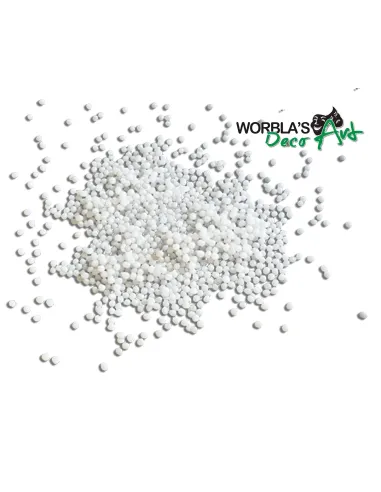
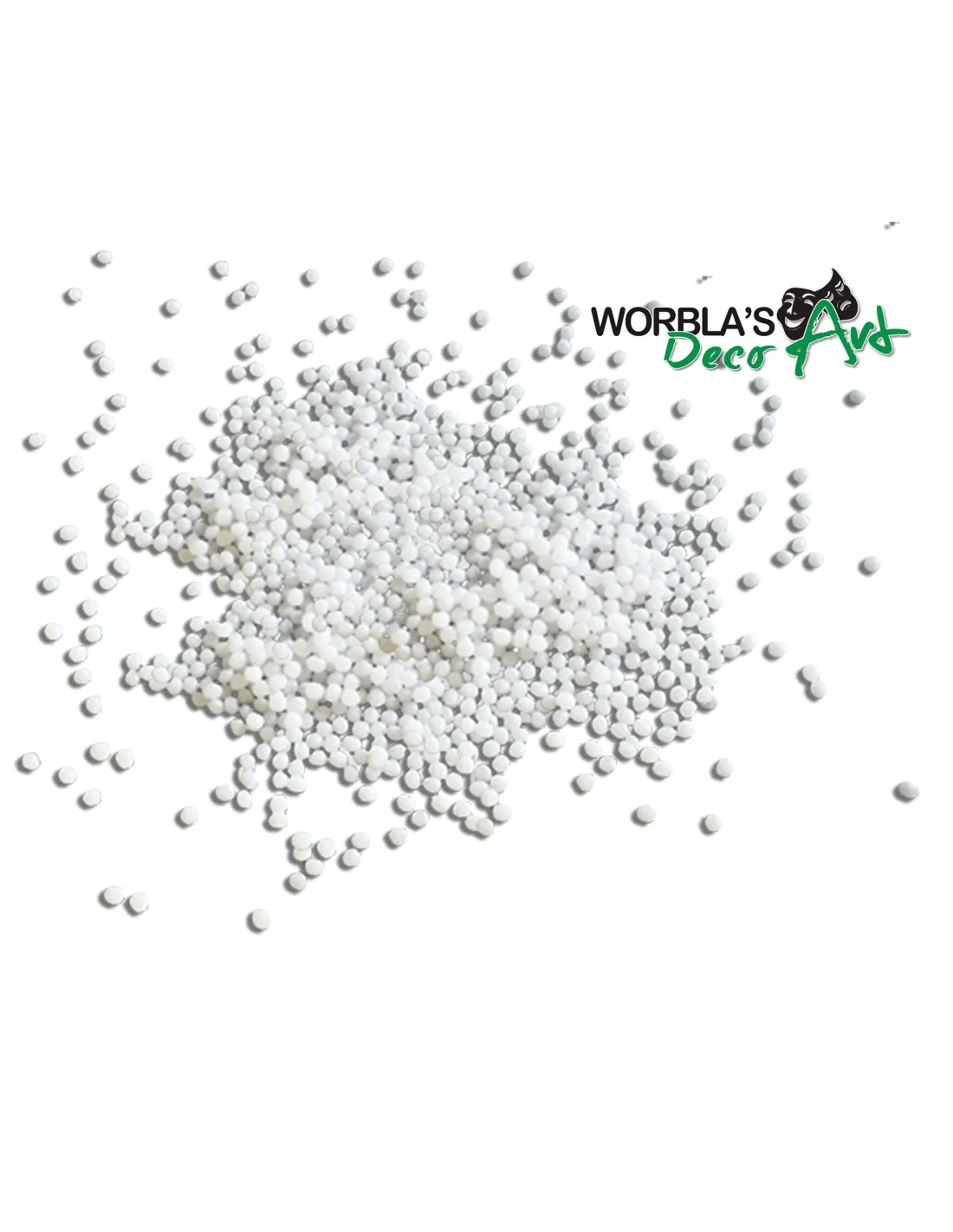
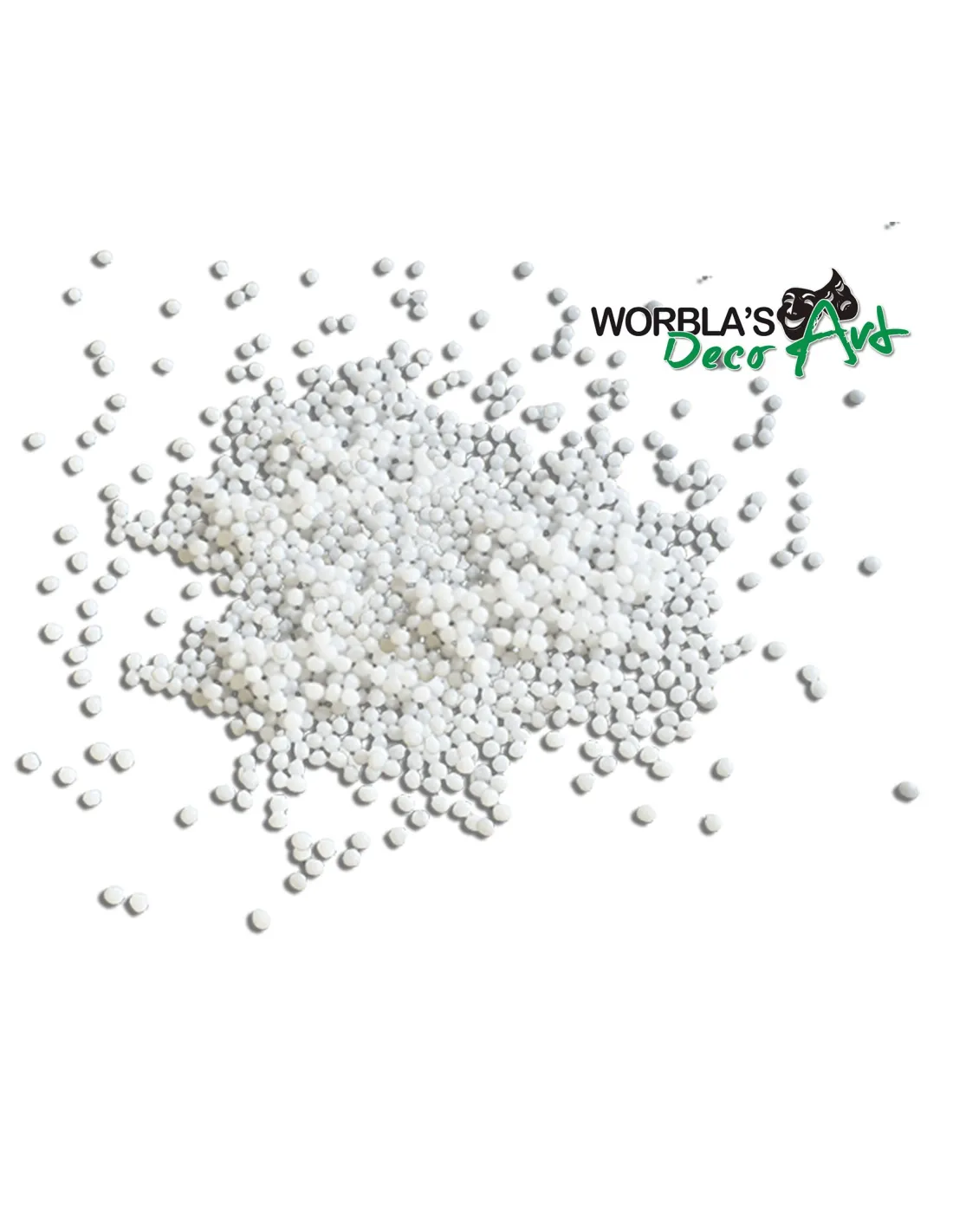
Worbla's Deco Art is a thermoplastic in micro-pellet form that activates from 65 °C, becoming a transparent, tacky and fully mouldable mass with no solvents or special tools required. Once cooled, it hardens without shrinkage, with a smooth finish that accepts paint, sanding and any type of surface treatment. It is indefinitely reusable: any trimming or leftover piece becomes working material again.
Technical specifications
| Parameter |
Value |
| Activation temperature |
65 °C |
| Hardening time |
~10 minutes |
| Cure shrinkage |
No shrinkage |
| Visual activation indicator |
Micro-pellets turn transparent |
| Solvents |
None |
| Reusable |
Yes, indefinitely |
| Supply form |
Micro-pellets |
| Surface finish |
Smooth, paintable and sandable |
What it is used for
Worbla's Deco Art is designed for those who need a precision thermoplastic with a low activation threshold. Its micro-pellet format makes it easy to measure out exactly the amount needed and allows working with fine-detail moulds without risk of damaging the base piece from excess heat. It is especially useful when lightweight, reusable pieces with a clean finish are required.
- Cosplay: making armour, accessories, props and decorative details
- Theatre and film set design: lightweight and durable prop elements
- FX makeup and prosthetics: high-detail, low-weight surface pieces
- Freehand modelling for sculptures, scale models or prototypes
- Casting over plaster or silicone moulds (with release agent)
- Filling and rebuilding damaged pieces or areas
- Colour integration during kneading by mixing acrylic paint directly into the material
- Textures and reliefs for decoration or prop making
How to use it
- Measure out: separate the amount of micro-pellets needed for the piece you are going to work on. Since it is reusable, you can start with a small amount and add more as needed.
- Activate the material: heat the pellets in hot water (65–80 °C), with a heat gun or with a heat press until they become completely transparent and tacky. That visual change is the sign that they are ready.
- Knead and shape: gather the activated pellets with your fingers or a modelling tool until you obtain a homogeneous mass. Model by hand or press firmly onto the mould to capture the detail.
- Work quickly: you have a working window of several minutes before it starts to harden. If it loses temperature, reheat it.
- Let it cool: the material hardens in about 10 minutes at room temperature, without shrinkage and retaining the exact detail of the mould.
- Finish the piece: once cool, sand it, paint with acrylics, apply primer or combine it with other parts by heat-welding them together.
- Recycle the leftovers: any surplus or unwanted piece can be reactivated with heat to be reused from scratch.
Usage tips
Temperature control: hot water vs. heat gun
Hot water is the most uniform method for activating large quantities of micro-pellets at once: submerge the pellets in a container of water at around 70–80 °C, drain them with a strainer and knead them immediately. The heat press or heat gun are ideal for already-formed pieces that you want to soften, join or retouch. Avoid temperatures well above 80 °C: the material is more workable within the optimal range and will not degrade.
Using with moulds and release agents
If you press the activated material onto a silicone or plaster mould to capture fine details, always apply a release agent to the mould before working. With silicone moulds demoulding is usually straightforward, but with plaster or porous materials a release agent prevents the mass from sticking. Since there is no shrinkage, the mould detail is transferred with complete fidelity.
Combining with other materials and finishes
Worbla's Deco Art bonds to itself with heat, making it easy to join pieces or add layers without adhesives. For complex cosplay pieces, combine it with Worbla's Finest Art (structural sheets) or Worbla's Black Art for areas requiring greater rigidity. If you want to integrate colour directly, knead a small amount of thick acrylic paint into the activated material before it hardens.
Frequently asked questions
At what temperature does this micro-pellet thermoplastic activate?
Worbla's Deco Art activates from 65 °C. This is a low activation temperature compared to other thermoplastics in the range, making it safer to handle and compatible with more delicate moulds. You can reach that temperature with hot tap water (in many cases that is enough), with a heat gun or with a heat press.
How do I know when the material is ready to model?
The material gives you a clear visual cue: the micro-pellets go from being opaque/white to becoming completely transparent when they reach the activation temperature. At that point they are tacky and malleable. If any pellet is still opaque, it needs more heat.
How long do I have to work the material before it hardens?
Depending on the ambient temperature, you have several minutes of comfortable working time. If the material starts to lose plasticity before you are done, simply reapply heat with a heat gun or submerge the piece in hot water again to restore malleability without any issue.
Can leftover material be reused?
Yes, indefinitely. Any trimming, offcut or piece you want to redo reactivates with heat exactly the same as the first time, with no loss of properties. This makes it especially cost-effective on projects involving a lot of experimentation or prototyping.
What is the difference between this material and standard thermoplastic sheets?
The micro-pellet format allows you to measure out exact quantities, fill gaps, build three-dimensional volumes from scratch and work very small or irregular areas with precision. Sheets like Worbla's Finest Art are better suited for covering large surfaces or providing flat structure. Both formats are complementary in many projects.
Can it be painted once hardened?
Yes. Once cool and hardened, Worbla's Deco Art accepts primer, acrylic paint, spray paint and any standard finishing system used in cosplay or set design. It is advisable to apply a coat of primer or gesso if you want a completely smooth finish, as the surface may show the texture of the pellets on unsanded pieces.
Is it compatible with silicone moulds?
Yes, it is one of its most common uses. When the activated material is pressed onto a silicone mould, it captures detail precisely and releases cleanly on cooling without the need for a release agent in most cases. With plaster or other porous material moulds, it is recommended to apply a release agent before pressing the material in.
Is it safe to work with without special protective equipment?
Worbla's Deco Art contains no solvents and generates no toxic fumes during activation. When working with hot water or a heat gun, care should be taken against the risk of burns from heat, especially when handling water at 70–80 °C. No mask or forced ventilation is required for normal studio use.