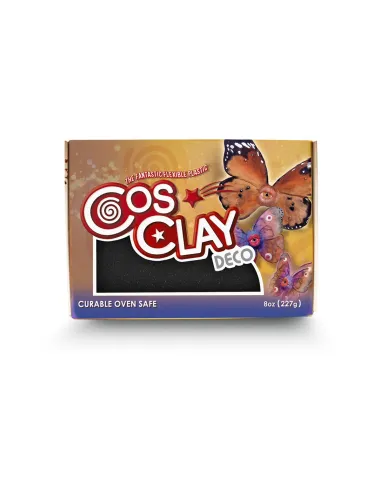
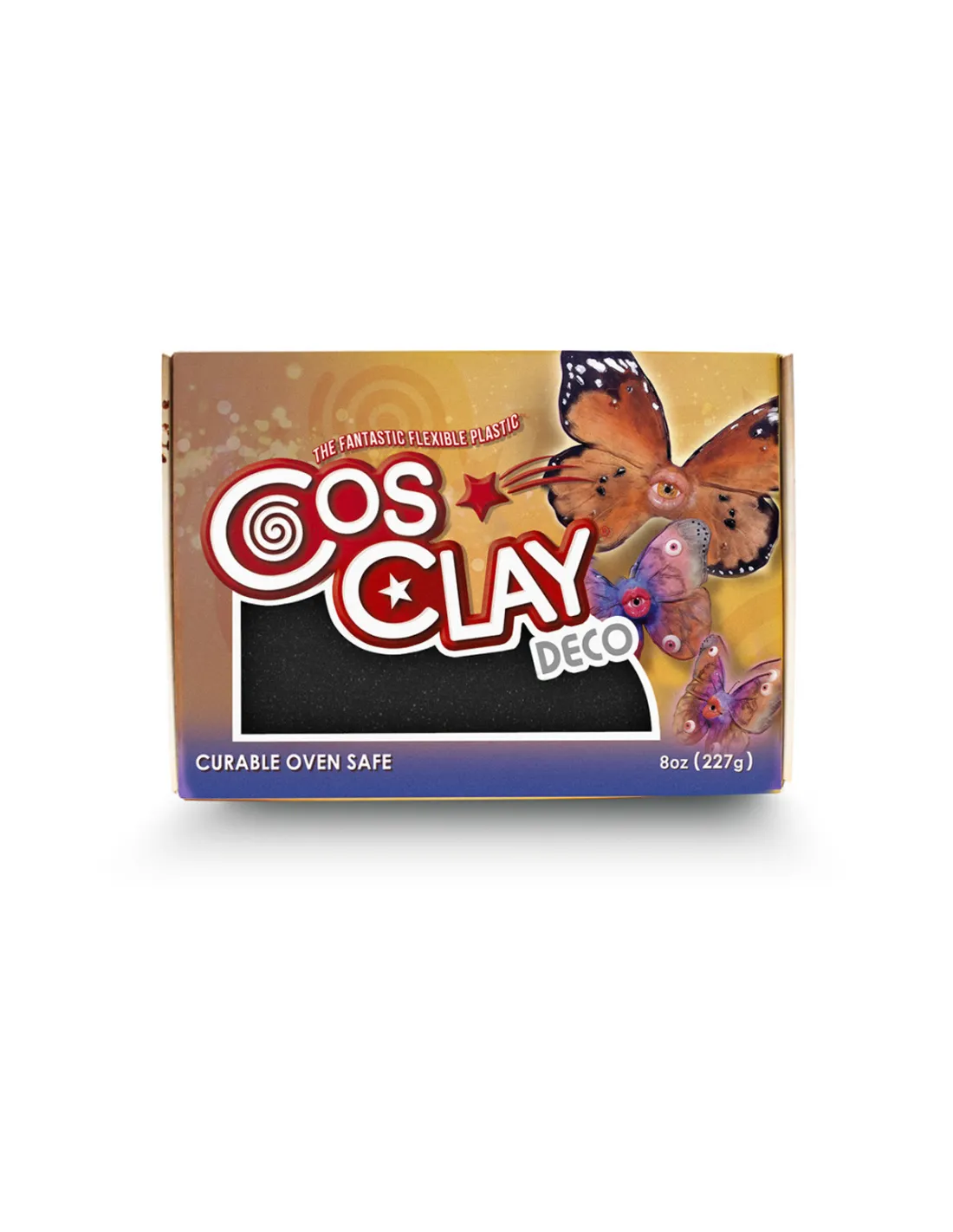
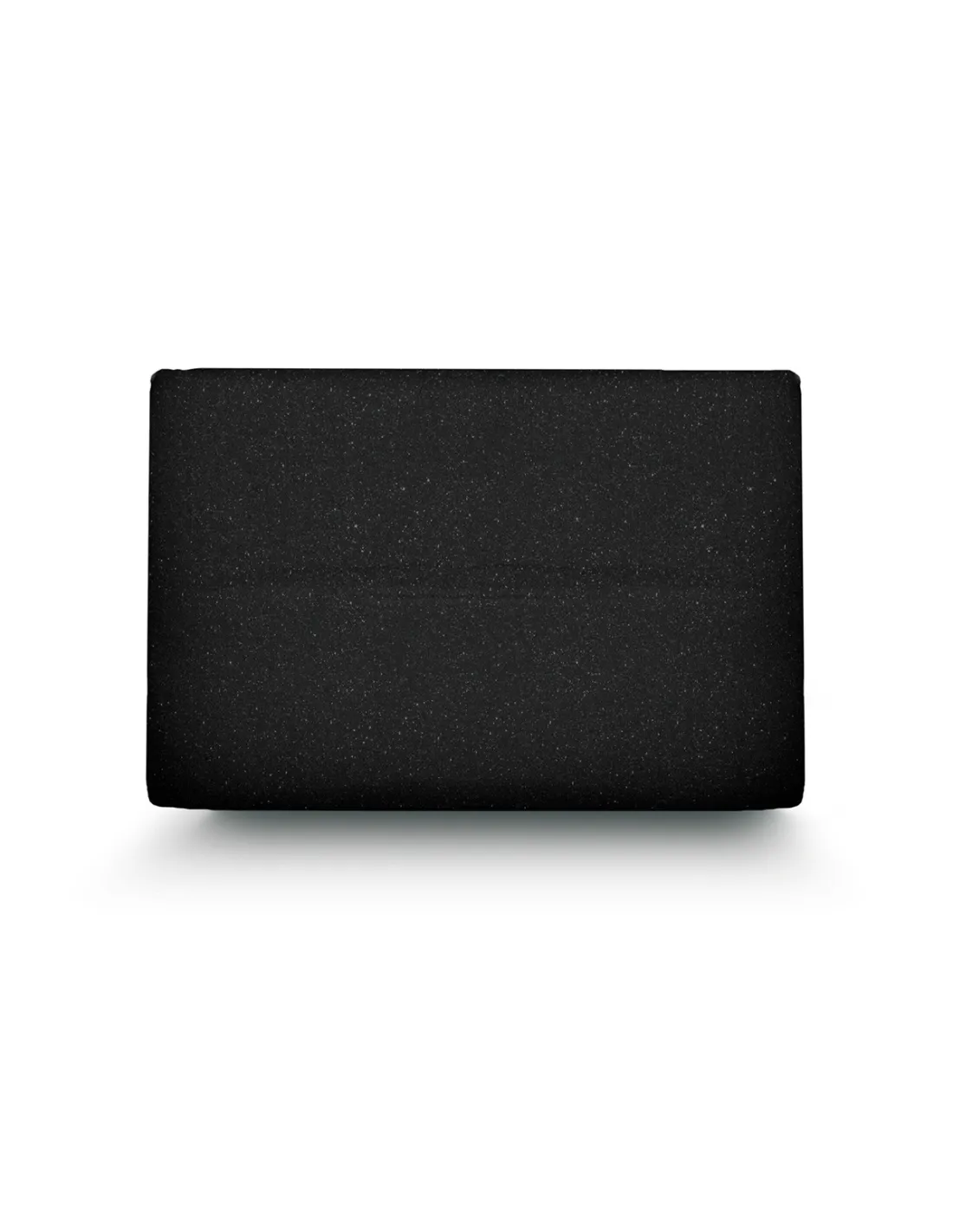
Cosclay Deco Black is a black hybrid plastic/rubber polymer clay, ready to sculpt and oven-cured at 135 °C while retaining permanent flexibility. Unlike conventional polymer clays, it does not crack, warp, or suffer shrinkage or expansion during baking. It is the go-to choice for sculptors, animators and artists working on delicate, articulated pieces or dark-finish work where minimising sanding afterwards is a priority.
Technical specifications
| Parameter |
Value |
| Colour |
Black (Deco Black) |
| Format |
227 g block |
| Cure temperature |
135 °C in a domestic oven |
| Result after curing |
Rigid and flexible (non-brittle) |
| Shrinkage / expansion |
None (100 % solid) |
| Supply state |
Ready-to-sculpt clay, no mixing required |
| Compatibility |
Blendable with other standard polymer clays |
What it is used for
Cosclay Deco Black is designed for any artistic or technical application where the material must withstand continuous handling without breaking. Its solid black colour makes it especially useful when working with dark finishes or when you want to minimise subsequent paint layers.
- Characters and puppets for stop motion and frame-by-frame animation
- Articulated figures and BJD (ball-jointed dolls)
- Collector miniatures and dioramas
- OOAK (One of a Kind) unique sculptures
- Props and special effects pieces requiring flexibility after curing
- Handcrafted jewellery and decorative accessories with fine detail
- Artistic prototypes and scale architectural models
How to use it
- Condition the clay. Knead the required amount by hand until it is smooth and homogeneous. In cold environments you can warm it slightly with your palms or hold it near a gentle heat source for a few seconds.
- Sculpt the piece. Work with your usual sculpting tools. You can use embossing and modelling tools for fine details. The clay holds its shape without drying out while you work.
- Reinforce if necessary. For large pieces or those with protrusions, incorporate a wire armature before baking to provide greater structural strength.
- Preheat the oven. Set the domestic oven to 135 °C. Use an oven thermometer to verify the actual temperature, as domestic ovens can vary.
- Bake the piece. Place the sculpture on baking paper or a ceramic surface. The indicative cure time is 15–30 minutes per 6 mm of thickness. Thinner pieces require less time.
- Allow to cool. Remove the piece from the oven and allow to cool to room temperature before handling. Do not force cooling with cold water.
- Final finishing. Once cool, you can sand, paint with acrylics, apply varnishes, or add more clay and re-bake for corrections or additional detail layers.
Usage tips
Blending with other polymer clays
Cosclay Deco Black is compatible with other standard polymer clays such as Super Sculpey Beige or Super Sculpey Firm Gray. Blending them in different ratios lets you adjust the final flexibility: more Cosclay means more flexibility; more conventional clay means greater rigidity. Run tests with small samples before committing to a large piece.
Oven temperature control
Sustained temperatures above 135 °C can affect the final result and generate fumes. Always use an independent oven thermometer to verify the actual temperature, especially in convection ovens. Ventilate the workspace during baking. Do not use a microwave: the heat is uneven and can ruin the piece.
Combining with internal structures
For articulated stop motion figures or BJDs, Cosclay Deco Black lends itself particularly well to working over coated wire armatures or microsphere thermoplastic structures such as Worbla's Deco Art. The flexibility of the cured material absorbs the stresses of movement without cracking at the articulation points — something critical in frame-by-frame animation.
Frequently asked questions
Can I re-bake an already cured piece to add more details?
Yes. Cosclay allows you to add layers of fresh clay over an already cured piece and re-bake it. This is one of its advantages over other polymer clays: the previously cured material does not degrade with a second bake as long as the 135 °C temperature is respected. This makes phased working and detail corrections straightforward.
What happens if I bake the piece for too long or at too high a temperature?
Excessive temperature can cause surface darkening, bubbles or even fume emission. Keep the oven at 135 °C and monitor the time. If the piece has varying thicknesses, always use the thickest section as the reference point. Always ventilate the workspace during baking.
Can polymer clay be painted once cured?
Yes. After curing and cooling, Cosclay Deco Black accepts acrylic paint without a primer in most cases. The black base colour reduces the number of layers needed when working with dark tones. For very precise finishes or oil paints, a light sanding with fine wet-and-dry paper (400–600 grit) improves adhesion.
Is it safe to use at home or in shared kitchen ovens?
Polymer clays cured at the correct temperature are non-toxic, but good ventilation of the space during baking is recommended. If you use the kitchen oven, ventilate the room and avoid baking food immediately afterwards. Many professional users dedicate a separate oven exclusively to their workshop materials.
What is the difference between Cosclay Deco Black and other black polymer clays on the market?
The main difference is the permanent flexibility after curing. Conventional polymer clays cure to a rigid, brittle state in thin sections. Cosclay incorporates a hybrid plastic/rubber formulation that maintains elasticity without sacrificing detail retention during sculpting.
How much clay do I need to sculpt a medium-sized figure?
It depends on the technique and size. For a 15–20 cm stop motion figure on a wire armature, the 227 g in this format is usually sufficient for a complete full-body figure in a thin layer. For solid sculptures or larger heads, consider combining it with Cosclay Sculpt Medium Firm Gray for the inner volume and reserving the Deco Black for the outer layers where colour matters.
Can it be used as a moulding material or to make moulds?
No. Cosclay is a direct modelling material, not a moulding material. If you need copies of a sculpture made in Cosclay, you must first cure the piece in the oven and then make a mould with platinum or tin silicone over the cured original. Bear in mind that some polymer clays can inhibit platinum silicones; cure and clean the original surface thoroughly before moulding.
Is Cosclay Deco Black suitable for jewellery worn in continuous skin contact?
Cured Cosclay is stable and non-toxic to the touch, and its flexibility makes it particularly resistant to the knocks typical of jewellery use. For pieces in prolonged skin contact, apply a varnish or finish lacquer specifically formulated for polymer clay to seal the surface and improve colour durability.