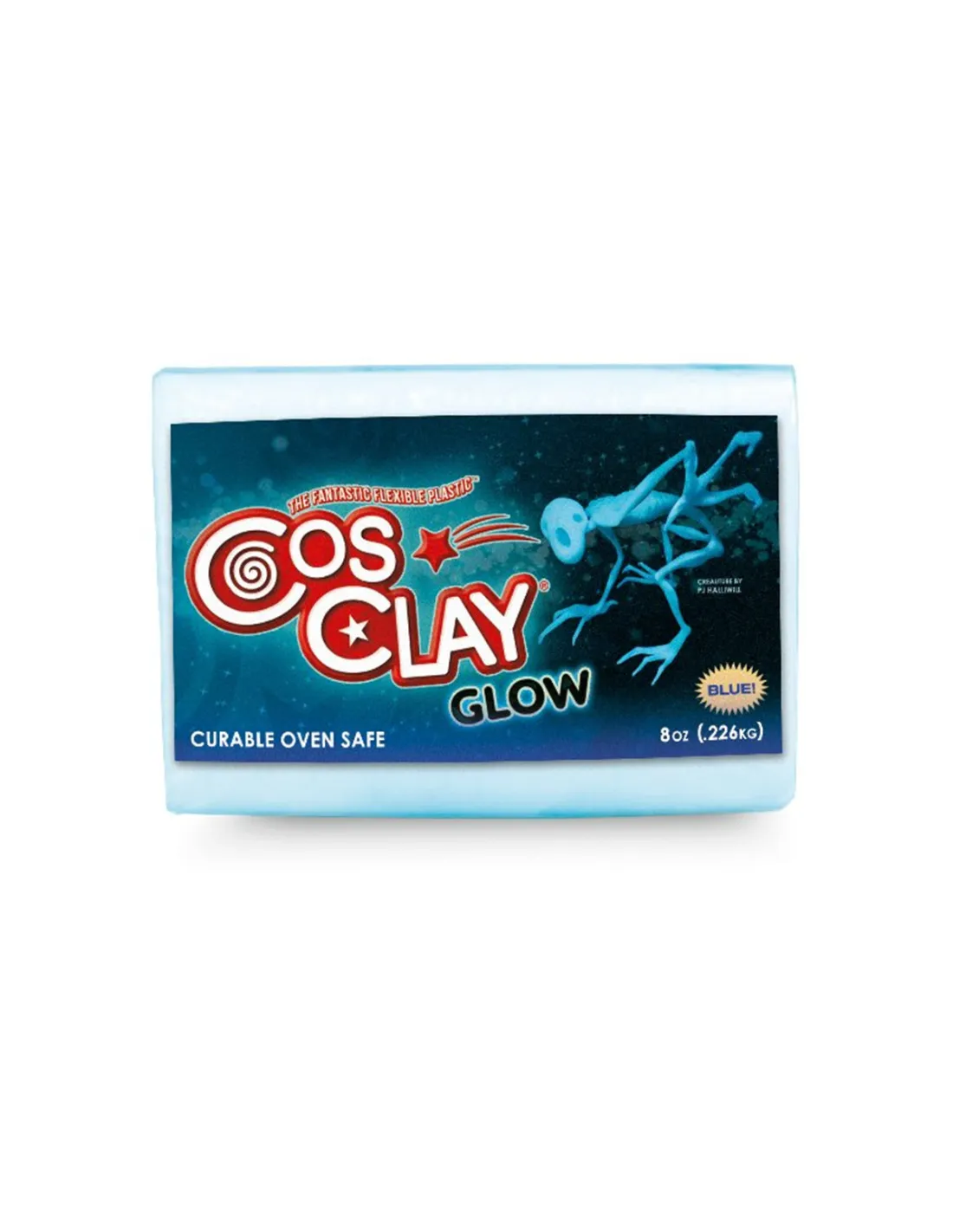
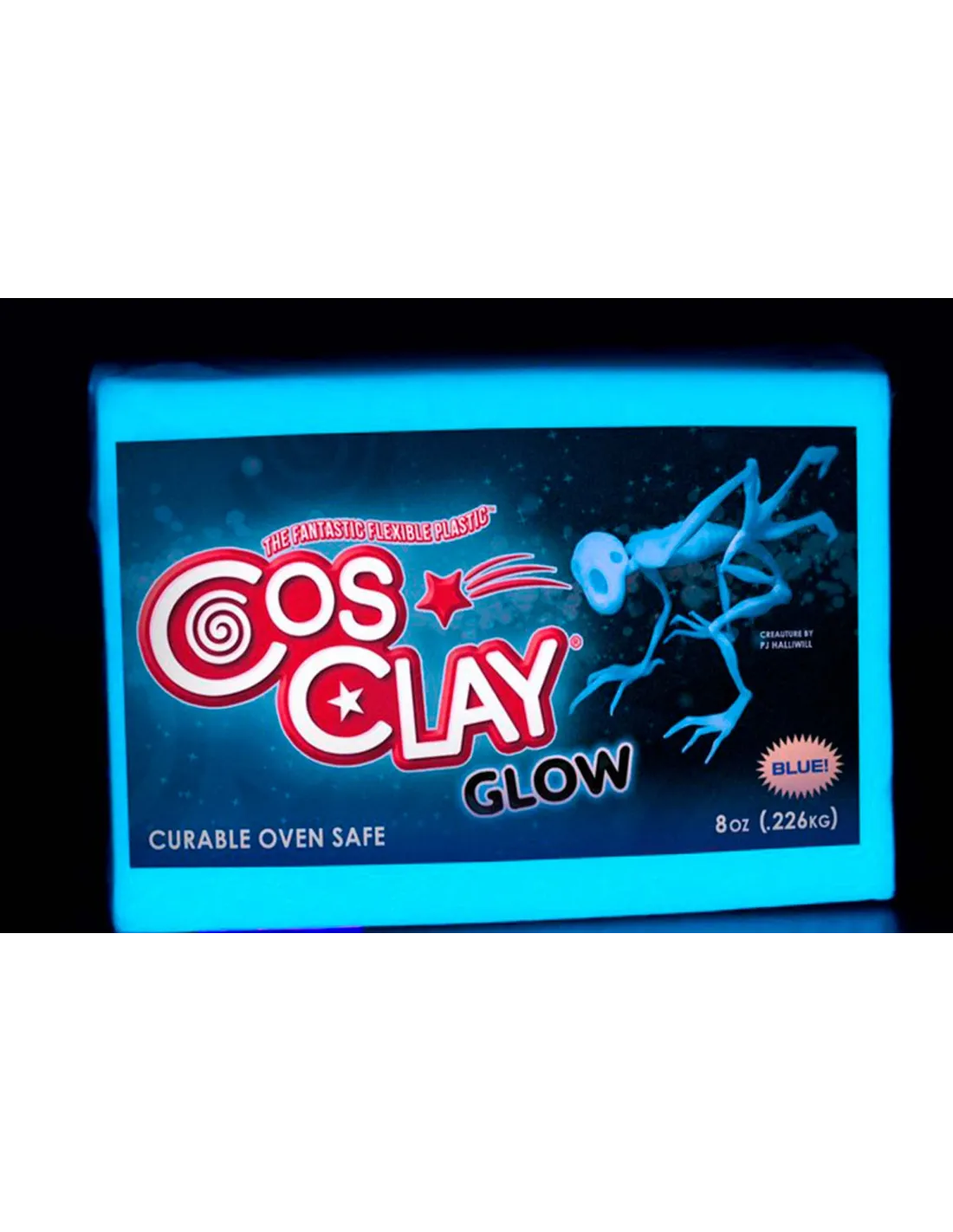
Cosclay Glow Blue is a hybrid plastic/rubber polymer clay that, after oven curing at 135 °C, retains real and lasting flexibility. Unlike conventional polymer clays, it does not break or crack in thin or delicate pieces, and in its Glow version it emits light in the dark once charged with ambient light. It is the ideal option for sculptors, animators and artists who need strong, fine-detail pieces with that distinctive luminescent effect.
Technical specifications
| Property |
Value |
| Material type |
Hybrid plastic/rubber polymer clay |
| Format |
226 g block |
| Colour |
Blue with glow effect (glows in the dark) |
| Cure temperature |
135 °C |
| Result after curing |
Flexible and strong, not brittle |
| Shrinkage / expansion |
None (100% solid) |
| Sag resistance |
High (holds shape during baking) |
| Raw state |
Malleable, with moderate self-support |
What it is used for
Cosclay Glow Blue is designed for makers who need pieces that are both strong and flexible, with the added visual impact of glow in the dark. Its most common applications include:
- Characters and puppets for stop motion with joints that must bend without breaking
- Articulated figures, ball-jointed dolls (BJD) and artistic marionettes
- OOAK (One of a Kind) collector sculptures
- Miniatures and dioramas with fine elements: petals, hair, tentacles, wings
- FX and prop making where post-cure flexibility is required
- Jewellery and handcrafted accessories with a luminescent effect
- Design prototypes where a degree of mechanical resilience is needed
How to use it
- Condition the clay: work a piece in your hands for a few minutes to soften it and improve its malleability. If the environment is cold, you can warm it gently with your palms or a mild heat source.
- Sculpt your piece: model with your fingers and sculpting tools or embossing tools. Cosclay holds detail and self-supports in moderate sections without needing an Armature in small pieces; for large or very thin pieces, use a wire core.
- Add or join sections: raw parts bond easily by pressing together. For post-cure joins with already baked pieces, add fresh clay at the joint and bake again.
- Prepare the oven: preheat a domestic oven to 135 °C. Use a separate oven thermometer to verify the actual temperature; domestic ovens often deviate by several degrees.
- Bake the piece: place the sculpture on a flat surface (ceramic tile, baking tray, baking paper). Baking time depends on thickness: approximately 15 minutes per 6 mm of the maximum thickness of the thickest section.
- Allow to cool: remove from the oven and allow to cool to room temperature before handling. Do not force cooling with cold water.
- Charge the glow: expose the cured piece to intense light (direct sunlight or a white LED lamp) for a few minutes to activate the luminescent effect.
- Finishing: once cool, you can sand, paint with acrylics, varnish or apply patinas. Cosclay's flexible finish accepts acrylics well without the varnish cracking.
Usage tips
Oven temperature control
The most common mistake with any polymer clay is incorrect temperature. Above 150 °C the clay can burn and release unpleasant fumes; below 130 °C the cure is incomplete and the piece remains brittle or tacky. Invest in a separate oven thermometer: it is the most important tool in your curing process. Always bake in a well-ventilated space.
Armatures and self-support
Cosclay has better self-support than most conventional polymer clays, but for pieces with thin appendages (fingers, long wings, tentacles) it is advisable to insert a wire core before baking. Using clay hollowing tools you can hollow out the interior of large pieces, reducing weight and the curing time needed in the thickest areas.
Combining with other polymer clays
Cosclay Glow Blue is compatible with other polymer clays that cure at similar temperatures, such as Super Sculpey Beige or Super Sculpey Firm Gray. You can use them together to achieve different hardnesses in a single piece (e.g., firm core with a flexible Cosclay surface layer). If you need a version without the glow effect for the same project, Cosclay Sculpt Medium Firm Gray offers the same post-cure flexibility in a neutral grey, ideal for combining in the same sculpture.
Frequently asked questions
How long does the luminescent effect last after charging?
The duration of the glow in the dark depends on the intensity and length of exposure to light. With a 5–10 minute charge under direct sunlight or an LED lamp, the piece can emit visible light for 20–60 minutes in complete darkness. The effect is most intense in the first few minutes and gradually fades. The material can be recharged indefinitely without losing its properties.
Can it be baked multiple times to add new parts?
Yes. Cosclay supports multiple bakings without degrading. You can add fresh clay onto an already cured piece, press it firmly to bond and bake again at 135 °C. This is one of the great advantages of this material for phased work or corrections.
What is the difference between this clay and a conventional polymer clay?
Conventional polymer clays cure to a rigid result that can snap or chip in thin pieces. Cosclay incorporates an elastomeric phase in its formulation, making the cured piece flexible and resilient: it bends without breaking. This makes it the preferred choice for doll joints, thin pieces and any application where post-cure brittleness is a problem.
Can it be painted after baking?
Yes. Once cured and cool, Cosclay accepts acrylic paints directly on the surface without primer, although light sanding with fine-grit sandpaper improves adhesion. Flexible acrylic varnishes work well; avoid very rigid varnishes that could crack with the flexing of the piece.
Is it safe to use with children?
Cosclay is a professional and artistic polymer clay. The curing process requires an oven at 135 °C, so oven use must always be supervised by an adult. Cold modelling is safe to the touch, but as with any workshop material it is recommended not to ingest it and to wash hands after use. It is not certified as a toy.
Can unbaked clay be stored? How long does it last?
Yes. Store leftover unbaked clay wrapped in cling film or in an airtight bag, away from heat and direct light. Under suitable conditions, uncured polymer clay can be kept for months or even years without hardening or deteriorating. If you notice it has become slightly firm, knead it with your hands to restore its plasticity.
What happens if the oven temperature is too high?
Above 150–160 °C the clay can darken, burn and release fumes. If this happens, ventilate the space thoroughly and discard the piece. This is why it is essential to verify the actual oven temperature with a separate thermometer before baking. A poorly calibrated domestic oven is the most common cause of burnt pieces.
What tools work best with this clay?