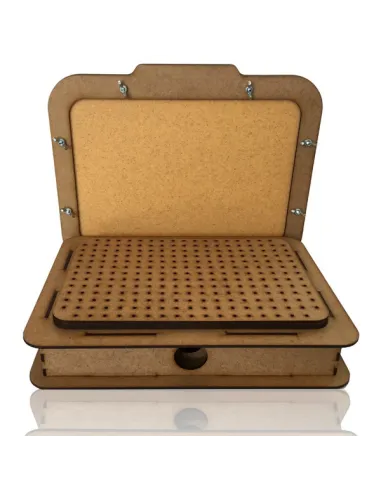
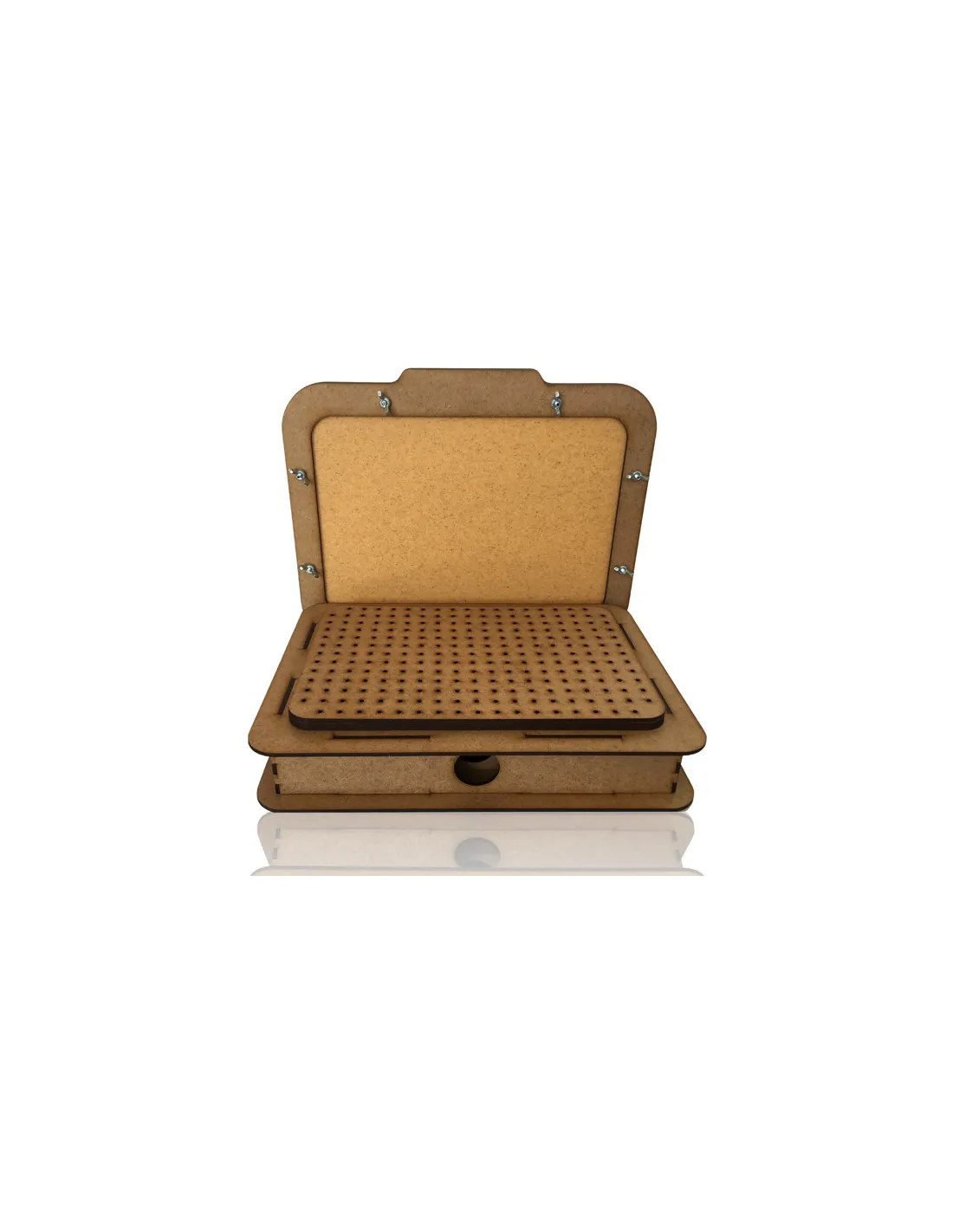
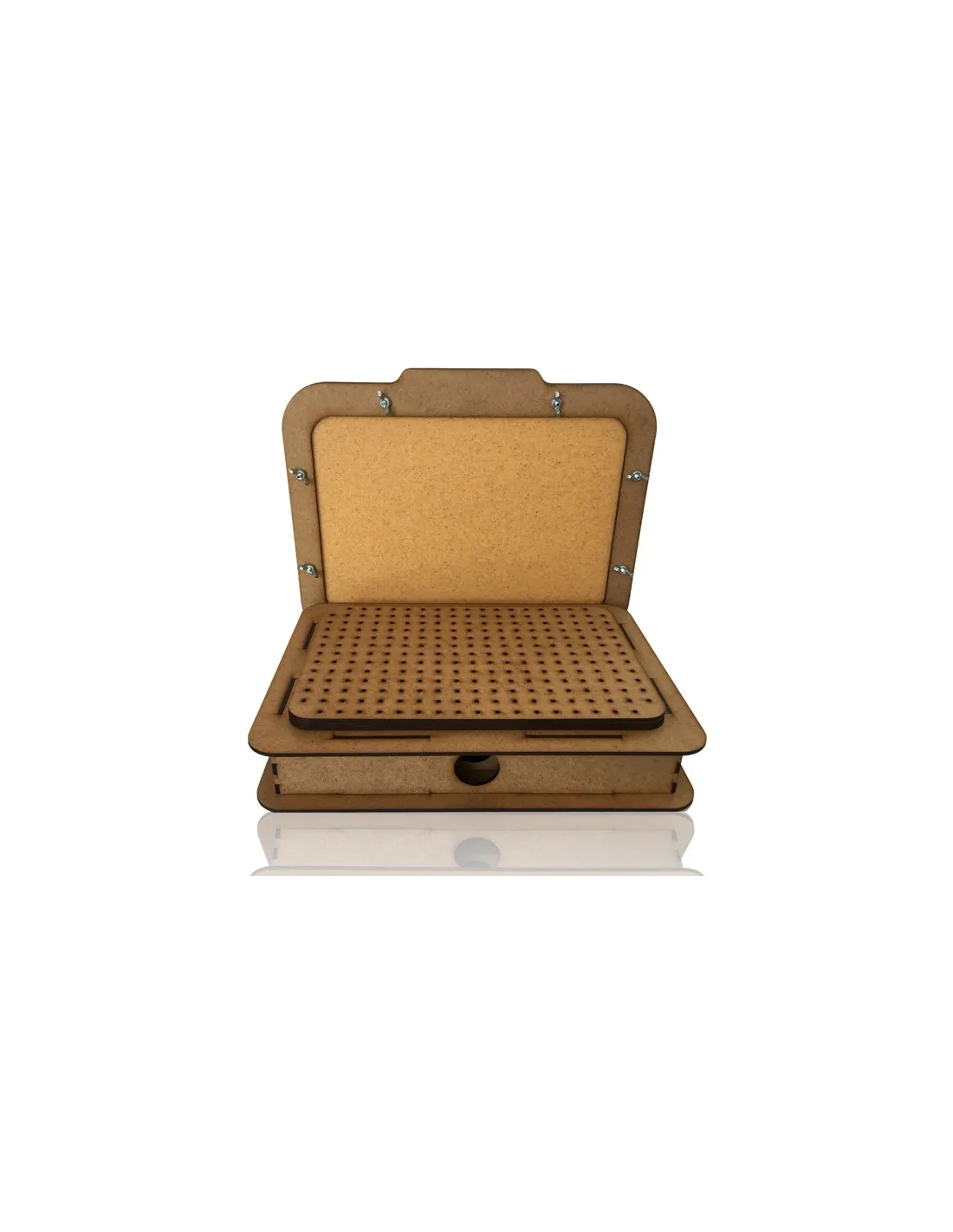
The Simbiox A4 vacuum former, available exclusively through Feroca, is the most effective solution for precisely and repeatably shaping thermoplastics such as Worbla's Finest Art, Worbla's Black Art, Worbla's Transpa Art or HIPS, with professional and reproducible results. Its DIN A4 size makes it compact and manageable for the workshop, without sacrificing working capacity. It assembles in under five minutes and works connected to any standard domestic vacuum cleaner.
Technical specifications
Feature
Detail
Base size
DIN A4 (210 × 297 mm)
Compatible materials
Worbla's Finest Art, Worbla's Black Art, Worbla's Transpa Art, Worbla's Meshed Art, HIPS (up to 1.5 mm thickness)
NON-compatible materials
PVC, Polypropylene, PET
Required vacuum source
Standard domestic vacuum cleaner (not included)
Assembly time
Approx. 5 minutes
Hardware
Included
Designed by
Simbiox
Exclusive distribution
Feroca
What it's used for
The A4 vacuum former is designed for those who need to reproduce complex shapes on thermoplastics with precision and without manual distortion. It is especially useful in small-batch production, where consistency between parts is essential. It is indispensable with Worbla's Transpa Art, which due to its transparent nature and optical properties requires uniform forming that a heat gun can rarely guarantee.
Making armatures, armour and accessories for cosplay with Worbla
Serial reproduction of small and medium parts in character and FX workshops
Forming HIPS sheets up to 1.5 mm thick for masks, shields and rigid parts
Working with Worbla Transpa Art for visors, optical elements or translucent details
Small-run production of decorative or scenic pieces for theatre and film
Rapid prototyping of thermoplastic parts over simple positive moulds
How to use it
Machine assembly: assemble the vacuum former following the included instructions. The hardware comes in the box. The entire process takes no more than 5 minutes.
Mould preparation: place the positive mould (the shape you want to form over) in the centre of the perforated base. The mould must be rigid and heat-resistant.
Cutting the thermoplastic: cut the Worbla or HIPS sheet slightly larger than the mould so that it covers the base and allows for a perimeter seal.
Heating the material: heat the sheet with a heat gun or in an oven until it reaches its activation temperature and becomes flexible and workable.
Positioning: quickly place the hot sheet over the mould and the vacuum former base, making sure it covers the entire perimeter.
Connecting the vacuum cleaner: connect the vacuum cleaner to the vacuum former duct and switch it on. The vacuum generated will cause the sheet to adhere perfectly to the mould, reproducing all the details.
Cooling: keep the vacuum cleaner running until the part has cooled and become rigid. Then switch off the vacuum cleaner and remove the part from the mould.
Finishing: trim the excess material with scissors or a craft knife and apply any finishing you need.
Tips for use
Temperature and material heating
Each Worbla variant has a slightly different activation temperature. Worbla's Finest Art and Worbla's Black Art activate at around 65–70 °C, while Transpa Art requires a little more heat and a very even distribution to avoid marks. Always heat in wide, uniform passes; localised overheating can create bubbles or weak spots in the final part. With HIPS, respect the 1.5 mm thickness limit: thicker sheets will not yield correctly under vacuum.
The mould matters as much as the machine
For good reproductions, the positive mould must be completely rigid and non-porous. Materials such as dense plaster, resin or treated wood work well. Avoid uncoated foam, as the heat from the thermoplastic can deform it. If the mould has areas with strong negative draft angles, demoulding can be difficult: design your moulds with part extraction in mind.
Vacuum cleaner: airflow over power
You don't need an industrial or high-powered vacuum cleaner. What matters is that it has sufficient airflow and that the seal between the sheet and the vacuum former base is good. If you notice the vacuum is incomplete, check that the sheet edges cover the entire perimeter surface of the base. Act quickly after positioning: the thermoplastic cools in seconds and loses flexibility.
Frequently asked questions
Do I need a special vacuum cleaner or will any household one do?
Any standard domestic vacuum cleaner will do. You don't need an industrial or high-powered one. What matters is that it has adequate suction airflow and that the connection to the vacuum former duct is airtight. Most standard household vacuum cleaners are perfectly suitable.
Does it work with any type of Worbla?
Yes. The A4 vacuum former is compatible with all available Worbla variants: Worbla's Finest Art, Worbla's Black Art, Worbla's Transpa Art and Worbla's Meshed Art. It is especially useful with Transpa Art, whose transparent nature requires very uniform forming that is difficult to achieve with a heat gun.
Can I use it with HIPS or other plastics?
Yes, it works with HIPS (High Impact Polystyrene) up to 1.5 mm thick. For thicker sheets, the vacuum generated by a domestic vacuum cleaner may not be sufficient to correctly form the material. It is not suitable for PVC, Polypropylene or PET.
What type of moulds can I use?
Any rigid, heat-resistant positive mould. Dense plaster, resin, treated wood or MDF are all good options. Avoid untreated porous materials or those that may deform under the heat of the activated thermoplastic, such as uncoated foam.
How long does assembly take?
Assembly of the vacuum former is very straightforward and takes approximately 5 minutes. All the necessary hardware is included in the box. No special tools are required.
Is it suitable for batch production?
Yes, as long as we are talking about short or medium runs and parts no larger than A4. The vacuum former allows you to repeat the process as many times as needed, producing consistent parts. For very long runs or large-format parts, larger-scale equipment would be required.
Can I form several parts at once?
It depends on the size of the moulds. If the moulds are small, you can place several on the A4 base simultaneously, as long as the thermoplastic sheet covers all of them and seals the perimeter properly. This is one of the advantages of this format for making small runs of repeated parts.
What is the difference between vacuum forming and using a heat gun directly?
With a heat gun you shape the thermoplastic by hand, which introduces variation between parts and is harder in areas with fine detail. The vacuum former applies vacuum evenly across the entire mould surface, reproducing details with much greater fidelity and without fingermarks. This is especially noticeable with transparent materials such as Worbla's Transpa Art.
Transparent thermoplastic Worbla activatable at 120 °C, reusable and recyclable. For visors, lenses, FX effects and light-interactive pieces in cosplay and set design.
Tap to zoom
You need to login or create account
Save products on your wishlist to buy them later or share with your friends.
Cookies on this site are used to personalise content and ads to deliver social media features and to analyse traffic. We also share information about your use of the site with our social media partners for advertising, personalisation and web analytics.. More information.