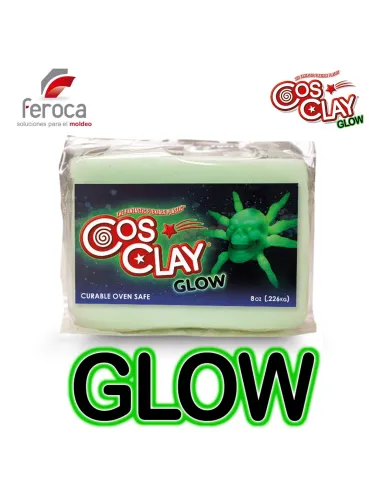
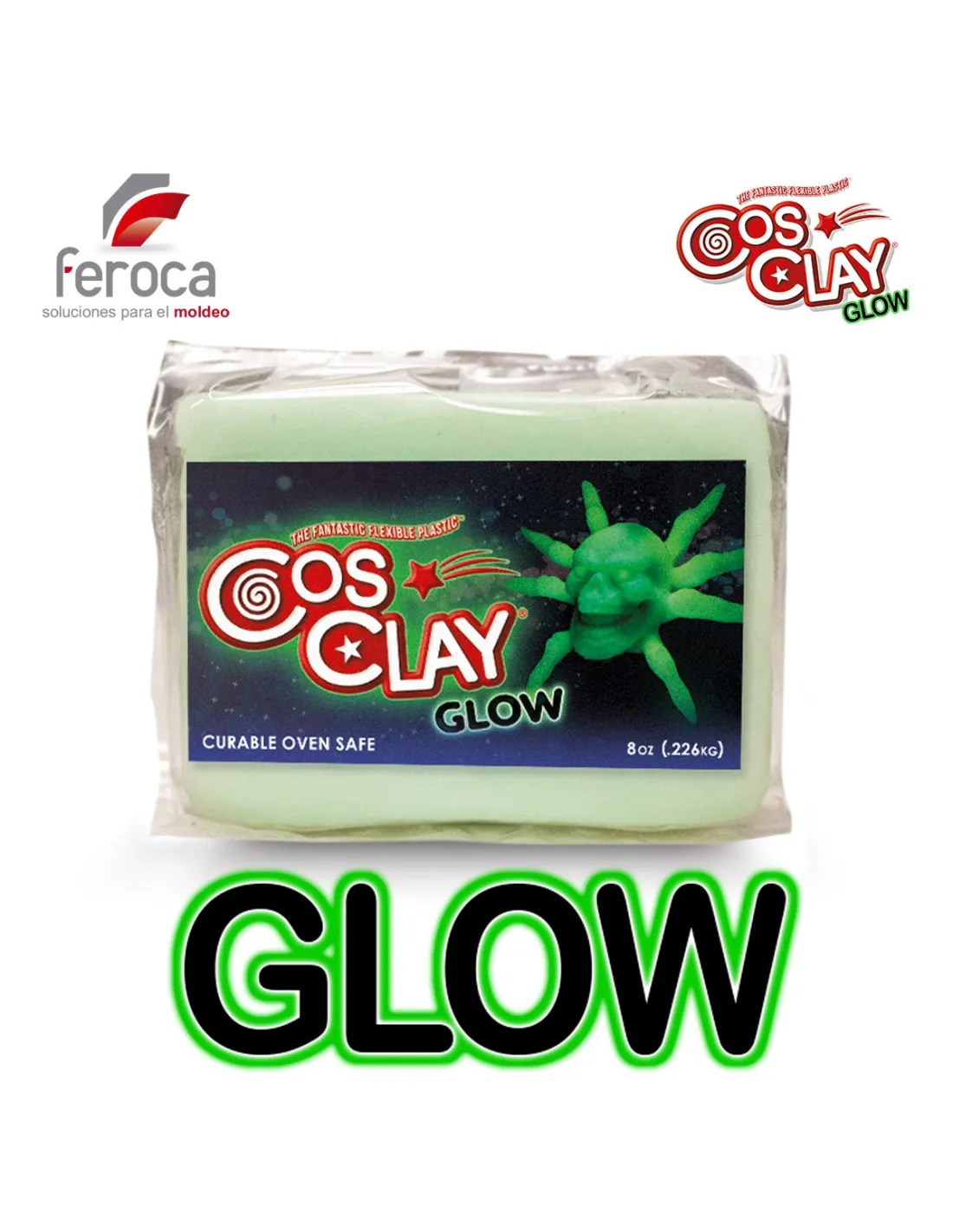
Cosclay Glow is a hybrid plastic-and-rubber polymer clay with a luminescent effect that, once baked at 135 ºC, retains real, lasting flexibility without sacrificing strength or detail. Unlike conventional polymer clays, it does not break when thin pieces are bent, making it the natural choice for Stop Motion animation, articulated figures and artistic sculpture where brittleness is a problem. The Glow variant adds a glow-in-the-dark finish, especially valued in special effects, dioramas and collectible pieces.
Technical specifications
| Parameter |
Value |
| Presentation |
227 g block |
| Curing temperature |
135 ºC (standard domestic oven) |
| Result after curing |
Flexible and resistant |
| Shrinkage / expansion |
No shrinkage or expansion |
| Material state |
100% solid (minimal volatility) |
| Variant |
Glow (luminescent effect) |
| Finish compatibility |
Acrylic paints, water-based varnishes |
What it is used for
Cosclay Glow is designed for sculptors, animators and artists who need pieces that can withstand continuous handling or must bend without breaking. The luminescent property makes it particularly attractive for atmospheric effects, collectible pieces with eye-catching finishes and any project where glow-in-the-dark is used as a visual element.
- Stop Motion characters and puppets with flexible joints
- Articulated figures and OOAK (One of a Kind) dolls
- Miniatures and diorama elements with delicate details
- Decorative and collectible pieces with luminescent effect
- Soft prototypes requiring tolerance to deformation
- Accessories and props for product photography and special effects
- Artistic sculptures with thin areas that would break with other clays
- Complement to other polymer clays such as Cosclay Sculpt Medium Firm Gray to combine rigid and flexible zones
How to use it
- Condition the material: work a piece of Cosclay Glow between your hands until it is soft and pliable. If it is very cold, a few seconds in your hands or near a moderate heat source will soften it quickly.
- Sculpt your piece: model with your hands and with sculpting tools, embossing tools or loop tools to achieve fine textures and details.
- Mix with other Cosclay if needed: you can blend it with Cosclay Sculpt Medium Firm Gray to adjust the firmness of different areas of the piece.
- Prepare the oven: preheat a domestic oven to 135 ºC. Use an oven thermometer to make sure the temperature is accurate; domestic ovens often deviate by several degrees.
- Bake the piece: place the sculpture on a baking surface (parchment paper or ceramic tile). Typical curing time is 15–30 minutes depending on the thickness of the piece. Very thick pieces may require a little more time.
- Allow to cool: remove the piece from the oven and let it cool to room temperature before handling. Do not speed up cooling with cold water.
- Finish and paint: once cool, you can sand, drill, glue or apply acrylic paints and water-based varnishes without any issues.
Usage tips
Temperature control: the critical point
The most common mistake when baking polymer clay is exceeding the recommended temperature. Above 150–160 ºC the clay can burn, darken and release unpleasant fumes. Always use an independent oven thermometer and bake in a well-ventilated space. If your oven has hot spots (most do), rotate the piece halfway through the baking time.
Internal armatures for articulated pieces
Cosclay Glow is flexible after curing, but Stop Motion pieces or articulated figures benefit enormously from an internal aluminium wire armature before sculpting. The wire provides structure and allows repeated articulation without material fatigue. Always seal the wire with the clay itself before baking to avoid internal voids.
Mixing and combining with other polymer clays
Cosclay Glow is 100% compatible with other oven-cure polymer clays. You can mix it with Super Sculpey Beige or Super Sculpey Firm Gray to adjust the hardness and final properties of different areas of your sculpture. This combination is especially useful when you need the body to be rigid while the limbs or decorative elements retain flexibility.
Frequently asked questions
What is the difference between a standard polymer clay and a flexible polymer clay?
Conventional polymer clays cure hard and rigid; thin pieces or those with slender projections tend to snap with handling. Cosclay Glow incorporates rubber components in its formulation, giving it real post-cure flexibility: you can bend limbs, wings or thin elements without them breaking — something essential for Stop Motion or articulated figures in continuous use.
What does the "Glow" effect mean and how does it work?
The Glow effect is a photoluminescent property: the material absorbs light (natural or artificial) and emits it in the dark for a period of time. No special treatment is required; simply expose the baked piece to light before turning it off. The result is especially striking in atmospheric dioramas, collectible pieces and special effects props.
Can polymer clay be painted once baked?
Yes. Cosclay Glow accepts acrylic paints and water-based varnishes without a primer in most cases. For very precise finishes or with oil paint, it is advisable to apply a thin coat of matte acrylic primer before painting. Bear in mind that very thick layers of paint over highly flexible areas may crack with repeated bending; use thin coats and varnish for greater durability.
Can I use the same oven I cook with?
Yes, although many artists prefer to have a dedicated oven for workshop materials. If you use your kitchen oven, bake in a well-ventilated space and do not exceed 135 ºC. Polymer clay baked correctly at the right temperature does not generate dangerous fumes, but exceeding the temperature can produce irritating smoke. Clean the oven afterwards if you share it with food use.
What happens if the piece has not cured properly after baking?
If the piece comes out soft or deforms when pressed after cooling, the temperature was probably insufficient or the baking time was too short. You can put the piece back in the oven without any problem; polymer clay accepts additional baking sessions. Check the actual oven temperature with an independent thermometer.
Can this clay be used to make moulds?
Cosclay Glow is formulated for sculpture and finished pieces, not for moulds. If you want to reproduce pieces sculpted with it, use platinum or tin silicones to make the mould once the piece has been baked. Bear in mind that some unbaked polymer clays can inhibit the curing of platinum silicones; always bake the piece before moulding it with addition-cure silicone.
How much material do I need for a medium-sized figure?
A 227 g block is sufficient for figures of 10–15 cm with an internal armature, as the wire takes up part of the volume. For detailed realistic heads of 8–10 cm or larger figures without an armature, more material may be needed. It is common to combine Cosclay Glow with Cosclay Sculpt Medium Firm Gray to optimise the use of the Glow material in the areas where the luminescent effect adds the most value.
Is Cosclay Glow compatible with other oven-cure polymer clays?
Yes, it is compatible with other oven-cure polymer clays. You can mix it directly with Super Sculpey Beige or Super Sculpey Firm Gray to modulate properties. Bear in mind that when mixing with non-Cosclay clays, the final flexibility will depend on the proportion of each material in the blend.