Shopping Cart


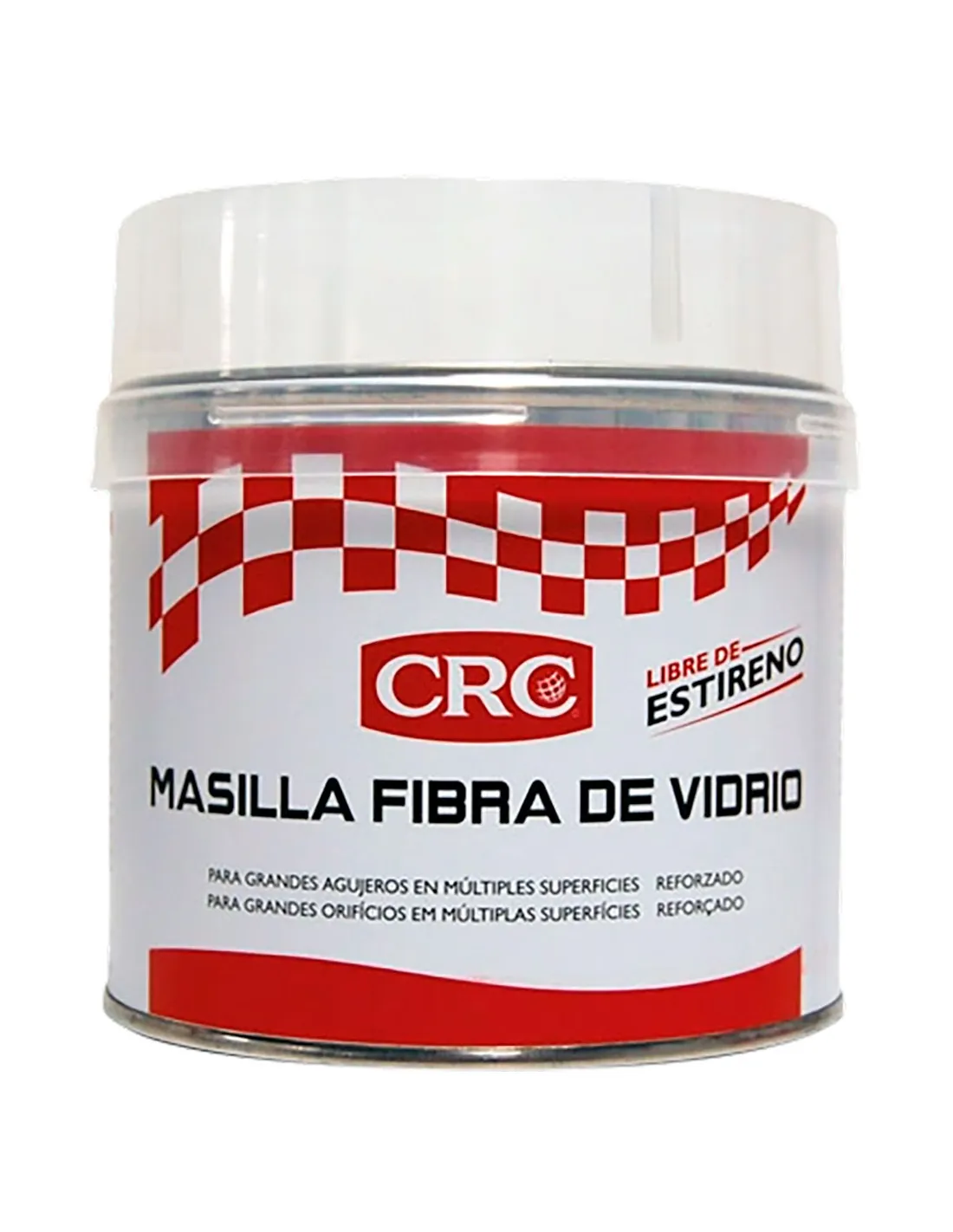
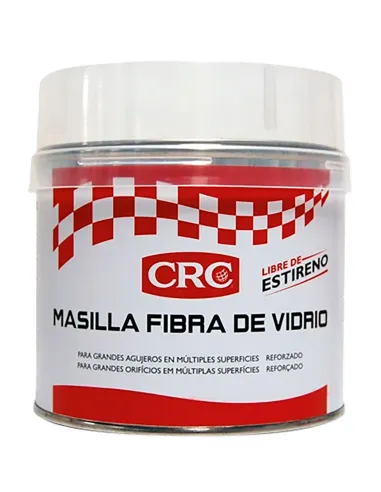
CRC Masilla de Fibra de Vidrio
301803250
€11.00
13,31 € Tax incl.
13,31 € Tax incl.
Two-component fibreglass-reinforced polyester filler. Fills holes >12 mm in metal, wood, concrete and plastics. 1 kg.
CRC Fiberglass Body Filler is a two-component polyester-based filler reinforced with fibreglass, designed for demanding structural repairs where a standard filler falls short. Its filling capacity exceeding 12 mm and its mechanical strength after curing make it indispensable in automotive workshops, construction, and industrial maintenance.
Technical specifications
| Property | Detail |
|---|---|
| Type | Fibreglass-reinforced polyester filler |
| Components | 2 (base filler + hardener) |
| Content | 1 kg |
| Filling capacity | Over 12 mm diameter |
| Application method | Manual with spatula |
| Drying | Fast |
| Post-cure finish | Sandable, paintable |
| Compatible substrates | Metal, wood, concrete, most rigid plastics |
What it's used for
This filler is designed for high-volume repairs where real mechanical strength is required. The fibreglass reinforcement provides superior cohesion compared to conventional polyester fillers, preventing cracks and sink marks when curing even in thick layers. It is the right choice when the damage is significant and the finish must withstand mechanical stress or demanding conditions.
- Bodywork repairs with through-holes, deep dents or treated rust spots
- Sealing and filling major cracks in concrete, mortar and masonry surfaces
- Rebuilding damaged, rotten or missing sections in wood
- Repair and reconstruction of broken edges and areas in rigid plastics
- Repair base prior to painting in automotive workshops or industrial maintenance
- Filling joints, service penetrations and voids in metal surfaces
- Rebuilding sculptural or prop pieces with structural damage before a fine finish with cellulosic filler
How to use it
- Prepare the surface: thoroughly clean the area to be repaired. Remove rust, grease, dust and any loose material. On metal, sand with medium-grit paper and apply a degreaser. On wood or concrete, make sure the surface is dry and free of contaminants.
- Measure out the hardener: spread the amount of filler you are going to use onto a clean, non-porous surface. Add the hardener at the ratio specified by the manufacturer (generally between 2 and 3% by weight). Too much hardener accelerates curing but can generate heat and reduce the final strength.
- Mix until homogeneous: blend the hardener into the filler with the spatula using a kneading motion, avoiding air incorporation. The mixture must show a uniform colour with no streaks of un-blended hardener.
- Apply to the damaged area: using a spatula, fill the hole or crack with pressure to ensure adhesion. For through-holes, it may be necessary to place a backing mesh on the rear face before applying the filler.
- Allow to cure: curing time depends on ambient temperature. The higher the temperature, the faster it cures. Do not force the process with excessive direct heat during the early stages.
- Sand and finish: once cured, the filler can be sanded with dry or wet sandpaper. Start with coarse grit to remove excess material and finish with fine grit before applying cellulosic finishing filler or primer.
Warning: polyester filler is a two-component product that generates an exothermic reaction when curing. Always work in well-ventilated areas. Use nitrile gloves, safety goggles and, if the space is confined or the application is prolonged, a respirator with an organic vapour filter. Avoid contact with skin and eyes. The hardener (benzoyl peroxide) is an oxidiser: keep it away from heat sources and do not mix it directly with the filler without correct measuring.
Usage tips
Working temperature
Polyester filler curing is very sensitive to temperature. Below 15 °C the process slows down considerably and the final result may be softer. Above 25 °C the working time shortens: only mix the amount you can apply within 3–5 minutes. In summer, keep the product in the shade before use.
Layered filling for large volumes
If the void to be filled exceeds 15–20 mm in depth, it is preferable to apply in two layers: a first layer to fill the bulk volume and, once cured and sanded, a second adjustment layer. This reduces the risk of polyester shrinkage generating internal stresses or surface cracks. For the final finish, a cellulosic filler will allow finer sanding and a surface better suited for painting.
Through-holes in sheet metal
On bodywork or thin sheet metal with through-holes, place a fibreglass mesh or perforated sheet as a backing support on the rear face before applying the filler. This prevents the material from falling through and allows you to build up layers with sufficient structural backing. If the damage is extensive and requires greater chemical or mechanical resistance, consider Epoxy Filler 610, which offers better adhesion to metals and improved moisture resistance.
Frequently asked questions
What is the difference between a fibreglass filler and a standard polyester filler?
Standard polyester filler is suitable for surface fills and corrections of a few tenths of a millimetre. Fibreglass-reinforced filler, like this CRC product, incorporates short fibre strands that act as internal reinforcement, allowing larger volumes (over 12 mm) to be filled without the material cracking or sinking during curing. It is the correct choice when the damage is deep or when structural strength is needed in the repair.
Can it be used over rusty surfaces?
No. The surface must be completely clean, dry and free of rust before applying the filler. Rust acts as a barrier that prevents proper adhesion and can continue spreading under the filler, ruining the repair. Treat the metal with sandpaper, an angle grinder or a rust converter and make sure you reach bare metal before applying.
How long does it take to cure before sanding?
It depends on the ambient temperature and the amount of hardener used. Under normal conditions (20–22 °C), the filler is usually ready to sand in 20–40 minutes. At lower temperatures the time increases; at higher temperatures it decreases. To check whether it is ready, press with your fingernail: if it leaves no mark and the surface has a uniform consistency, you can start sanding.
Is it suitable for outdoor use or areas exposed to moisture?
Fibreglass polyester filler is mechanically resistant, but polyester can be sensitive to prolonged moisture if it is not properly sealed and painted. For outdoor repairs, it is essential to apply a primer and a painted topcoat to protect the filler from the elements. If moisture exposure is critical, consider Epoxy Filler 610, which offers greater chemical and moisture resistance.
Can you paint directly over the cured filler?
Not directly. Once sanded, a primer must be applied before the topcoat. The primer seals the porosity of the filler, improves paint adhesion and prevents the paint solvents from attacking the surface. In automotive workshops, this step is standard and critical for a durable finish.
What should I do if the filler does not cure or remains soft?
The most common cause is too little hardener or a working temperature that was too low. Check that the hardener ratio is correct and that the mixture is completely homogeneous before applying. If the filler is already applied and soft, remove it mechanically and repeat the process with the correct dosage. Working below 10 °C can prevent curing even with the correct ratio.
Is it compatible with all plastics?
The filler is compatible with most rigid plastics, but does not bond well to flexible plastics or to polyethylene or polypropylene without prior treatment. On problematic plastics, apply a plastic-specific primer before the filler. For repairs on plastics with greater flexibility, a lightweight epoxy filler with better adhesion properties may be more appropriate.
What coverage does 1 kg of filler provide?
Coverage depends on the volume of the voids to be filled and the application thickness. As a reference, 1 kg of filler covers approximately 1 to 1.5 m² at a layer thickness of 1 mm. For spot filling of holes of several millimetres, 1 kg is sufficient for a considerable number of automotive bodywork or construction repairs.
No reviews
Tap to zoom