Shopping Cart


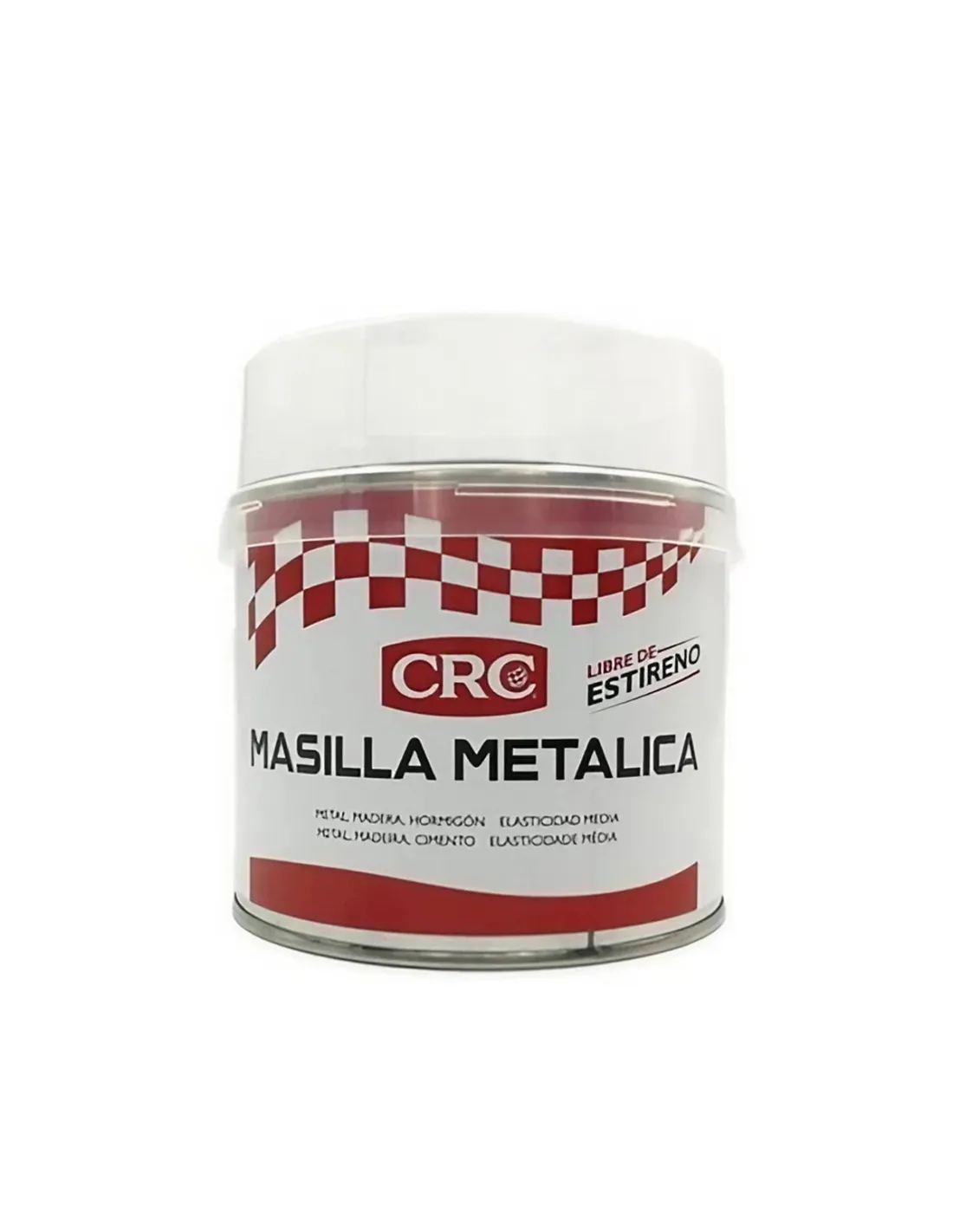
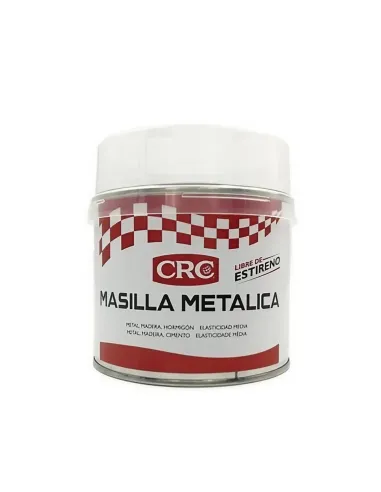
CRC Metallic Putty - 1Kg
301803100
€20.00
24,20 € Tax incl.
24,20 € Tax incl.
Two-component polyester filler with aluminium, styrene-free. Hardener ratio 2–4%, ready to sand in 20–30 min. Withstands up to 120 °C.
CRC Masilla Metálica is a two-component polyester repair filler loaded with aluminium pigments, formulated without styrene, asbestos or silicone. Designed to level, fill and restore metal, wood and concrete surfaces with real chemical and thermal resistance, leaving the area ready to sand in just 20–30 minutes at room temperature. If you need a technically serious filler for demanding workshop or on-site work, this is the option.
Technical specifications
| Parameter | Value |
|---|---|
| Type | Two-component polyester repair filler |
| Filler | Aluminium pigments |
| Styrene-free | Yes |
| Asbestos-free / silicone-free | Yes |
| Texture | Smooth and thixotropic |
| Hardener ratio | 2 – 4 % by weight |
| Time to sanding | 20 – 30 min (room temperature) |
| Chemical resistance | Acids, bleaches, water and salts |
| Thermal resistance | Up to 120 °C |
| Compatible surfaces | Metal, wood, concrete |
| Format | 1 kg |
| Applications | Industrial, automotive, professional DIY |
What it is used for
CRC Masilla Metálica is designed for structural and finishing repairs where real mechanical and chemical resistance is required. Its aluminium load makes it particularly suitable when heat resistance or compatibility with metal surfaces are job requirements.
- Filling and levelling dents, cracks and pinholes in sheet metal
- Repairing deteriorated wood components or pieces with deep breaks
- Restoring concrete surfaces damaged by impact or corrosion
- Surface preparation before painting or lacquering in automotive work
- Sealing and repairing parts exposed to moderate heat (up to 120 °C)
- Repairs in industrial environments with exposure to aggressive chemicals
- Rebuilding profiles and edges on metal or wood parts
How to use it
- Prepare the surface: clean and degrease the area to be treated. Remove rust, loose paint or dust. Sand lightly to improve mechanical adhesion.
- Measure the hardener: mix between 2 and 4 % by weight of hardener relative to the base filler. In cold temperatures, work towards the upper end of the range; in warm conditions, towards the lower end.
- Mix thoroughly: stir with a spatula on a non-porous surface until a uniform colour is achieved with no hardener streaks. Avoid incorporating air.
- Apply the filler: spread with a flexible spatula over the repair area. Apply in layers if the fill is deep, allowing partial cure between coats.
- Wait for cure: at room temperature, the filler will be ready to sand in 20–30 minutes. Do not force the process with direct heat during the first few minutes.
- Sand and finish: start with medium-grit sandpaper (P80–P120) and refine progressively to the desired finish. The surface can be painted, lacquered or primed without issues.
Warning: CRC Masilla Metálica contains an organic peroxide hardener. Always work with nitrile gloves, safety glasses and in well-ventilated spaces. Do not mix the hardener directly into the base filler tin: always dispense onto a separate working surface. Avoid contact of the hardener with clothing, skin and eyes. In case of eye contact, rinse with plenty of water and seek medical advice.
Usage tips
Temperature and working time
Ambient temperature directly affects working time and cure. Below 15 °C the cure slows down considerably; above 25 °C the working time shortens. Adjust the hardener ratio within the 2–4 % range according to workshop conditions: less hardener in summer, more in winter. Do not apply the filler to surfaces below 5 °C.
Deep fills and high-volume repairs
For fills deeper than 5–6 mm, apply in several layers allowing the previous one to gel before adding the next. This reduces shrinkage and improves inter-layer adhesion. If the gap is very large, you can first use a fibreglass filler as a structural base and finish with CRC Masilla Metálica.
Finishing and paint compatibility
Once sanded, the surface can receive primer, paint or lacquer directly. Because it is formulated without silicone, it does not cause repainting problems or fish-eyes in subsequent paint, a common issue with conventional fillers. If the final finish is painted, make sure the filler is fully cured before applying primer.
Frequently asked questions
How much hardener should be added exactly?
The correct ratio is between 2 and 4 % by weight of the base filler. For 100 g of filler, add between 2 and 4 g of hardener. Using less slows the cure and can leave uncured areas; using more speeds up the process too much and can generate bubbles or uneven cure. With CRC Masilla Metálica, always work within that range and adjust according to ambient temperature.
Can it be applied over rusty surfaces?
Not directly. Before applying the filler, remove all rust with sandpaper, an abrasive disc or a chemical rust remover. The adhesion of any polyester filler over loose rust is poor and the repair will eventually lift. Once the metal surface is clean, sand lightly and apply the filler without delay to prevent the metal from rusting again.
How long does it take to fully cure?
At room temperature (20–23 °C), CRC Masilla Metálica is ready to sand in 20–30 minutes. Full cure, which allows painting or lacquering, is reached in approximately 1–2 hours under normal conditions. In cold weather, the process can take considerably longer. Applying direct heat during the first minutes of cure is not recommended to avoid bubbles.
Does it withstand the heat from engines or industrial parts?
CRC Masilla Metálica withstands up to 120 °C continuously, making it suitable for areas close to engines, pipes or industrial parts with moderate temperatures. For applications exposed to higher temperatures, specific products with greater thermal resistance should be considered.
Is it compatible with all types of paint?
Yes. Being formulated without silicone, CRC Masilla Metálica is compatible with primers, water-based and solvent-based paints, lacquers and enamels. The absence of silicone eliminates the risk of fish-eyes or adhesion problems when repainting, which is especially important in automotive work or on parts that will have a high-quality finish.
Can it be dry-sanded or only wet-sanded?
The filler can be perfectly dry-sanded once cured, which makes workshop use straightforward. For finer finishes, especially in the last passes before priming, wet sanding with fine sandpaper (P220 or higher) provides a more uniform finish and reduces dust generated.
How long does the product last unopened?
Stored in a cool, dry place away from heat sources and direct light, CRC Masilla Metálica maintains its properties for the period indicated by the manufacturer on the packaging. Once opened, close the lid tightly to prevent moisture and contaminants from entering. The hardener should likewise be stored sealed and kept away from the base filler.
Can it be used on wood or only on metal?
CRC Masilla Metálica is compatible with metal, wood and concrete. On wood, make sure the surface is clean, dry and lightly sanded to improve adhesion. On very porous woods or those with prior surface treatments (varnishes, oils), it may be necessary to sand down to bare wood before applying the filler.
No reviews
Tap to zoom