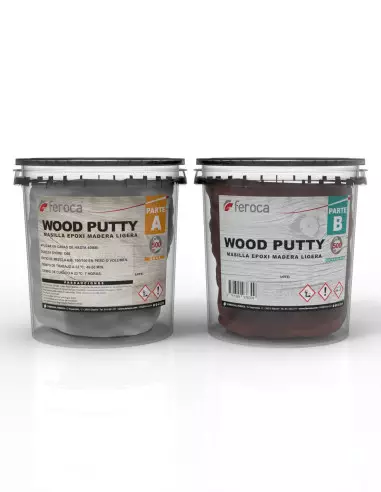
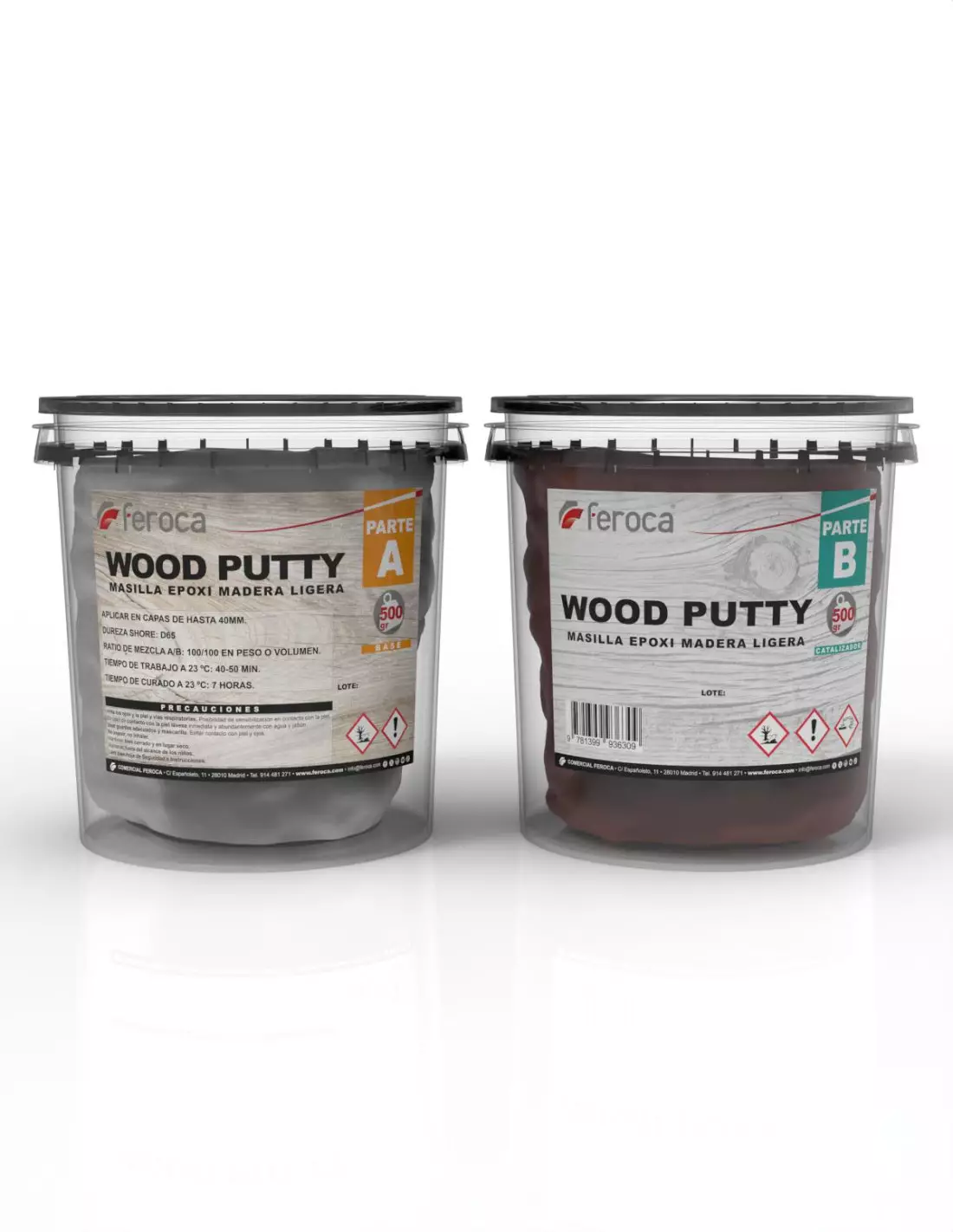
Wood Putty is a two-component epoxy putty with very low density, designed for direct sculpting, repair and fabrication of lightweight parts with a wood-like finish. Once cured it is rigid, sandable, drillable and millable, and its density is so low that it floats on water, making it the go-to option when the final weight of the part is a critical factor.
Technical specifications
| Parameter |
Value |
| Type |
Two-component epoxy putty |
| Cured colour |
Light brown (wood-like) |
| Mix ratio by volume |
1A : 1B (100:100) |
| Working time |
40-50 minutes |
| Full cure time |
7 hours at room temperature |
| Cured density |
Very low — floats on water |
| Cured finish |
Rigid, sandable, drillable, millable, paintable |
| Application |
By hand, with spatula or sculpting tools |
What it is used for
Wood Putty is designed for work that requires a lightweight, machinable material with a good surface finish. Its low density and wood-like behaviour make it especially useful in the following areas:
- Fishing lure making: optimal buoyancy, easy carving and subsequent painting
- Sculpture and direct modelling without the need for a mould
- Lightweight mother moulds and shells for silicone moulds
- Filling and repairing parts made of wood, foam or composites
- Large sculptures applied over expanded polystyrene (EPS foam)
- Lightweight cores in epoxy laminates with fibreglass or carbon fibre
- Prototypes and models requiring subsequent machining (lathe, milling machine, CNC)
- Repair of carved wood pieces and picture frames in restoration work
How to use it
- Prepare the surface: clean the substrate removing dust, grease and loose debris. For porous woods or foams, a prior wipe with isopropyl alcohol improves adhesion. You can use Isopropyl Alcohol 99.9% for this cleaning step.
- Put on your PPE: always work with nitrile gloves and adequate ventilation.
- Measure 1:1 by volume: take equal parts by volume of component A and component B. Do not measure by eye: use graduated containers or cut the same length from each stick if the product comes in stick format.
- Mix thoroughly: knead both components with gloved hands or a spatula for at least 2-3 minutes until a uniform colour with no streaks is achieved. Any unmixed area will remain uncured.
- Apply and sculpt: you have between 40 and 50 minutes of working time. Apply the putty to the surface and shape it with sculpting tools or by hand. Lightly moisten your fingers or tools with water to prevent sticking.
- Wait for cure: leave at room temperature for a full 7 hours before machining, sanding or painting.
- Machine and finish: once cured, the part can be sanded, drilled, milled or painted with any compatible epoxy, acrylic or water-based paint.
Warning: two-component epoxy putties can be irritating to skin and respiratory tract during mixing and curing. Always work with nitrile gloves, in well-ventilated spaces and, if you are going to sand or machine the cured part, wear a particle mask. Consult the product SAFETY DATA SHEET before use.
Usage tips
Temperature and working time
The higher the ambient temperature, the shorter the available working time. In summer or in warm workshops (above 25 °C), work in small portions and have the shape planned before you start mixing. Below 18 °C curing can be significantly extended; in that case, a gentle heat source (40-50 °C) applied to the part will speed up the process without affecting the result.
Application on foams and porous substrates
Wood Putty bonds well to expanded polystyrene (EPS foam) and polyurethane foam, making it an excellent exterior finish for large lightweight sculptures. Apply a thin first coat as a primer and let it partially harden (around 20-30 minutes) before adding the final sculpting layer: this prevents the weight of the fresh putty from deforming the soft core. If you need greater structural strength in laminated parts, the fibreglass filler can complement it in higher-load areas.
Surface finish and painting
Once cured and sanded, the surface accepts water-based primers, acrylic paints and synthetic enamels without any issues. If the goal is to imitate wood grain, apply a clear primer coat and use dry brush painting techniques with brown and ochre tones: the porous texture of the cured material takes subtle colour very well. For fishing lure parts, seal thoroughly with a waterproof two-component varnish before using them in water.
Frequently asked questions
Can this putty be used to repair real wood?
Yes. Wood Putty bonds well to clean, dry wood. Clean the area to be repaired, remove dust and grease, mix the required amount and apply with a spatula. Once cured, sand flush and paint to match the rest of the piece. Its light brown tone helps visual integration without the need for paint.
How much actual time do I have to work the mix before it hardens?
At room temperature (20-22 °C) you have between 40 and 50 minutes from the moment you finish mixing. After that point the putty starts to stiffen and cannot be reworked. Plan the shape before mixing and work with portions you can finish within that time.
Is it safe to use this putty on expanded polystyrene?
Yes. Unlike polyesters, two-component epoxy putties such as Wood Putty do not contain aggressive solvents that attack expanded polystyrene (EPS foam). You can apply it directly onto the foam as a finishing or sculpting layer without the substrate dissolving.
Can it be sanded and painted once cured?
Absolutely. After the 7-hour cure, Wood Putty behaves like dense wood: it accepts wet-and-dry sandpaper, files, drill bits, milling cutters and craft knives. The surface takes primers, acrylic paints, lacquers and enamels. For parts that will be in contact with water (lures, outdoor elements) apply a final waterproof seal.
What happens if I do not mix the two components properly?
Poorly mixed areas will remain uncured: soft, sticky or with a different appearance. That is why it is essential to knead until a completely uniform colour with no streaks from either component is achieved. If you detect uncured areas after the indicated time, there is no way to recover them: you will have to remove the material and reapply.
Can I speed up curing by applying heat?
Yes. A moderate heat input (40-50 °C) shortens the cure time without compromising the final properties. You can use a heat lamp, a workshop heater or even a domestic oven at low temperature. Avoid exceeding 60 °C during curing to prevent internal stress in the part.
Can it be used to make fishing lures?
It is one of its most common applications. Wood Putty has such a low cured density that it floats on water, making it ideal for surface lures. It also accepts carving with a craft knife or gouges and painting with an airbrush or brush. Always seal the finished part with a waterproof varnish before using it in water.
Do I need a release agent if I use a mould to shape it?
It depends on the mould material. With silicone moulds no release agent is needed, as the epoxy putty does not bond to silicone. With wood, plaster or plastic moulds it is advisable to apply a release agent or at least a coat of petroleum jelly to facilitate demoulding without damaging the part.