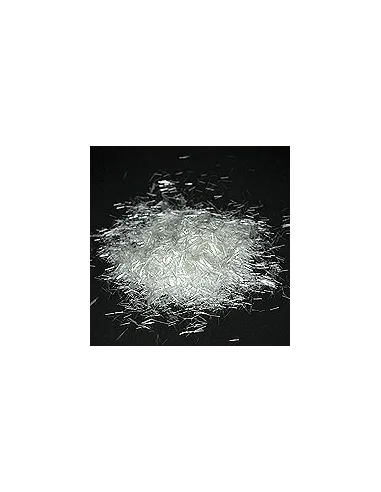
6 mm chopped strand fiberglass is a high-performance structural filler designed to reinforce polyester, epoxy and acrylic resins. Its cut length is optimised for homogeneous dispersion throughout the polymer matrix, increasing the mechanical strength and impact resistance of the resulting laminate or putty. If you need to add reinforcement filler with full control over fibre ratio and orientation, this is your material.
Technical specifications
| Parameter |
Value |
| Material |
E-glass fibre |
| Cut length |
6 mm |
| Format |
1 kg bag |
| Compatibility |
Polyester, epoxy and acrylic resins |
| Application |
Structural reinforcement filler, fibre putties |
What it's used for
6 mm chopped strands are incorporated directly into the liquid resin before application or gelation, acting as dispersed reinforcement throughout the entire mass. They are especially useful when rigidity and crack resistance are needed without resorting to traditional fabrics or matting. They also allow you to formulate structural filling putties with very good mechanical properties.
- Reinforcement of polyester resin laminates in complex geometry parts
- Reinforcement filler in epoxy resins for structural parts
- Manufacturing fibre putties with high impact resistance by mixing the strands in high proportion with polyester resin
- Repair of cracks and weakened areas in existing fibreglass laminates
- Reinforcement of cast parts in acrylic resins
- Artisanal and semi-industrial composite projects requiring isotropic reinforcement
- Spray-up applications without the need for a chopper gun
How to use it
- Prepare the chosen resin (polyester, epoxy or acrylic) in a clean, dry container, following the manufacturer's recommended ratios.
- Add the chopped strands to the uncatalysed resin. The usual ratio for moderate reinforcement is 20–30% by weight relative to the resin; for structural putties you can go up to 50% or more.
- Mix with a spatula or paddle until the strands are evenly distributed throughout the entire mass, avoiding lumps or fibre-free areas.
- Add the catalyst or hardener at the correct ratio and mix again carefully to avoid introducing air bubbles.
- Apply the mixture to the mould or repair area before gelation begins. You can spread it with a spatula or pour it depending on the geometry of the part.
- Allow to cure for the time required based on the resin used. Do not demould before the part has reached the appropriate hardness.
- Once cured, the part can be sanded, painted or post-processed in the usual way.
Usage tips
Ratios according to end use
For light reinforcement integrated into a fluid laminate, work with low ratios (15–25% by weight). If your goal is to create a thick, structural putty, increase the ratio to 50% or even more. Bear in mind that the higher the fibre content, the more viscous and difficult to handle the mixture will be, so it may be helpful to slightly preheat the resin or work at a higher ambient temperature to improve flow. If you also need a thixotropic effect to prevent sagging, you can add AT2 silica gel to the mixture.
Combine with other fillers to adjust properties
Chopped strands can be combined with other fillers to fine-tune the behaviour of the final mixture. Adding hollow glass microspheres reduces the weight of the part without sacrificing too much strength. For a white, lightweight filling filler with good workability, you can incorporate marble powder into the resin. Experiment with ratios in small quantities before applying to the final part.
Storage and handling
Store the strands in their original bag, tightly sealed, in a dry place away from moisture. Fibreglass can irritate the skin and mucous membranes if handled without protection: use nitrile gloves, an FFP2 particulate mask and safety goggles when handling. If you are working with polyester resins, ensure good ventilation in the workspace to prevent styrene build-up. After full cure, the material is inert and safe.
Frequently asked questions
What types of resin are these strands compatible with?
6 mm chopped strand fiberglass is compatible with polyester resins (including orthophthalic, isophthalic and DCPD types), epoxy resins and acrylic resins. In all cases, the fibre sizing promotes adhesion with the polymer matrix, ensuring good load transfer between fibre and resin.
What fibre ratio should I add to the resin?
It depends on the application. For general reinforcement integrated into a fluid laminate, a ratio of 15–30% by weight relative to the resin is recommended. For manufacturing dense structural putties, you can go up to 50% or more. The higher the ratio, the more viscous and difficult to apply the mixture will be, so it is worth adjusting the proportion according to the geometry and application method.
Can they be used to make repair putties?
Yes, this is one of their most common applications. Mixing chopped strands in high proportion with polyester resin produces a fibre putty with excellent impact and crack resistance, ideal for repairing damaged laminates, filling areas with material loss, or creating localised reinforcements in fibreglass parts.
What is the difference between chopped strands and fibreglass mat?
Mat is a sheet of short fibres bonded by a binder, designed for use in layer-by-layer lamination. Chopped strands, on the other hand, are mixed directly into the liquid resin to create an isotropically reinforced filler (with no preferred orientation). Chopped strands are more versatile for putties, fillers and castings, while mat is better suited for flat or curved laminates with layer-controlled thickness.
Can they be combined with other fillers such as microspheres or silica?
Yes, absolutely. Combining chopped strands with hollow glass microspheres reduces the weight of the finished part. Adding AT2 silica gel increases the thixotropy of the mixture, preventing it from sagging in vertical applications. These combinations are common in composite workshops and boat repair.
What protection do I need when working with fibreglass?
Loose fibreglass can irritate the skin, eyes and respiratory tract. It is recommended to use nitrile gloves, safety goggles and an FFP2 particulate mask during handling and mixing. Once cured in the resin matrix, the material is inert and poses no contact risk.
How far does a 1 kg bag go?
Yield depends on the filler ratio you use. At a ratio of 25% by weight relative to the resin, 1 kg of chopped strands can reinforce 4 kg of resin. For 50% putties, one bag covers 2 kg of resin. In spot repair projects, one bag can cover multiple interventions, as the material does not expire if kept dry and protected from moisture.
Can it be used for manual spray-up without a chopper gun?
Yes. Unlike the industrial spray-up process (which uses continuous roving chopper guns), 6 mm chopped strands already come at the right length to be incorporated directly by hand into the resin. This makes them ideal for small workshops and semi-professional use without specialised equipment.