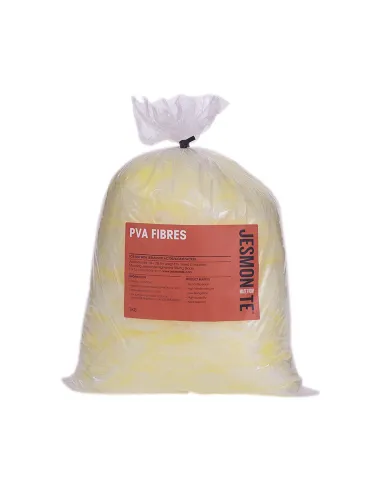
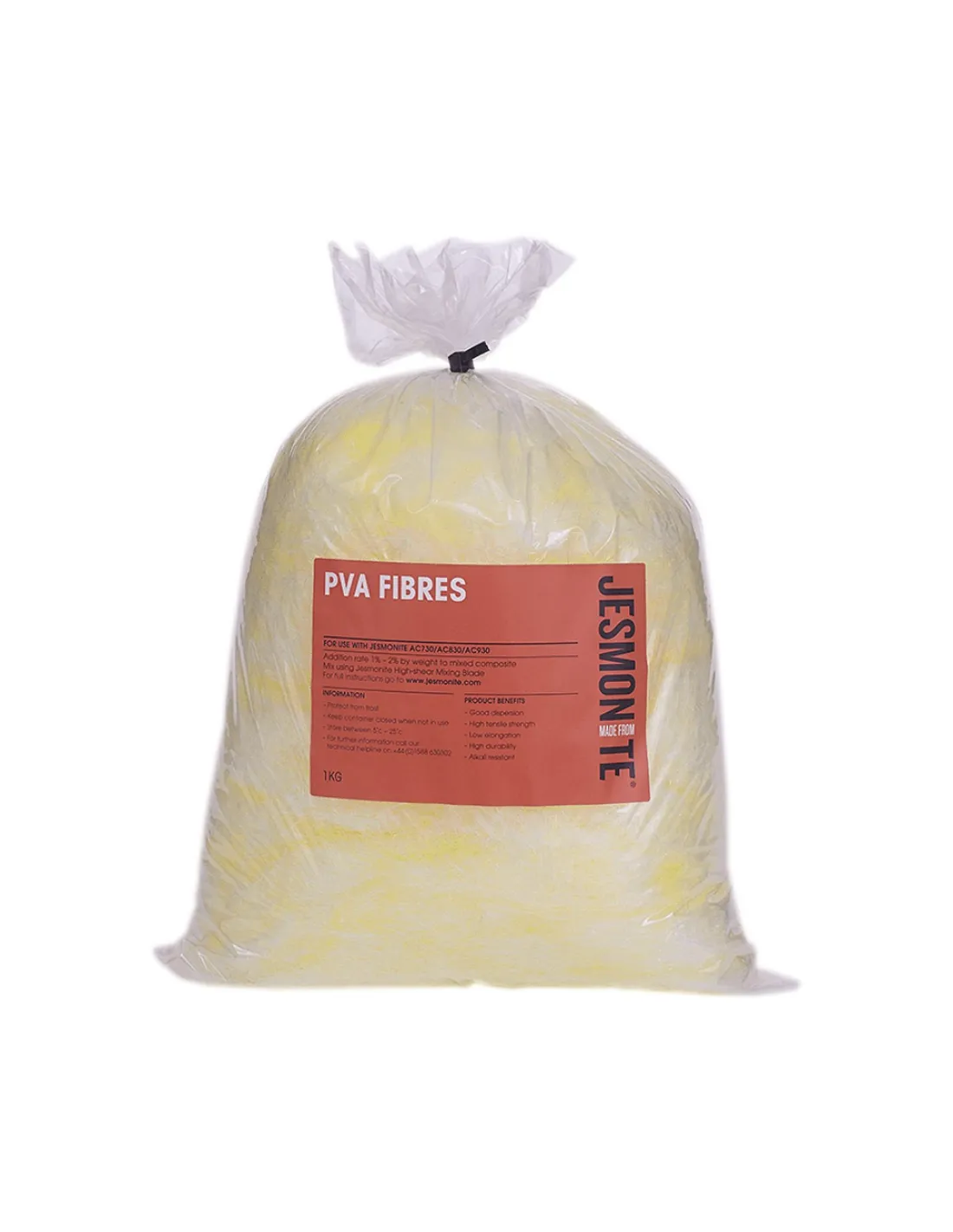
PVA (polyvinyl alcohol) fibres are a synthetic reinforcement specifically designed for polymer-modified cement systems such as Jesmonite AC100. They combine high mechanical strength, low elongation and exceptional chemical adhesion to the cementitious matrix, making them the most efficient alternative to traditional fibreglass reinforcement in acrylic cement applications.
Technical specifications
| Parameter |
Value |
| Material |
Synthetic polyvinyl alcohol (PVA) |
| Format |
Short-cut fibres |
| Weight per pack |
1 kg |
| Addition ratio |
2 g – 10 g per mix |
| Compatibility |
Jesmonite AC100, polymer-modified cements |
| Solvents / VOC |
Solvent-free, VOC-free |
| Storage temperature |
5 °C – 25 °C |
| Storage |
Keep sealed, avoid freezing |
What it is used for
PVA fibres are designed to internally reinforce polymer-modified cement mixes, increasing their structural integrity without adding significant weight or altering the mixing process. They are particularly valuable when the finished piece will be subjected to demanding conditions or outdoor exposure.
- Internal reinforcement of castings with Jesmonite AC100 for decorative and architectural pieces
- Improved impact resistance in panels, sculptures and outdoor pieces
- Protection against freeze-thaw cycles in outdoor installations
- Replacement of fibreglass fabric in thin castings where laminating is not viable
- Reinforcement of cementitious compounds with Acrystal Prima + Basic Crystal
- FX and set design applications requiring lightweight yet strong cementitious pieces
How to use it
- Weigh the required amount of PVA fibres according to the desired ratio: between 2 g and 10 g per mix. The higher the ratio, the greater the final stiffness and strength.
- Pour the liquid component of the cementitious system (for example, the liquid from Jesmonite AC100) into the mixing container.
- Add the PVA fibres directly to the liquid before incorporating the powder base. This order is key to achieving uniform dispersion.
- Mix with a suitable mixing paddle until the fibres are completely dispersed with no lumps or clumps visible.
- Add the powder base following the instructions for the chosen cementitious system and continue mixing until a homogeneous mass is obtained.
- Pour or apply the mix into the mould in the usual way. The fibres do not alter the working time of the base material.
- Allow to cure under normal conditions. Once demoulded, the piece will show significantly improved fracture resistance and thermal shock resistance.
Usage tips
Dosage by application
Use low doses (2–4 g) for interior decorative pieces where workability and surface finish are the priority. Increase the dose up to 8–10 g for outdoor pieces, especially in cold climates or where there is a risk of frost, where resistance to fracture from ice expansion is critical.
Correct fibre dispersion
The most common mistake is adding the fibres together with the powder: they form lumps that do not dissolve and create weak points. Always add to the liquid first and mix thoroughly before incorporating the base. If you are using a retarder to extend working time, mix it into the liquid before the fibres as well.
Storage and preservation
PVA is sensitive to freezing: below 0 °C the fibres can clump together irreversibly. Always store between 5 °C and 25 °C in a tightly sealed container to prevent absorption of ambient moisture. A 1 kg pack goes a long way; seal it carefully after each use.
Frequently asked questions
Can these fibres be used with any cement system?
They are optimised for acrylic polymer-modified cements, such as Jesmonite AC100 or the Acrystal systems. Their chemical adhesion to the polymeric binder is what gives them their effectiveness. In conventional Portland cements without a polymer component, the improvement is lesser and the result less predictable.
Do these fibres completely replace fibreglass fabric?
It depends on the application. In solid castings and complex geometries where laminating a fabric is not viable, PVA fibres are the most practical solution. For laminates with alternating layers of mix and reinforcement, fibreglass fabric remains more efficient. In many projects both are used: PVA fibres in the mix and fabric in the outer laminate layers.
How much does strength increase with the use of these fibres?
The improvement is especially notable in impact fracture resistance and freeze-thaw cycles. The fibres act as microcrack bridges: when the piece begins to crack, the fibres dissipate the stress and halt propagation. Compressive strength improves more modestly; the main benefit lies in toughness and durability under severe weather conditions.
Do the fibres affect the surface finish of the piece?
With doses within the recommended range (2–10 g) and good prior dispersion in the liquid, the fibres do not affect the surface finish in contact with the mould. At very high doses or with poor dispersion, visible filaments may appear on the surface. If surface finish is critical, work with the minimum dose and ensure thorough mixing.
Can they be combined with fillers or additives?
Yes. PVA fibres are compatible with common fillers such as hollow glass microspheres to lighten the piece, or with silica gel AT2 to adjust mix viscosity. Add the fibres to the liquid first, then the remaining additives, and finally the powder base.
Do the fibres alter the working time of the mix?
No. PVA fibres are inert with respect to the curing reaction of the polymer cement; they neither accelerate nor retard setting. If you need more working time, use the specific retarder for the system you are using.
Are any special precautions required when handling them?
PVA fibres contain no solvents and emit no VOCs. However, as they are short synthetic fibres, it is advisable to work in a ventilated space and wear a particle mask to avoid inhaling airborne fibres during weighing and dosing. Avoid contact with eyes.
How much product do I need?Calculate the exact amount before buying and avoid wasting material.
Go to the calculator →