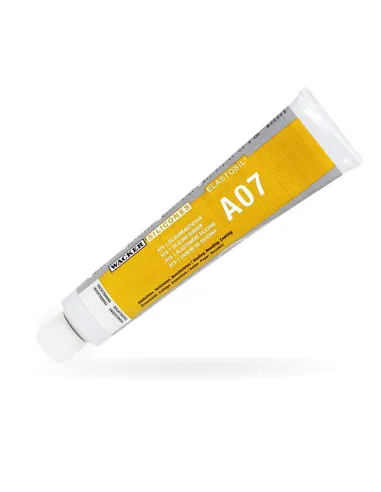
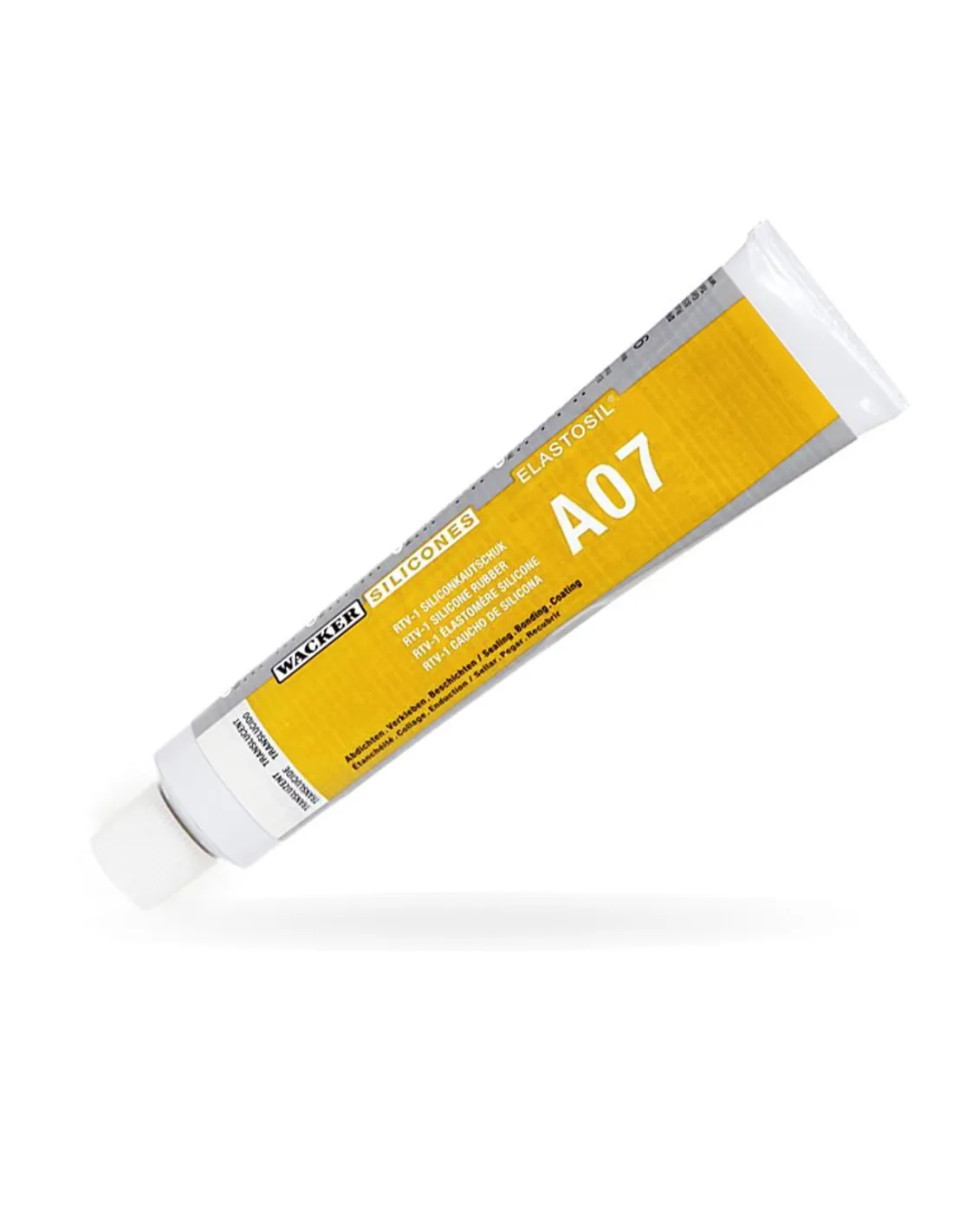
Elastosil A07 is a single-component transparent silicone with high flowability, designed as a flexible adhesive for repairing silicone moulds and parts, and as a base for formulating silicone paints on any already-cured substrate. It cures by ambient moisture with no catalyst required, and its transparency makes it ideal for applications where the colour of the adhesive cannot interfere with the final result.
Technical specifications
| Parameter |
Value |
| Type |
Single-component silicone (1K), moisture cure |
| Colour |
Transparent |
| Consistency |
Very fluid |
| Container |
90 ml |
| Compatibility |
Already-cured tin (condensation) and platinum (addition) silicones |
| Compatible thinners |
Naphtha or hexane |
What it is used for
Elastosil A07 solves two common workshop problems with silicone: bonding and repairing already-cured silicone parts, and painting silicone surfaces with pigment. Being extremely fluid, it penetrates well into cracks and joints, and once cured it forms an elastic, flexible film that is compatible with the silicone substrate.
- Repair of broken or torn silicone moulds
- Bonding and consolidation of silicone prosthetics, masks and special effects
- Intrinsic silicone painting: thinned with Naphtha or hexane and pigmented, applied over any cured silicone
- Sealing pores or small surface defects in silicone parts
- Flexible bonding between silicone parts in special effects and animatronics applications
- Joining silicone inserts or pieces in prosthetics for film and theatre
How to use it
- Make sure the surfaces to be joined or repaired are clean, dry and free of grease or release agent. If the parts have been in contact with release agent, clean them thoroughly with solvent before applying.
- If using it as an adhesive or repair agent, apply a thin layer of Elastosil A07 directly onto one or both surfaces using a spatula, brush or syringe.
- Press the parts together and maintain light pressure for the first few minutes to ensure contact.
- Allow to cure at room temperature with normal humidity. Surface cure is fast; through-cure depends on layer thickness and ambient humidity.
- If using it as a silicone paint, thin the A07 with Naphtha or hexane to the desired viscosity, add pigment and apply by brush or airbrush over the already-cured silicone surface.
- Allow the solvent to evaporate completely before handling the painted piece.
Usage tips
Thinning for silicone painting
The more you thin the A07 with Naphtha or hexane, the more translucent the pigment layer will be. For intense colours, reduce the solvent ratio. For glazes and skin effects, work with very thin, overlapping layers. Always work in a well-ventilated space when using solvents.
Ambient humidity and cure time
Elastosil A07 cures exclusively by contact with moisture in the air. In dry environments or with thick layers, through-cure may take several hours. If you need to speed up the process, you can slightly increase ambient humidity with a humidifier. Do not apply thick layers all at once: work in thin layers to ensure even curing.
Container storage
After each use, clean the cap and nozzle thoroughly and seal the container airtight. A07 cures by moisture, so any entry of humid air into the container may cause it to start gelling. If the surface of the product inside the container has cured, remove it before using the product underneath, which is normally still in good condition.
Frequently asked questions
Can I use this silicone adhesive on already-cured platinum silicone?
Yes. Elastosil A07 is compatible with both already-cured tin (condensation) and platinum (addition) silicones. Being a single-component moisture-cure product, it does not interact with the cure system of the underlying silicone.
Does it need a catalyst to cure?
No. Elastosil A07 is single-component and cures exclusively by ambient moisture. No mixing or additional catalyst is required. If you need to accelerate the cure of a different two-component silicone, products such as the Curing Agent 81 VF are designed for that purpose, but do not apply to the A07.
What solvent can be used to thin it for painting silicone?
The recommended solvents are Naphtha (petroleum ether 40-60) or hexane. Both are light aliphatic solvents that evaporate quickly and do not degrade the silicone. Avoid polar solvents such as acetone or alcohol, as they can affect pigment adhesion.
What pigments can I use to paint silicone?
Use specific silicone-compatible pigments. Pigments in silicone oil are the most common. Avoid pigments containing sulphur or alkyd bases, which could interfere with future applications over platinum silicones.
Can it be applied in thick layers?
This is not ideal. As it cures by ambient moisture, thick layers take much longer to cure internally and may remain soft at the core. It is recommended to work in successive thin layers, allowing each one to cure before applying the next.
How do you clean the brush or tool before it cures?
Before it cures, clean tools with Naphtha or hexane. Once cured, silicone cannot be dissolved with solvents; it would need to be removed mechanically.
Can I increase the viscosity of the A07 for vertical applications?
Elastosil A07 is by nature very fluid. If you need a thicker silicone adhesive for vertical surfaces or ceilings, consider adding Thixo Additive in a small proportion to increase thixotropy and prevent sagging.
Is it suitable for bonding silicone to other materials such as foam or latex?
A07 bonds well to cured silicone. Adhesion to other materials such as foam or fabric may be functional, but for structural bonds on non-silicone substrates, a preliminary test is recommended. For bonds between very different materials, also consider the cyanoacrylate adhesives in the Feroca catalogue, such as Ciano Normal or Ciano muy Líquido, depending on the type of bond.