Shopping Cart


Profile EVA Half Shank 1 meter
208261010
€4.00
4,84 € Tax incl.
4,84 € Tax incl.
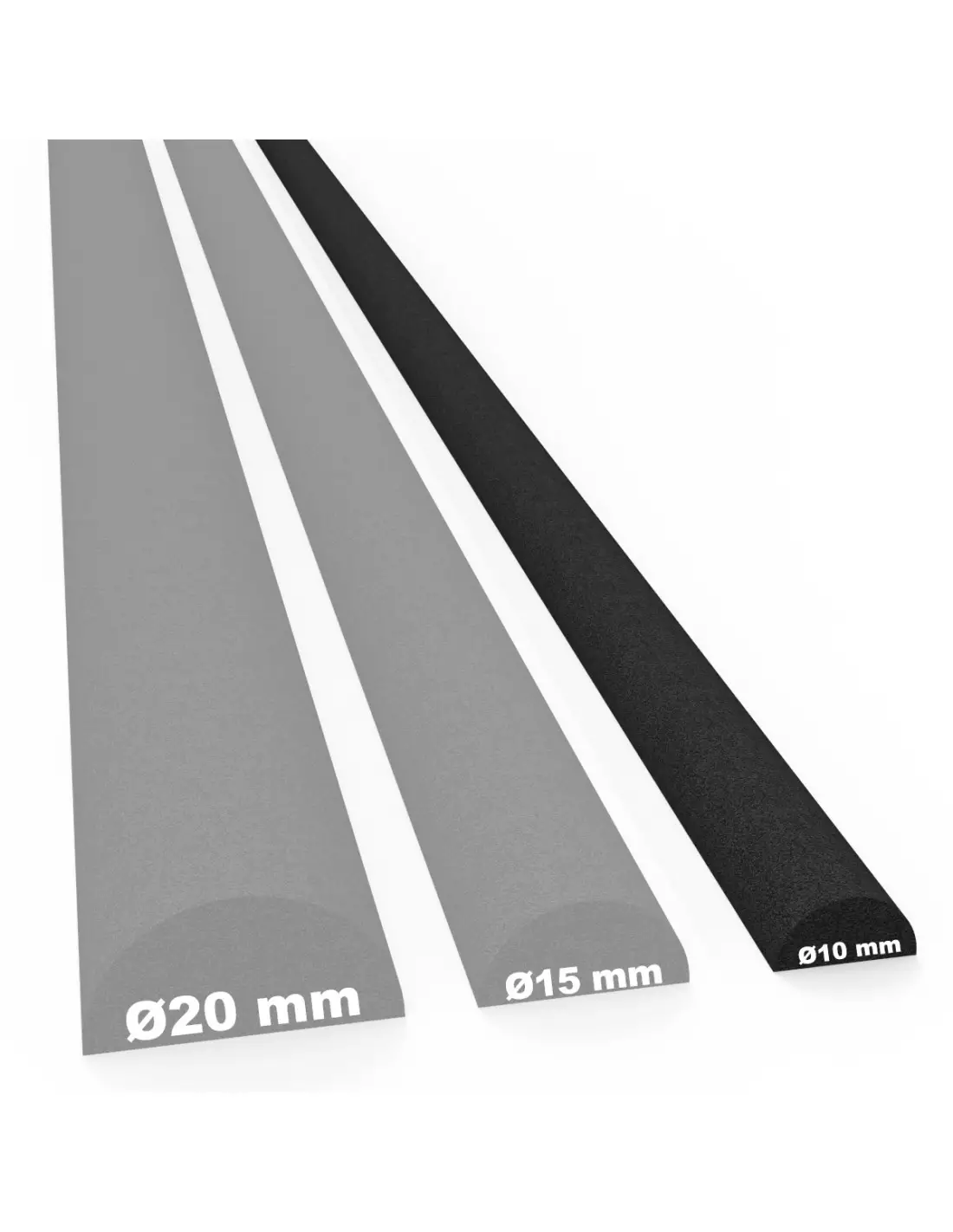
Prefabricated EVA half round profile, 1 m. Thermoformable, lightweight and easy to cut. Available in Ø10, Ø15 and Ø20 mm for trims and edge finishing in cosplay.
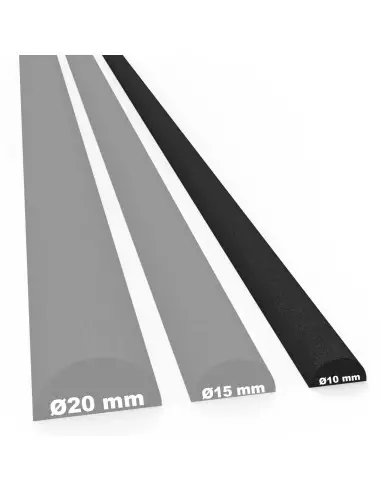
The EVA Half Round Profile is a prefabricated EVA foam moulding with a semicircular cross-section, designed to add trims, raised edges and smooth transitions to armatures, helmets and props without needing to carve from scratch. Lightweight, flexible and thermoformable with gentle heat, it conforms effortlessly to curves and complex surfaces. Available in three diameters (Ø10, Ø15 and Ø20 mm) in 1-metre lengths per unit.
Technical specifications
| Feature | Value |
|---|---|
| Material | EVA Foam (Ethylene-Vinyl Acetate) |
| Profile | Half round |
| Available diameters | Ø10 mm / Ø15 mm / Ø20 mm |
| Length | 1 metre per unit |
| Hardness | 30–35 Shore A |
| Thermoformable | Yes, with a heat gun at low temperature |
| Compatible adhesive | Contact cement (recommended), cyanoacrylate (short sections) |
| Machinable | Yes: cutting, sanding, bevelling |
What it is used for
The half round profile is designed to add volume, continuity and a professional finish to pieces made from EVA sheets. Its semicircular cross-section creates elegant, smooth transitions — ideal for separating areas, marking design lines or raising edges without complex cuts.
- Perimeter trims on cosplay and LARP armatures
- Raised edges and finishing details on helmets, shoulders and chest plates
- Smooth transitions between pieces or panels of thicker EVA
- Decorative ribs on swords, shields and props
- Separations and design lines in sci-fi, fantasy or medieval aesthetics
- Joint concealment for visual continuity across the build
- Detailing of housings, panels and false piping on props and set pieces
How to use it
- Measure and cut: Calculate the required length on the piece and cut the profile with a sharp craft knife or scissors. For angles and corners, make 45° mitre cuts.
- Thermoform if needed: Apply gentle heat with a heat gun to soften the profile and conform it to curved surfaces. Hold the shape until it cools and sets.
- Prepare the surface: Make sure the bonding area on the EVA base piece is clean, dust-free and well levelled to maximise adhesion.
- Apply adhesive: Use contact cement on both surfaces (profile and base), allow the solvent to flash off according to the adhesive instructions, then press together firmly. For very short or specific sections, cyanoacrylate is also suitable.
- Finish the edges: Once bonded, you can lightly sand the ends or bevel them for an even cleaner transition with the base sheet.
- Seal and paint: Apply a coat of EVA-compatible sealer before painting to achieve a uniform, long-lasting finish.
Usage tips
Precise cuts at corners
To achieve clean 90° corners without gaps or overlaps, make two 45° mitre cuts using a sharp craft knife and a metal guide. Practise first on a scrap piece: the hardness of EVA makes clean cutting straightforward, but consistent pressure is key to a perfect angle.
Tight curves and complex surfaces
For very tight curves, heat the profile with the heat gun using short, continuous movements, avoiding holding the heat in one spot. Once soft, press the profile onto the surface and hold it in place with your fingers or masking tape until it cools. On very small-radius curves, making small notches on the flat face of the profile (the bonding face) every 5–10 mm makes folding easier without visible deformation on the outside.
Compatibility with FRC FOAM sheets
This profile is fully compatible with FRC FOAM 2 mm, 5 mm and 10 mm sheets in terms of density and thermal behaviour, ensuring seamless integration both in visual finish and heat response during combined thermoforming.
Frequently asked questions
Can this type of profile be painted directly?
It is not recommended to apply paint directly to EVA without a sealer first. The foam is porous and absorbs paint unevenly. Apply a coat of EVA-compatible sealer — available in the Feroca catalogue — and once dry you can paint with acrylics, latex paints or dedicated sprays for a uniform finish without cracking.
Which diameter is most suitable depending on the size of the piece?
As a general guide: Ø10 mm is ideal for small details, fine separation lines and smaller-scale pieces; Ø15 mm suits standard-sized armatures and helmets; and Ø20 mm works best on large pieces such as chest plates, shields or large-format props where the trim needs visible volume at a distance.
How much heat can it withstand without permanently deforming?
The EVA profile handles typical working temperatures well (up to around 60–70 °C briefly), but with a heat gun held close at high temperature it can deform permanently if not controlled. When thermoforming, work with the heat gun at a medium distance (15–20 cm) using continuous movements. Once cooled, the shape sets stably.
Which adhesive gives the best results for bonding this profile to EVA?
Contact cement is the most recommended option for long sections: it provides a flexible bond that withstands the bending and movement of the armature without coming loose. Cyanoacrylate is suitable for fixing specific points or very short sections, but it creates a rigid bond that may fail if the piece is repeatedly flexed.
Is it possible to combine different diameters on the same piece?
Yes, and it is a common technique in professional cosplay. Combining Ø20 mm on the main outlines with Ø10 mm for interior details creates a visual hierarchy that adds depth and character to the armature. Make sure transitions between diameters are symmetrical if the design calls for it.
Can it be used on pieces that will be outdoors?
EVA is moisture-resistant, but prolonged exposure to UV rays can yellow the foam over time. For outdoor use or long-duration events, apply a UV-protective sealer and avoid leaving the armature in direct sunlight for extended periods when not in use.
How should it be stored correctly to prevent deformation?
Store profiles flat or gently rolled, without folding them at an angle. Avoid storing in places with high temperatures (near radiators, in a car in summer) as heat could cause permanent deformation. Under normal room-temperature conditions the material remains stable for years.
No reviews
Tap to zoom