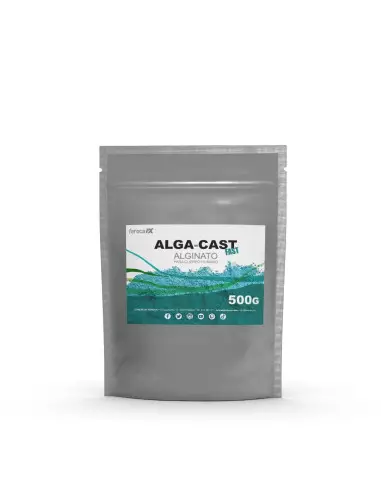
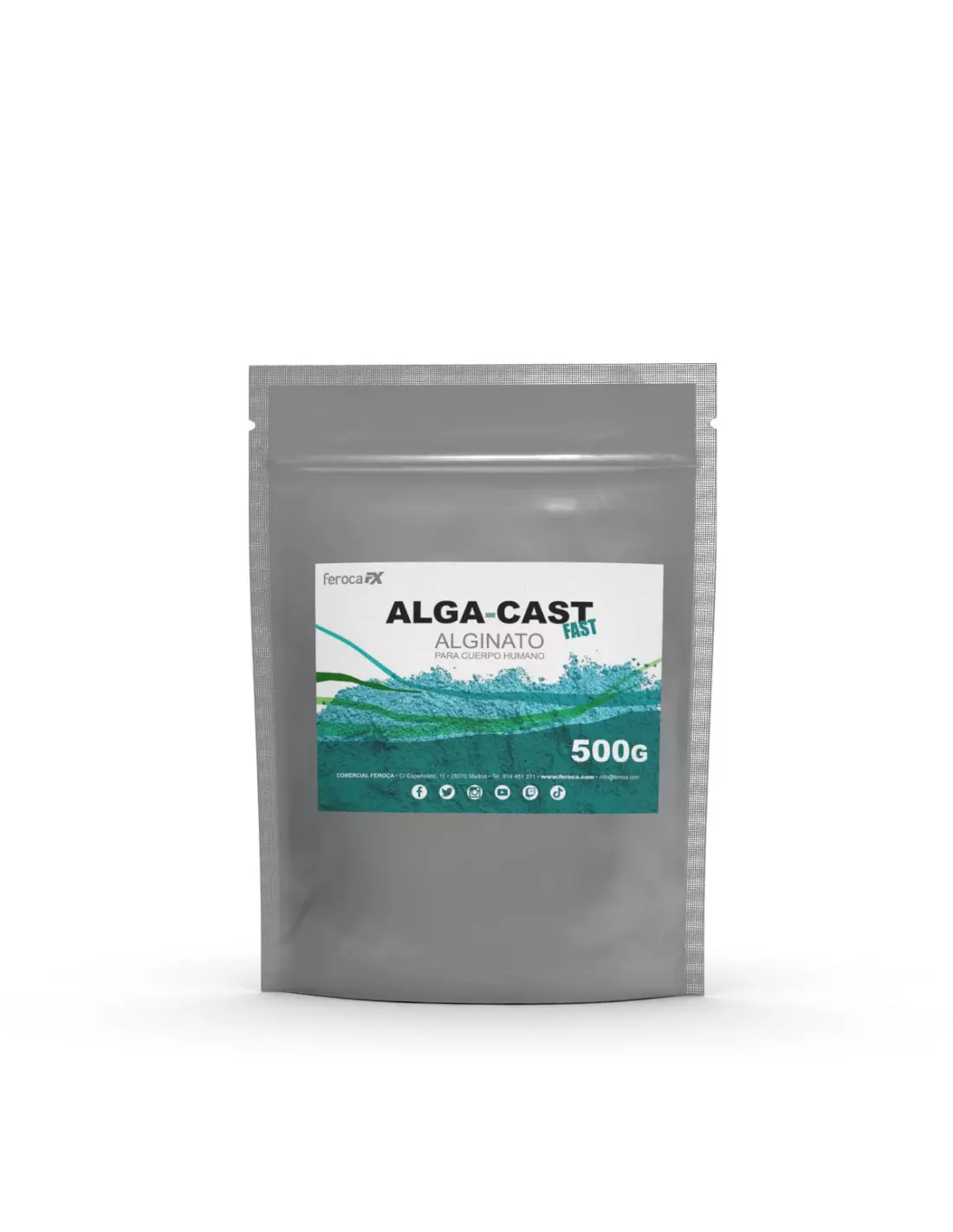
Alga-Cast Fast is a professional alginate specifically formulated for direct contact with human skin: non-toxic, completely safe, and with exceptional detail capture. If you need a mould of hands, face, or any body part in just a few minutes, this is your go-to material.
Technical specifications
| Parameter |
Value |
| Material type |
Alginate for body moulding |
| Safe for human skin |
Yes, certified non-toxic |
| Mix ratio (by volume) |
1 part powder : 3 parts water |
| Working time |
~2 minutes |
| Cure time |
3 – 3.5 minutes |
| Mould uses |
1 – 2 castings (temporary mould) |
| Final mould state |
Flexible, hydrophilic |
| Presentation |
Powder |
Quantity guide by body area
| Area to mould |
Indicative alginate amount |
| Baby foot/hand |
300 g |
| Adult foot/hand |
500 g |
| Face without ears |
500 g |
| Full head to shoulders |
1.5 kg |
| Front torso |
750 g |
| Full torso |
1.5 kg |
| Arm to elbow |
750 g |
| Buttocks |
500 g |
| Intimate parts |
300 g |
| Full body |
~7 kg |
Indicative amounts. Results may vary depending on body shape and operator experience. The user assumes responsibility for the final quantity required.
What it is used for
Alga-Cast Fast is designed for Life Casting and special effects where rapid and safe capture of body surface detail is required. It is the standard starting point in FX workshops, photography studios, and artistic projects:
- Hand and foot moulds of babies and adults for keepsakes or sculpture
- Full face moulds for theatrical or film prosthetics
- Torso, arm, and other body area moulds for special effects
- Bases for casting plaster, polyurethane resins, and other fill materials
- Replicas for artistic installations and exhibitions
- Educational and introductory moulding workshops
How to use it
- Prepare the area: make sure the skin is clean and dry. In areas with heavy hair, apply a thin layer of paraffin oil or petroleum jelly to make mould removal easier.
- Measure the materials: use a ratio of 1 part powder to 3 parts water by volume. Cold water slightly extends the working time; warm water shortens it.
- Mix quickly: add the powder to the water (not the other way around) and mix vigorously until you get a smooth, lump-free paste. You have about 2 minutes before it starts to gel.
- Apply to the skin: spread the paste evenly, covering the entire area to be moulded with a minimum thickness of 1.5 – 2 cm to ensure mould strength.
- Reinforce with plaster bandages: before the alginate fully gels, apply wet plaster bandages on top to create the rigid mother mould that holds the shape.
- Wait for the cure: within 3 – 3.5 minutes the alginate will have set. Check the gel by touching the remaining paste in the bowl before removing the mould.
- Demould carefully: ask the subject to make small movements to gently release the mould. Remove the alginate + plaster mother mould assembly.
- Cast immediately: alginate loses water (syneresis) quickly. Cast your plaster or resin within the first 15–20 minutes after demoulding for best detail.
Tips and tricks
Control the water temperature
Water temperature is the simplest way to adjust working time. At 15 °C you will get an extra 30 to 60 seconds, which is useful for complex areas or when working alone. At 25 °C the cure is faster, which is ideal when the subject is a young child who cannot stay still for long. Never use very hot water: it accelerates curing in an uncontrollable way and can cause an uncomfortable sensation on the skin.
The plaster mother mould is essential
Alginate is flexible and without external support it will deform when removed and when casting. Always apply a mother mould using plaster bandages while the alginate is still soft but no longer flowing. This ensures the mould retains the exact geometry of the moulded area. For higher dimensional accuracy in castings, consider high-hardness plaster as a fill material.
Work as soon as you demould
Alginate is hydrophilic: if left exposed to air, it begins to shrink within minutes due to moisture loss (syneresis), distorting the detail. If you need to wait before casting, store the mould inside its plaster mother mould and wrap it with a damp cloth or plastic wrap. Even so, cast within 30 minutes. If your project requires reusable or long-lasting moulds, consider skin-safe silicone instead.
Frequently asked questions
Is it safe to apply this material directly to skin?
Yes. Alga-Cast Fast is specifically formulated for contact with human skin: it is non-toxic and safe. It is used without any release agent on healthy skin. In areas with heavy hair, it is recommended to apply a thin layer of oil or petroleum jelly to facilitate demoulding without pulling.
How many uses does the mould last?
Alginate is a temporary moulding material. Alga-Cast Fast allows between 1 and 2 castings depending on the material cast and the care taken during demoulding. If you need a reusable mould, the right option is to use a body-safe silicone.
What materials can I cast inside an alginate mould?
The most common are plaster (standard or high-hardness), stone plaster, and flexible or rigid polyurethane resins. Plaster is the most economical and straightforward option for beginners. For more durable results, high-hardness plaster offers better detail and mechanical strength.
Can I store the mould to use the next day?
It is not recommended. Alginate loses water quickly (syneresis) and the mould will shrink and distort within a few hours even when stored with moisture. Ideally, cast within the first 15–30 minutes after demoulding. If you need durable moulds, use body silicone.
How do I adjust the cure time?
Water temperature is the main factor. Cooler water (10–15 °C) extends the working time; warmer water (20–25 °C) shortens it. Alga-Cast Fast has a working time of about 2 minutes and gels at 3–3.5 minutes with water at room temperature (18–22 °C). If you need more manoeuvring time, try the Alga-Cast Slow version.
What is the difference between the Fast and Slow versions?
Alga-Cast Fast gels in 3–3.5 minutes, making it ideal for subjects who cannot hold a position for long (children, difficult areas). Alga-Cast Slow offers a longer working time, suited for complex geometry areas or when working without an assistant.
Do I need a release agent for the plaster bandages of the mother mould?
There is no need to apply a release agent between the alginate and the plaster mother mould, as both materials bond in a controlled way and the set alginate acts as a natural barrier. You should make sure to apply the mother mould while the alginate is still in its soft phase so that it seats properly on the surface.
Is there a starter kit to begin without buying materials separately?
Yes. Feroca offers a complete alginate and plaster kit that includes everything needed to make your first hand and foot moulds, ideal for those new to the technique.