Shopping Cart



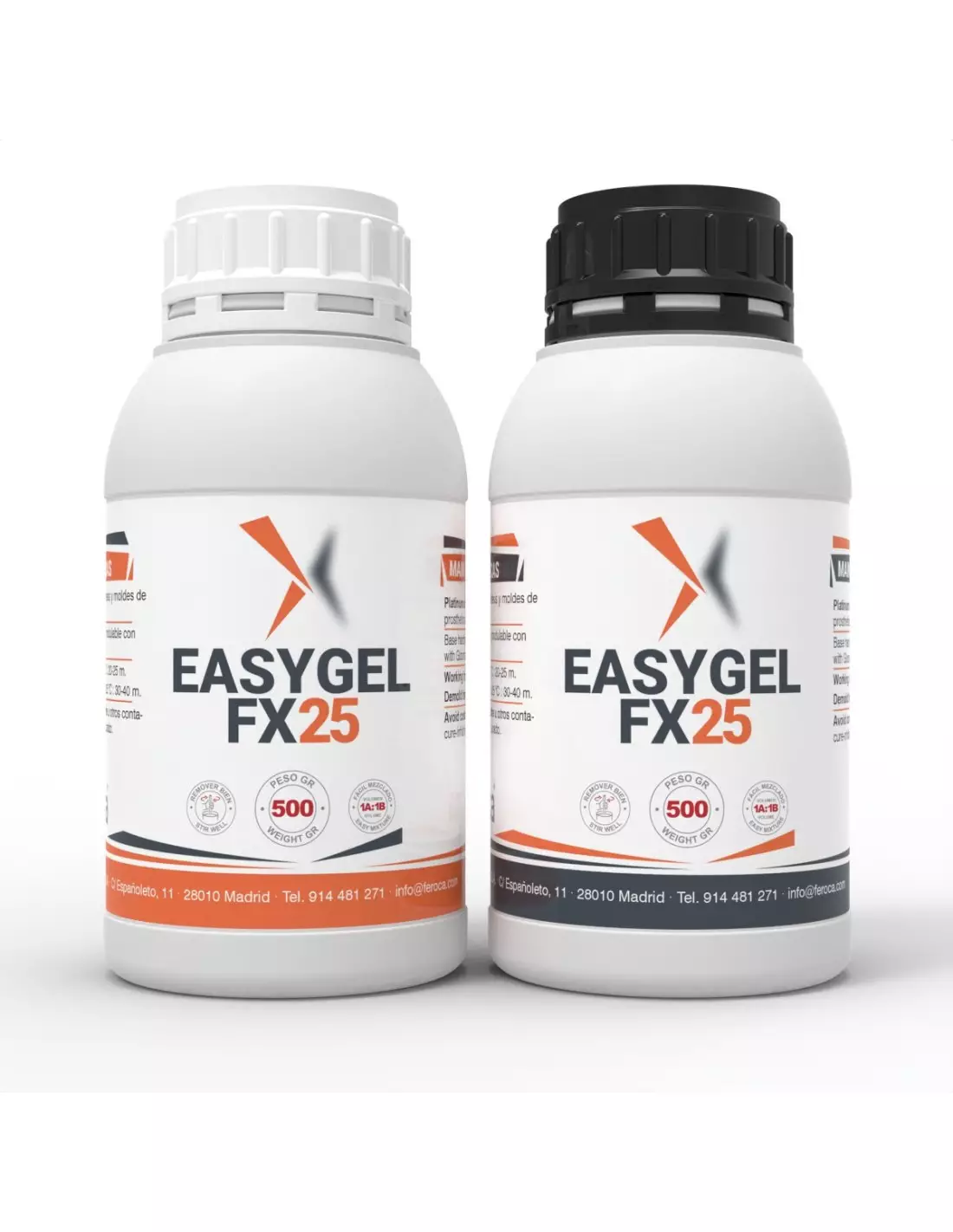
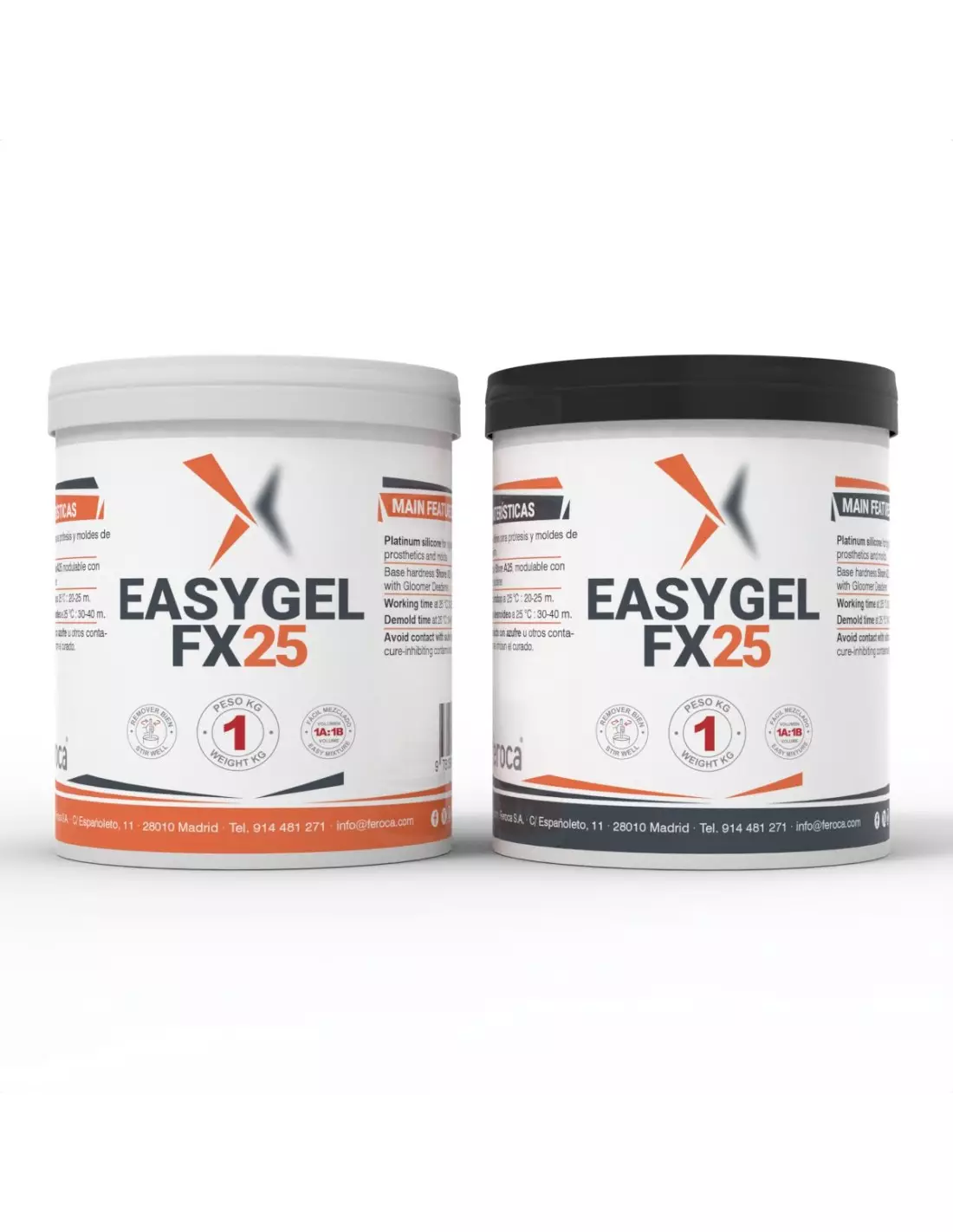
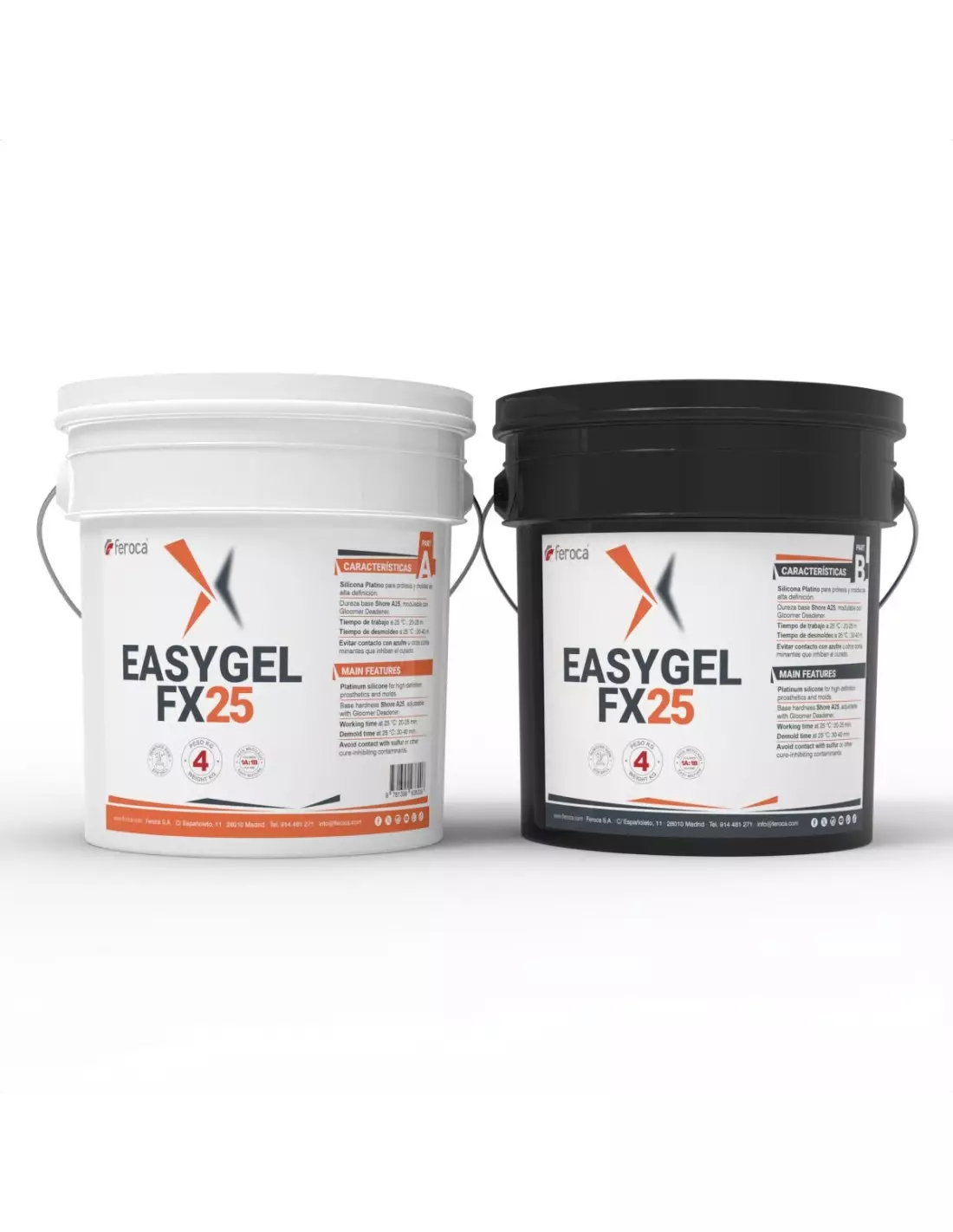
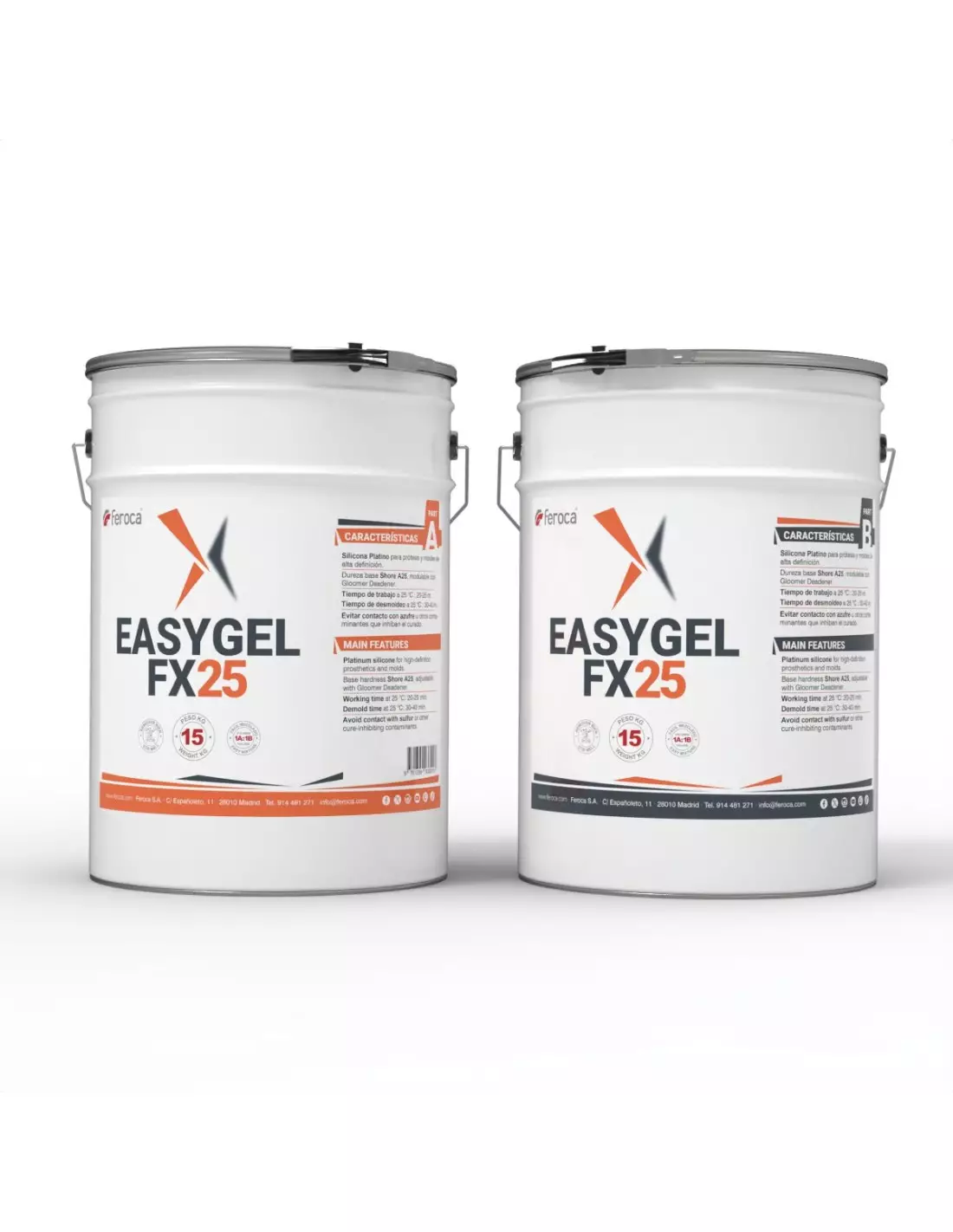
EasyGel FX25 - Silicone for Prosthesis FX and Mold -
201353601
€27.00
32,67 € Tax incl.
32,67 € Tax incl.
Shore A25 platinum silicone, 1:1 ratio, translucent, for FX prosthetics and high-definition moulds. Working time 5 min, cure time 40 minutes.
EasyGel FX25 is a two-part platinum (addition) silicone with Shore A25 hardness, specifically formulated for the manufacture of special effects prosthetics and high-definition moulds. Its high translucency, 1:1 ratio by weight and volume, and ultra-soft behaviour make it a go-to material for FX artists who need seamless edges, pore reproduction and completely convincing artificial skin on the performer.
Technical specifications
| Parameter | Value |
|---|---|
| Type | Platinum (addition) silicone, two-part |
| Mix ratio by weight | 100A : 100B |
| Mix ratio by volume | 100A : 100B |
| Shore Hardness | A25 |
| Colour | Translucent |
| Working time (25 °C) | 5 min |
| Cure time (25 °C) | 40 minutes |
| Shrinkage | No appreciable shrinkage |
| Compatibility | Gloomer Deadener |
| Usage range | 10% (slight modification) — 30% (human skin feel) |
| Ratio for encapsulated prosthetics | 1A : 1B : 10–30% Deadener |
What it is used for
EasyGel FX25 is designed for special effects professionals and students who need an ultra-soft, translucent silicone with excellent detail reproduction. Its Shore A25 hardness places it at the softest end of the EasyGel range, making it ideal both for building natural-finish prosthetics and for producing high-resolution flexible moulds.
- Special effects prosthetics: wounds, scars, facial deformations and theatrical character make-up
- Foam encapsulation for anaplastology prosthetics
- Skin and soft tissue moulds with faithful reproduction of pores and fine textures
- Character pieces with ultra-thin edges for direct make-up application over silicone
- Body part replicas for props, film and television
- Moulds for casting resins, waxes or plasters where high flexibility is required
- Reborn baby and hyperrealistic doll fabrication
- Soft tissue prototypes and replicas for medical simulation and training
How to use it
- Prepare the surface: make sure the mould or positive you are working on is clean, dry and free of contaminants (no latex, sulphur, tin or uncured epoxy). Apply a Release agent if the surface requires it.
- Weigh the components: mix part A and part B at a 100:100 ratio by weight or by volume. Use a precision scale to ensure the exact proportion.
- Hand mixing: stir for 2–3 minutes with a spatula, scraping the walls and bottom of the container thoroughly to obtain a homogeneous, streak-free mixture.
- Degassing (optional but recommended): place the mixture in a vacuum chamber for 2–3 minutes to remove air bubbles before casting or application.
- Pigmentation and additives: if you need colour, add Key-Pigments at this stage. If you want a thixotropic texture for vertical application, incorporate Thixo Additive. For encapsulated prosthetics, add Gloomer Deadener at 10–30% of the total AB mixture.
- Apply or pour: you have 5 minutes at 25 °C to work. For moulds, pour in a thin stream from a low point so the material flows on its own and displaces air. For layered prosthetics, apply with a spatula or brush.
- Curing: allow to cure at room temperature for 40 minutes. Heat accelerates the process; do not demould before the piece is completely firm to the touch.
- Demoulding: demould carefully, pulling evenly. Shore A25 is very soft — handle the piece gently to avoid deforming it.
Warning — Platinum silicone inhibition: EasyGel FX25 is a platinum (addition) silicone. The platinum catalyst can be inhibited by contact with certain materials, preventing full or partial cure. Common inhibiting materials: latex, sulphur-based clays (sulphur plasticines), tin silicones (condensation), uncured epoxy, freshly cast polyester, uncured urethane rubbers, vinyl and some metal surfaces. Before working with a new material, always carry out a small cure test. If the mould surface or positive has been in contact with any of these materials, seal it with lacquer or shellac before pouring EasyGel FX25.
Usage tips
Ultra-thin edges on FX prosthetics
The low Shore A25 hardness of EasyGel FX25 allows the prosthetic edges to be worked down to a minimum thickness that visually blends with the performer's skin. To achieve this, apply the final peripheral layer with a fine brush in outward strokes, progressively thinning the material. Once cured, use Key-Pigments to paint the prosthetic from the inside before encapsulation, or directly in the mix during blending. If you need to encapsulate the edges to facilitate blending, apply Key-Cap Plastic as an encapsulant.
Using deadener for encapsulated prosthetics
For anaplastology or high-mobility prosthetics, you can further soften EasyGel FX25 by incorporating Gloomer Deadener into the mix. The standard ratio is 10–30% of deadener over the total AB mixture (i.e. 1A : 1B : 0.2–0.6D by weight). Mix thoroughly before adding pigments. This technique reduces the effective hardness below Shore A25 and improves the dynamic behaviour of the piece on the skin.
Moulds with vertical areas or counter-mould geometry
If you are working on vertical surfaces or moulds with complex geometry, add Thixo Additive to the mix to increase viscosity and prevent sagging. The thixotropic additive does not alter cure time or final mechanical properties — it only modifies the fresh material's rheology. Always use a rigid counter-mould (resin, plaster or fibre) to support the EasyGel FX25 mould during casting of the reproduction material and prevent deformation.
Frequently asked questions
What materials can inhibit the cure of a platinum silicone?
Platinum silicones like EasyGel FX25 are sensitive to several inhibiting materials: latex, sulphur-based clays and plasticines, tin silicones (condensation), uncured epoxy, freshly cast polyester, uncured urethane rubbers, vinyl and some metal surfaces. If the silicone remains sticky or uncured at the contact zones, inhibition is the most likely cause. Always carry out a small test before proceeding with the full piece and seal any suspect surfaces with lacquer or shellac.
Can I use a tin silicone for the mould and then cast prosthetics in platinum silicone?
No. Platinum silicone does not cure correctly over tin silicone — residual tin catalyst inhibits the platinum. If you need a mould to produce prosthetics in EasyGel FX25, the mould must also be made of platinum silicone or a non-inhibiting material (resin, sealed plaster, etc.).
Is it necessary to use an encapsulant on platinum silicone prosthetics?
It is not strictly necessary, but it is highly recommended. The encapsulant (such as Key-Cap Plastic) creates a film over the prosthetic that allows the edges to be blended with the performer's skin and facilitates subsequent make-up application with paints designed for silicone. Without an encapsulant, conventional paints do not adhere correctly to silicone.
How can I add colour to the silicone before casting the prosthetic?
Add Key-Pigments directly into the AB mixture before pouring. These are pigments specifically formulated for platinum silicones and do not interfere with the cure. The translucency of EasyGel FX25 allows for subtle pigmentation that mimics skin tones in a very natural way.
What deadener ratio should I use to soften the silicone for encapsulated prosthetics?
For encapsulated prosthetic applications, between 10% and 30% of Gloomer Deadener over the total AB mixture is recommended, by weight. That is: 1 part A + 1 part B + 0.2–0.6 parts deadener. Mix A and B first, then incorporate the deadener before adding pigments.
Can the cure be accelerated with heat?
Yes. Like all platinum silicones, EasyGel FX25 cures faster at higher temperatures. An oven at 60–70 °C can reduce the cure time to 15–20 minutes. However, heat also shortens working time, so for complex applications it is preferable to cure at room temperature to allow more working time.
Is a counter-mould necessary when working with such a soft silicone?
Yes, it is highly recommended. The Shore A25 hardness of EasyGel FX25 makes the mould very flexible and prone to deforming under the weight of the reproduction material. A rigid counter-mould in plaster, resin or fibreglass ensures the mould geometry is maintained during casting and that copies are faithful to the original.
Can I use this silicone to make reborn babies or hyperrealistic dolls?
Yes. EasyGel FX25 is suitable for reproducing reborn baby parts thanks to its translucency and Shore A25 hardness, which gives a very soft and realistic feel. A vacuum chamber is recommended to remove bubbles before casting and achieve perfect surfaces. Use rigid moulds or moulds with a rigid counter-mould to ensure dimensional accuracy of each piece.
- Color
- Translucent
- Working Time
- 5min
- Curing Time
- 40min
- Shore Hardness
- A25
- Volume Mixing Ratio
- 100A:100B
- Mixed Weight Ratio
- 100A:100B

No reviews
Tap to zoom