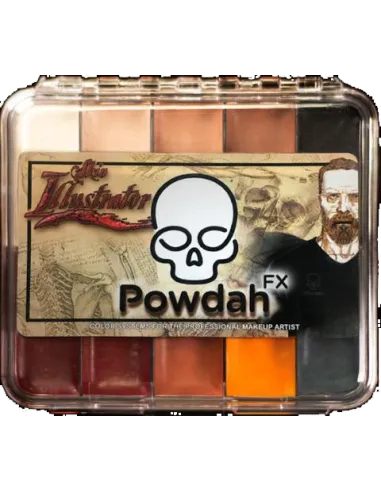
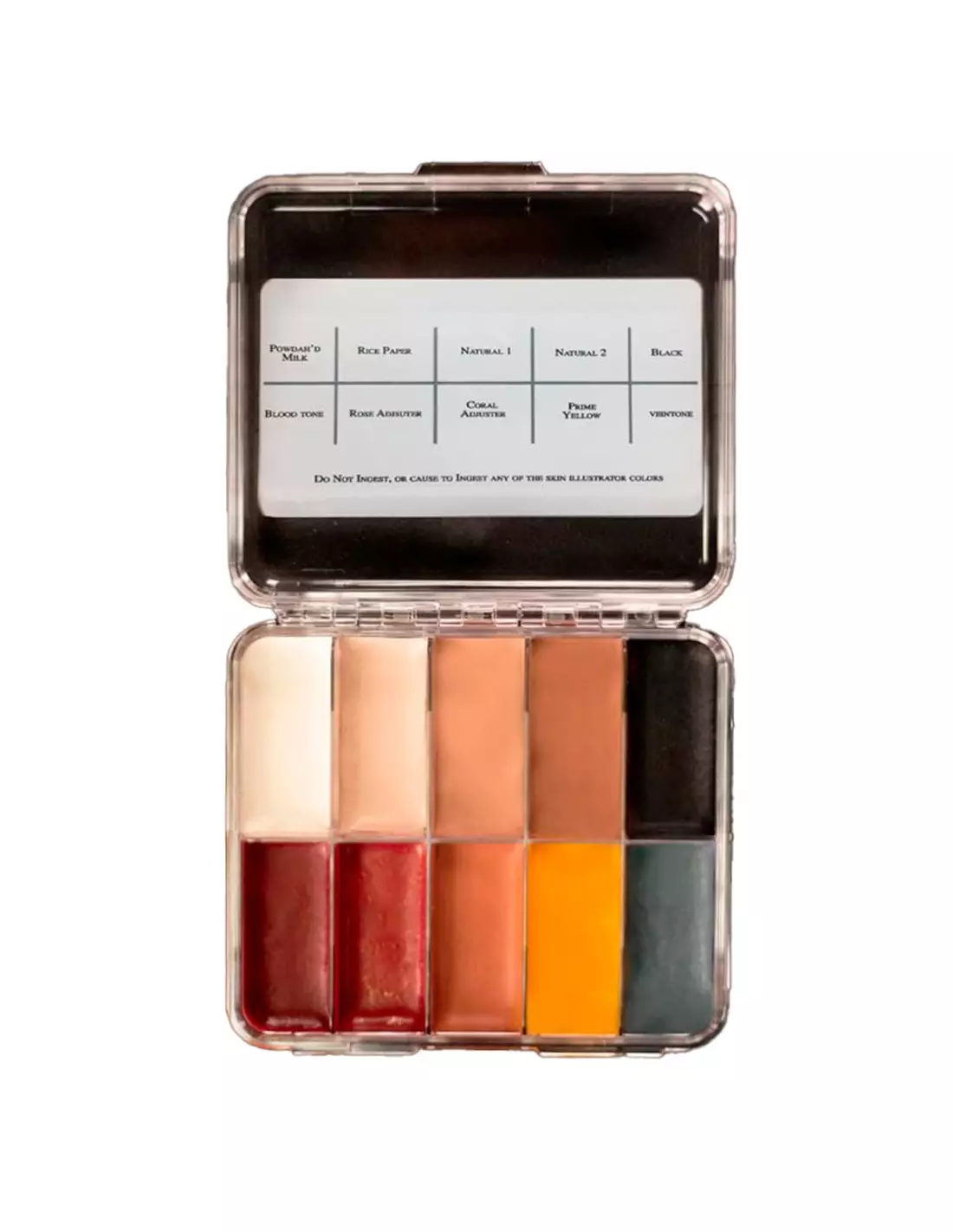
The Skin Illustrator Powdah On Set Palette is a 12-colour alcohol-activated makeup palette designed in collaboration with SFX artist Marc Clancy (Powdah). Conceived specifically for creating realistic wounds and moulage, it brings together in a single format the essential tones for SFX character work, with exceptional coverage and durability on skin, silicone and latex.
Technical specifications
| Product type | Alcohol-activated makeup palette |
|---|
| Number of colours | 12 |
|---|
| Colours included | Powdah'd Milk, Rice Paper, Natural 1, Natural 2, Black, Blood Tone, Rose Adjuster, Coral Adjuster, Prime Yellow, Vein Tone (and 2 additional colours depending on formulation) |
|---|
| Compatible surfaces | Natural skin, silicone, latex |
|---|
| Recommended activator | Skin Illustrator Activator, Skin Illustrator Slow Activator, isopropyl alcohol 99.9% or ethyl alcohol 96° |
|---|
| Application method | Fine brush or mascara wand |
|---|
| Colour mixing | Compatible with the entire Skin Illustrator range |
|---|
| Use | Special effects, moulage, character makeup |
|---|
What it's used for
This palette was designed with the on-set SFX artist in mind who needs a complete kit for set work. The top row of colours is aimed at skin tone simulation and base blending, while the bottom row concentrates the detail colours for wound interiors and finishing. It is especially useful for:
- Creating realistic wounds: cuts, burns, bruises and lacerations
- Moulage and trauma simulation for medical and military training
- SFX character makeup for film, television and theatre
- Painting silicone and latex prosthetics on set
- Adjusting and blending skin tones over any base shade
- Vein details, subcutaneous colour changes and wound depth
- Effects makeup practice for artists in training
How to use it
- Make sure the surface to be painted (skin, silicone or latex) is clean and dry.
- Activate the colour by lightly dampening the brush with isopropyl alcohol 99.9%, ethyl alcohol 96°, Skin Illustrator Activator or Skin Illustrator Slow Activator.
- Load the brush with the desired colour directly from the palette and apply to the surface with gentle strokes.
- For fine detail areas (wound interiors, veins), use a fine-tipped brush or a mascara wand.
- Blend colours directly on the palette or on the surface to create transitions and custom shades.
- Allow to dry between layers: alcohol-activated colour dries very quickly once the alcohol evaporates.
- Repeat layers to build opacity or colour depth as required by the effect.
- Set the finish if necessary with the appropriate fixing product for the surface type.
Tips for use
Controlling brush moisture
The amount of activator on the brush determines transparency and working time. With a very wet brush you get perfect translucent layers for glazing and colour transitions. With an almost dry brush you achieve greater opacity and drier textures, ideal for simulating dry skin or scabs. Experiment with the amount of activator to master both effects.
Application order for realistic wounds
Follow anatomical logic when building a wound: start with the lightest tones (Powdah'd Milk, Rice Paper) for the peripheral areas and stretched skin. Then add the reds and Blood Tone to the core of the injury. Reserve Black for the deepest shadows and necrotic edges. Vein Tone is used to add vascular branching around the wound and lend anatomical believability.
Compatibility with the rest of the Skin Illustrator range
All colours in this palette are fully miscible with the rest of the Skin Illustrator range, such as the Skin Illustrator FX Palette for special effects or the Skin Illustrator Flesh Tone Palette to extend the range of skin tones. Mixing them allows you to build a virtually unlimited colour library adapted to any skin tone or effect.
Frequently asked questions
What activates these colours?
The colours in the Skin Illustrator Powdah On Set Palette are activated with Skin Illustrator Activator, Skin Illustrator Slow Activator, isopropyl alcohol 99.9% or ethyl alcohol at 96°. Never use water or pharmacy alcohol with additives, as these can affect colour adhesion and finish.
Can it be used on silicone and latex?
Yes. The palette is formulated to adhere to natural skin, silicone and latex. It is especially useful for painting prosthetics on set, as alcohol-activated colours penetrate the porous surface of latex and bond well to properly prepared silicone.
How long does the makeup last once applied?
Skin Illustrator alcohol-activated colours have significantly greater durability and staying power than conventional makeups. Once the alcohol has dried, the colour is resistant to water and light perspiration. For maximum durability during long shoots, apply a suitable setting product over the finished makeup.
Can I mix these colours with other palettes from the same brand?
Is it suitable for artists with no prior SFX makeup experience?
Yes. Marc Clancy designed this palette specifically with the beginner artist in mind. The colour selection is logically organised: the top row for skin tones and the bottom row for wound details, making it easy to learn the logic of building effects from scratch.
What tools are best suited for applying these colours?
Fine makeup brushes are the primary option. For very small detail areas, a mascara wand is very practical. The palette wells are compact, so large sponges are not the most convenient tool for loading colour directly from the palette.
How is this type of makeup removed?
Being an alcohol-activated makeup, it is easily removed with a suitable solvent for the surface type. On skin, an oil-based makeup remover or a dedicated alcohol makeup remover works effectively. On silicone or latex, consult the recommended solvent for each material to avoid damaging the prosthetic.
What is the difference between using the Activator and the Slow Activator?
The Skin Illustrator Activator is the standard activator, with fast evaporation that allows you to work quickly through successive layers. The Slow Activator extends working time, which is useful when you need to create more elaborate colour transitions or work in very dry environments where the standard activator evaporates too quickly.