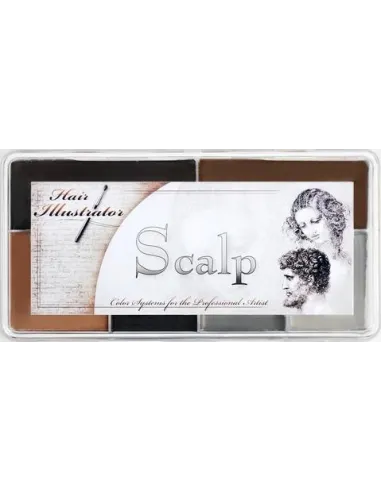
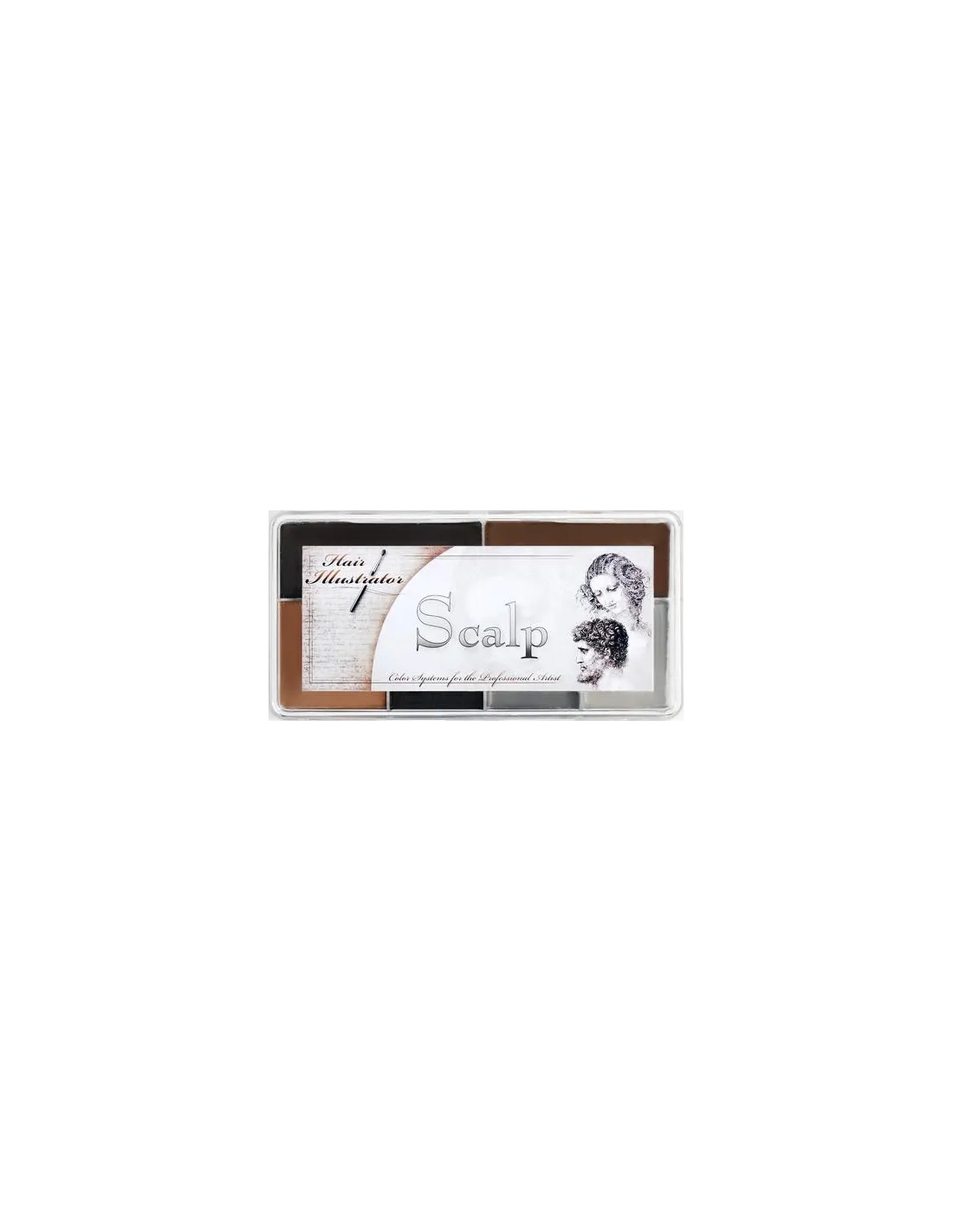
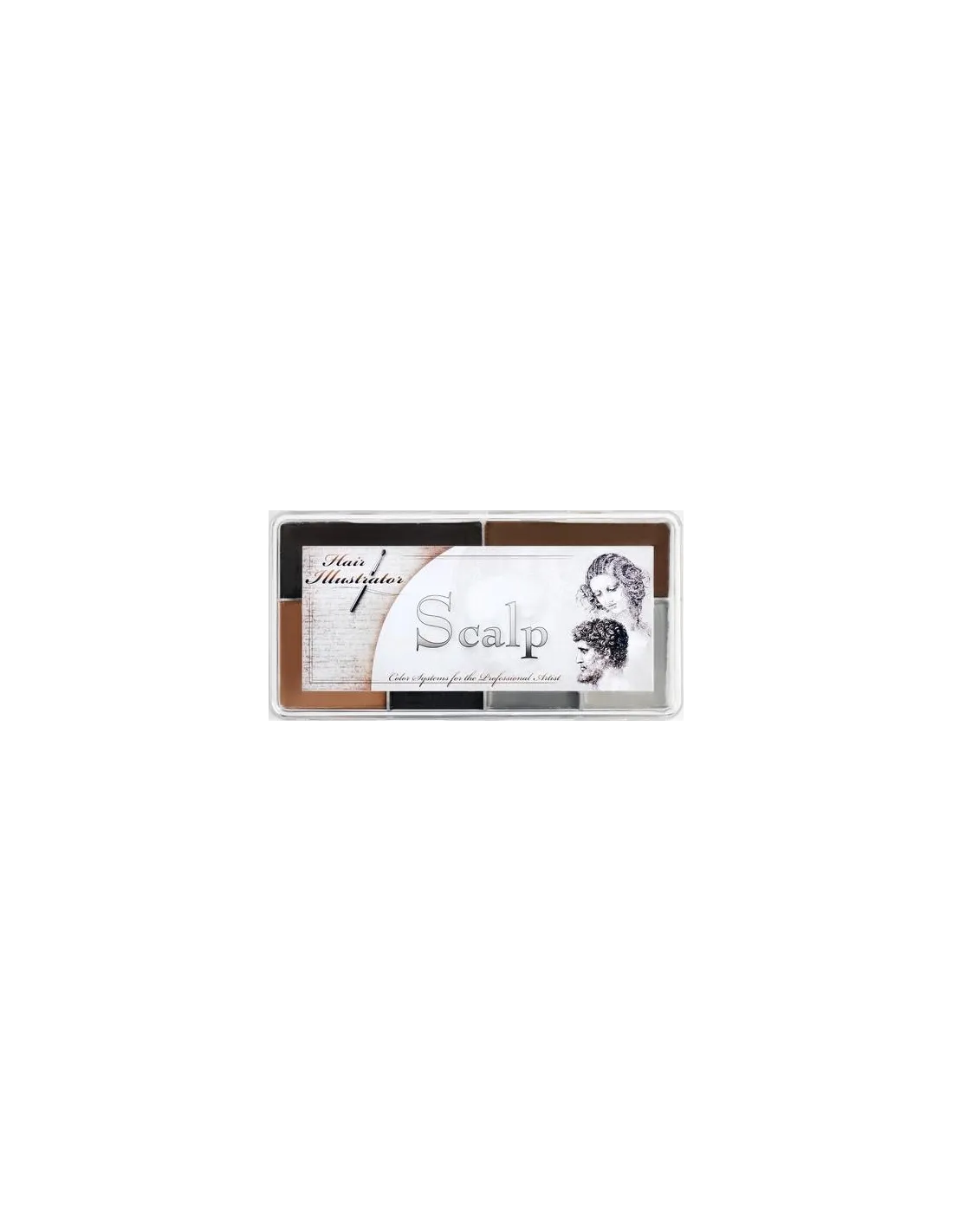
The Hair Illustrator Scalp Palette is an alcohol-activated makeup palette designed specifically for scalp work: patch coverage, root darkening, visual fill of sparse areas, and full or partial baldness effects. Its 6 high-coverage colours adhere to skin, natural hair, silicone and latex, and blend seamlessly with the rest of the Skin Illustrator range to achieve any hair tone with professional precision.
Technical specifications
| Feature |
Detail |
| Product type |
Alcohol-activated makeup (alcohol base) |
| Number of colours |
6 |
| Compatible surfaces |
Skin, natural hair, silicone, latex |
| Activation |
Skin Illustrator Activator, Slow Activator or 96° ethyl alcohol |
| Removal |
Telesis Super Solv or Telesis Makeup Remover |
| Application |
Brush, sponge, mascara wand |
| Range |
Hair Illustrator / Skin Illustrator |
What it's used for
The Scalp Palette is designed for any situation where you need to work on the scalp or hair roots with a realistic, long-lasting finish. Its coverage is dense and its colours can be mixed together or combined with other palettes from the Skin Illustrator range to fine-tune the tone with total precision.
- Visual fill and coverage of patches or sparse areas of the scalp
- Darkening of light or grey roots in ageing or character effects
- Creating partial or full baldness effects on silicone and latex prosthetics
- Characterisation of wigs and hairpieces to match the actor's scalp tone
- Retouching hairline edges on hair prosthetics
- Sweat, dirt or hair ageing effects in film and television production
- Theatrical and special effects makeup requiring tonal continuity between skin and hair
How to use it
- Prepare the surface: make sure the skin, prosthetic or hair is clean, dry and free of grease or product residue.
- Activate the colour: dampen the brush, sponge or mascara wand with the specific Skin Illustrator Activator, with the Slow Activator for longer working times, or with 99.9% isopropyl alcohol. Never use 70° alcohol, MEK, acetone or water, as they do not correctly activate the pigment.
- Load the brush with colour directly from the palette and apply with short strokes following the direction of the hair or the contour of the scalp.
- Mix colours on the palette itself or on the surface to adjust the tone. You can combine with any other palette from the Skin Illustrator range.
- Allow to dry for a few seconds. The colour sets quickly as the alcohol evaporates.
- Layer coats to increase coverage or create shadows and depth in the hairline area.
- To remove the makeup, apply Telesis Super Solv or Telesis Makeup Remover with a cotton pad or gauze and remove gently.
Tips for use
Always activate with high-proof alcohol
Ethyl or isopropyl alcohol must be at 96° or higher (ideally 99.9%). With 70° alcohol the pigment does not dissolve properly, the colour is uneven and adhesion suffers. If you are working on set and need a longer manipulation time before drying, use the Slow Activator instead of the standard activator.
Application technique on scalp and prosthetics
For patch coverage, a makeup sponge gives a more uniform and natural result than a flat brush. Work in thin layers: it is better to build coverage in two or three passes than to overload in a single one. For hairline edges and root detail, a fine brush or mascara wand provides more control. When working on silicone, make sure the prosthetic is properly adhered before starting to colour.
Combining with other palettes in the range
The Scalp Palette is formulated to blend directly with the rest of the Skin Illustrator palettes. If you need to adjust the tone or add warmth to the scalp, mix on the palette or on the surface with colours from the Complexion Palette or the Dark Fleshtone Palette. For wound, bruise or ageing effects in the same area, complement with the FX Palette.
Frequently asked questions
Is this type of alcohol makeup suitable for direct use on skin?
Yes. The Hair Illustrator Scalp Palette is formulated to be applied directly to the skin of the scalp, as well as to hair, silicone and latex. It is the standard in professional film, television and theatre makeup for characterisations on real skin.
What is used to activate this type of makeup palette?
The specific Skin Illustrator Activator, the Slow Activator (for longer working times) or 99.9% isopropyl alcohol. Do not use 70° alcohol, MEK, acetone or water: they do not activate the pigment correctly and ruin the finish.
How durable is it once dry?
Once activated and dry, alcohol-activated makeup has excellent resistance to friction, perspiration and set lighting heat. It is one of the most widely used systems in professional production precisely because of its durability compared to other types of makeup.
Can it be applied to wigs and hairpieces?
Yes, the Scalp Palette works perfectly on natural and synthetic hair in wigs and hairpieces, as well as on the lace or silicone bases of hair prosthetics. It is especially useful for matching the hairline tone to the actor's scalp or for customising the colour of a pre-made wig. If you are going to implant hair into silicone prosthetics, rooting needles are the standard tool for that process.
Can colours from different palettes in the range be mixed?
Yes, all colours in the Skin Illustrator and Hair Illustrator line are compatible with each other. You can mix them on the palette itself or directly on the working surface to achieve any intermediate tone. The Flesh Tone Palette and the Complexion Palette are the most common complements when working in the transition zone between the scalp and facial skin.
How is alcohol makeup removed?
With Telesis Super Solv or Telesis Makeup Remover, applied with a cotton pad or gauze. Do not use water alone: it is not effective for dissolving alcohol-based pigment. The removal process is quick and non-aggressive on the skin when the appropriate remover is used.
Does alcohol makeup need to be set with any additional product?
Not in most cases. Alcohol-activated makeup sets on its own as the solvent evaporates. In situations of extreme perspiration or very long shoots, some makeup artists apply a very light layer of activator on top at the end to re-seal the colour, but it is not a mandatory step.
Does it work on silicone surfaces previously painted with other products?
It depends on the base product. On untreated silicone or silicone prepared with compatible primers, alcohol-activated makeup adheres well. If the silicone already has layers of intrinsic paint or other makeups, adhesion may vary. It is always advisable to do a test on a small area before applying over the entire piece.