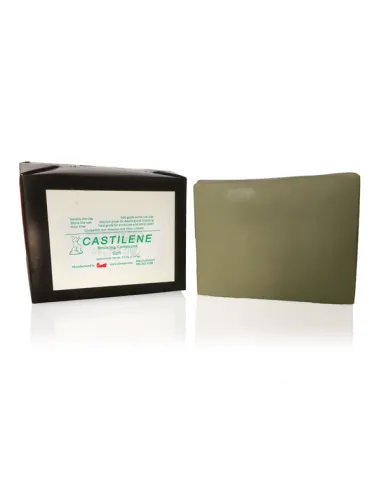
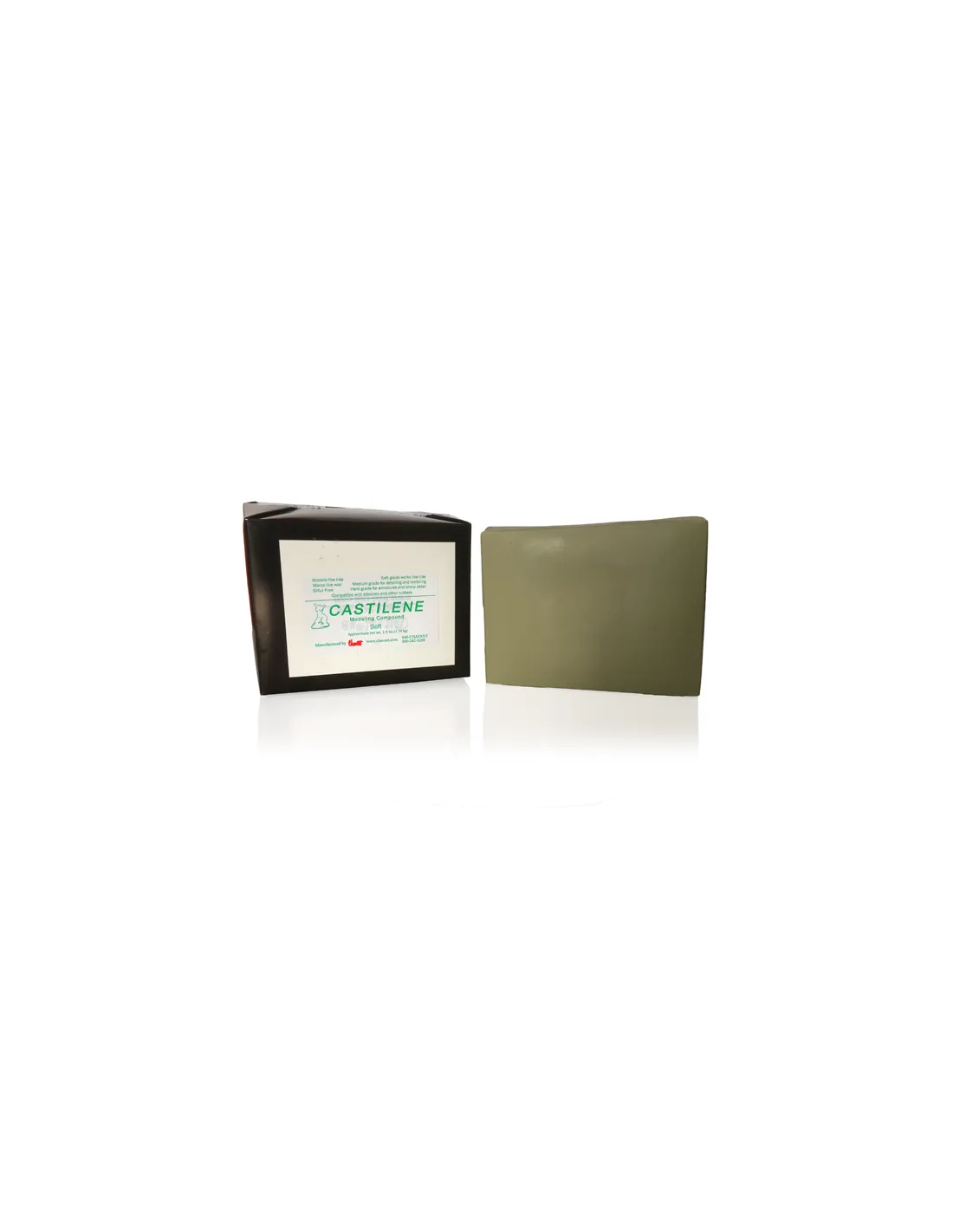
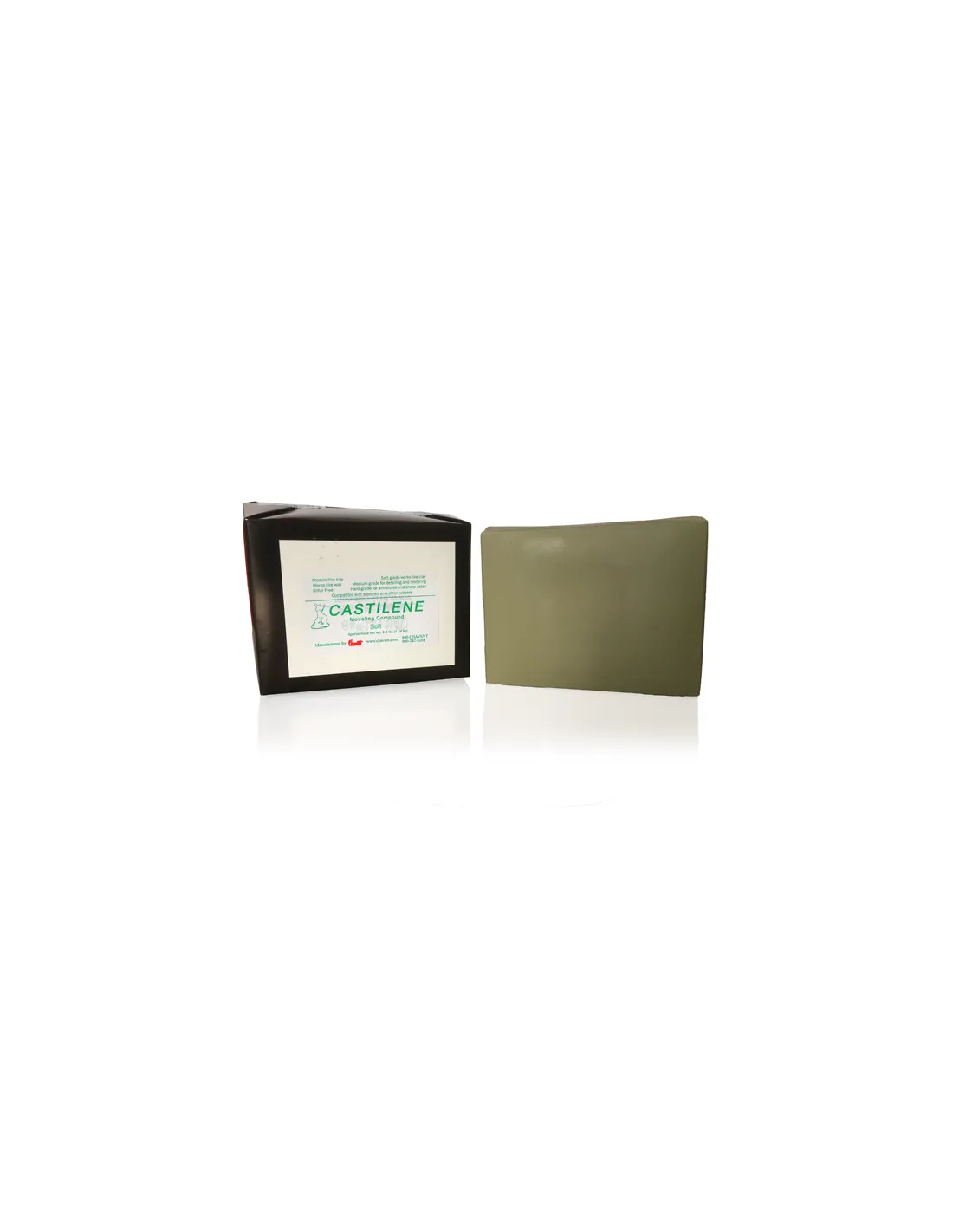
Castilene Soft is a professional soft-hardness modelling compound, sulphur-free, that combines clay-like behaviour with the look and workability of wax. It weighs 40% less than conventional professional oil clays, making it a comfortable choice for large-volume pieces without an Armature in most cases. Compatible with platinum and tin silicones, it is the go-to choice for sculptors, prosthetics artists and special effects professionals.
Technical specifications
| Format | 1.14 kg block |
|---|
| Hardness | Soft |
|---|
| Type | Wax-based modelling compound |
|---|
| Sulphur-free | Yes — compatible with platinum silicones |
|---|
| Weight vs. conventional oil clays | 40% lighter |
|---|
| Recommended working temperature | Below 80 °C |
|---|
| Melting / casting temperature | Above 80 °C (melts and can be poured) |
|---|
| Supported heating methods | Heat lamp, hot box, heat gun, slow cooker, microwave, double boiler |
|---|
| Direct flame | No — prohibited |
|---|
| Cross-hardness compatibility | Yes — Soft, Medium and Hard are mutually mixable |
|---|
| Use in casting | Yes — when melted above 80 °C |
|---|
What it is used for
Castilene Soft is the preferred hardness for direct hand and tool modelling, especially when a soft response and high cold-detail capacity are needed. Its lightness and silicone compatibility make it particularly versatile in production environments.
- Sculpting characters, busts and life-size or oversized figures
- Prototyping pieces for platinum silicone moulds
- Special effects and prosthetics for stage and screen
- Modelling surface layers over a Castilene Hard or Medium base
- casting into moulds when melted above 80 °C
- Creating fine textures and finishing details on volumetric pieces
- Blending with other Castilene hardnesses to adjust material stiffness to the workflow
How to use it
- Heat the Castilene Soft block using whichever method best suits your studio: heat lamp, hot box, heat gun, microwave or double boiler. Never use direct flame.
- Monitor the temperature and avoid exceeding 80 °C during work: above that threshold the material can generate air bubbles and lose consistency.
- Once the working temperature is reached, model with your hands or with modelling tools. The Soft responds well to body heat and warm tools.
- To build the piece efficiently, start with a base of hard hardness, add layers of Soft for detail work, and finish with Hard if very fine lines are needed.
- Cool the piece to increase the material's hardness and carry out burnishing or polishing with wax-compatible products.
- If you want to make a casting, heat the material above 80 °C until fully melted and pour it carefully into the mould.
- Once the sculpture is finished, you can take a platinum silicone mould directly: Castilene contains no sulphur and will not inhibit the cure.
Tips and techniques
Temperature management in the studio
Castilene Soft is very sensitive to ambient temperature. In cold studios it will be stiffer and allow greater definition; in warm studios or during summer it may be too soft for certain details. Use a hot box or surface heater to keep the working area active without overheating the entire piece. If the material starts showing surface bubbles, lower the temperature immediately.
Blending hardnesses for complex workflows
All three Castilene hardnesses (Soft, Medium and Hard) are fully compatible and can be mixed in any proportion. A common technique is to use Hard for the Armature or bulk mass, Medium for secondary forms, and Soft for skin, texture and fine detail. Blend warm by kneading both materials together until a uniform consistency is achieved.
Polishing and mould preparation
For the best surface finish, cool the finished piece before polishing. You can use standard wax polishing products. If you are taking a mould with platinum silicone, no specific Release agent is required due to the absence of sulphur, although a light coat of release can ease demoulding without damaging the sculpture. Avoid using the piece as a master in contact with sulphur-containing materials if you plan to use addition silicone in a subsequent step.
Frequently asked questions
Can this type of material be modelled without an Armature?
Yes. Thanks to its lightness — 40% less than conventional oil clays — and its cold rigidity, Castilene Soft allows large-volume pieces to be built without an Armature in most cases. For very large sculptures or those with pronounced overhangs, it is recommended to use Hard hardness as the structural core and work Soft on the outer layers.
What is the maximum temperature to respect during modelling?
Do not exceed 80 °C. Above that point the material generates air bubbles and may melt. If your goal is precisely to melt Castilene for use in casting, heat it in a controlled manner beyond that threshold, but always with caution and never with direct flame.
Is it compatible with platinum silicones for mould making?
Yes. Castilene Soft contains no sulphur, so it does not inhibit the cure of addition (platinum) silicones. You can pour platinum silicone directly onto the sculpture without any special pre-treatments, although a thin coat of Release agent always aids demoulding and protects the original piece.
Can this compound be used to make final pieces or only as a master for moulding?
Castilene is formulated primarily as a modelling material and mould master. It is not a high-strength casting material or a technical plastic. However, when melted above 80 °C it can be poured into moulds to obtain finished wax pieces, useful as positives for lost-wax casting or similar techniques.
What is the difference between the three available hardnesses?
The Soft hardness is the softest and responds best to body heat and gentle tools, ideal for detail work and skin. Medium offers a balance between malleability and definition. Hard is the stiffest when cold and allows the finest details with warm tools. All three are compatible and can be mixed together.
How do you soften it correctly before starting work?
Several methods can be used: heat lamp, hot box, hot-air heat gun, slow cooker, microwave or double boiler. Heat gradually and evenly. Never use direct flame. Always ensure the temperature does not exceed 80 °C to avoid bubbles and loss of consistency.
Does this material harden permanently or can it be reused?
Castilene does not set or polymerise: it is a thermoplastic compound that hardens when cooled and softens when heated, indefinitely. You can reuse leftover material as many times as needed, reducing waste on long-term projects.
How much material do I need to model a life-size head?
A solid life-size human head can require between 3 and 5 kg of material depending on wall thickness and whether an interior Armature is used. With Castilene Soft and a Hard core you can optimise consumption. For a bust up to the shoulders, estimate between 6 and 10 kg in total. The 1.14 kg block is a manageable reference for adding material layer by layer.