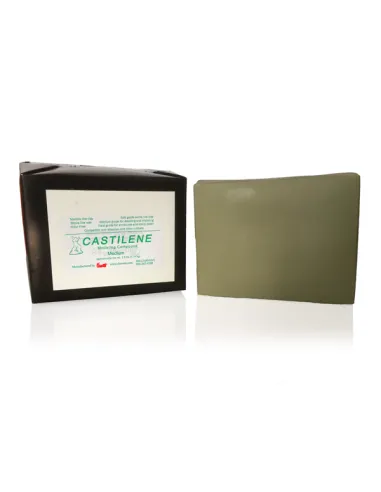
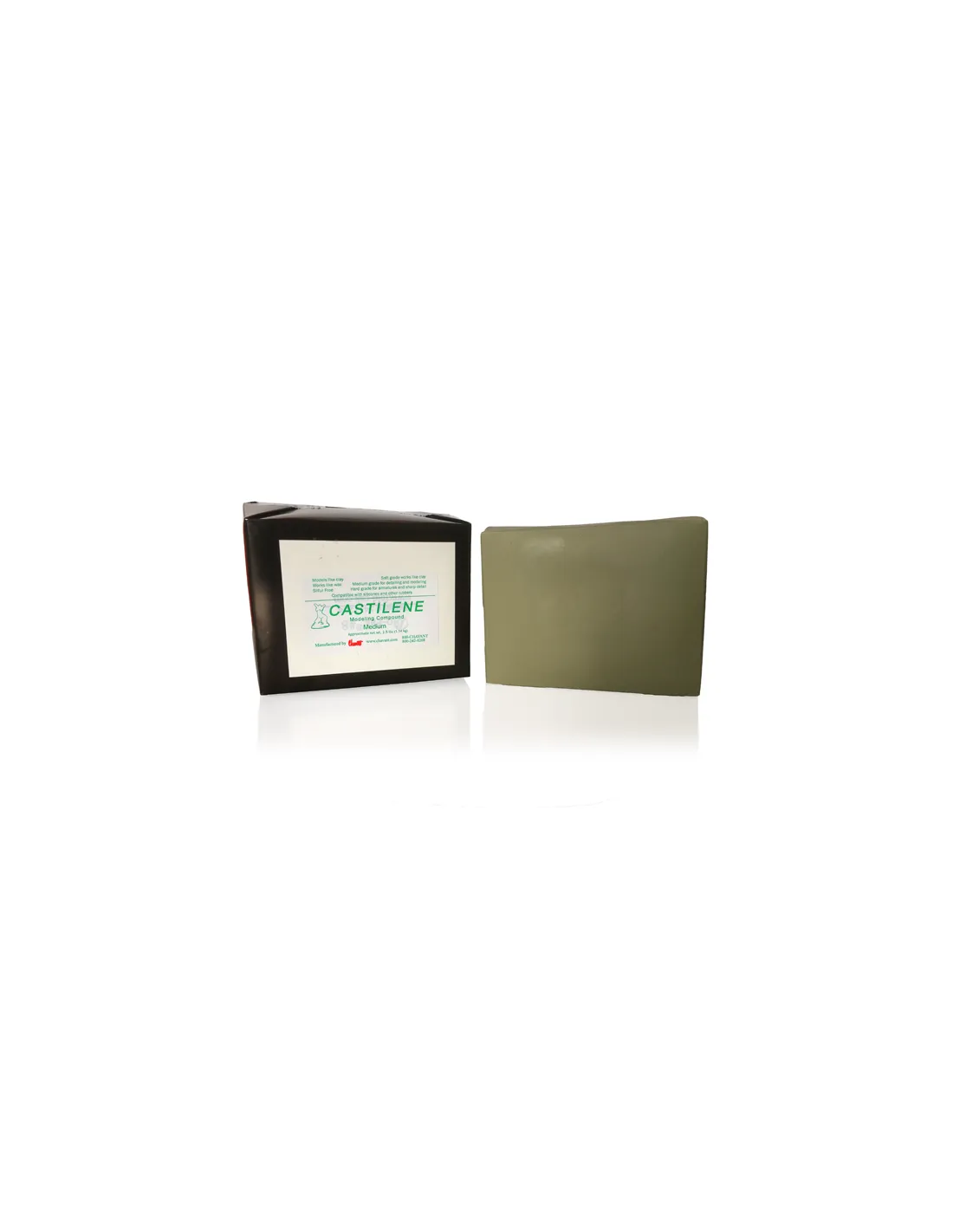
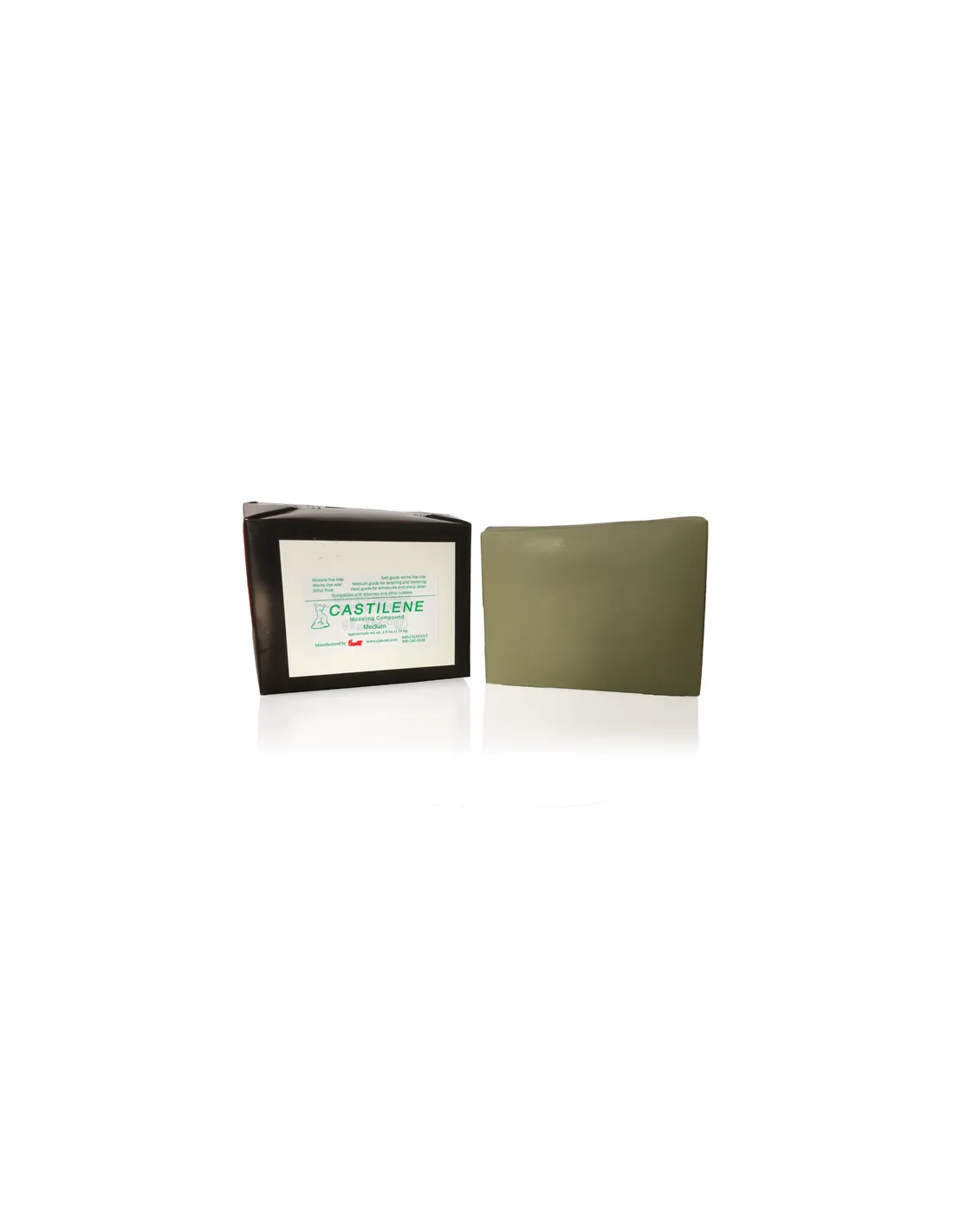
Castilene Medium is a professional sulfur-free modelling compound that combines the malleability of clay with the appearance and behaviour of a wax. At medium hardness it strikes the perfect balance between ease of use and detail capability, ideal for both figurative sculpture and industrial prototyping. It weighs 40% less than most professional modelling clays on the market, making it especially comfortable to work with on large-format pieces.
Technical specifications
| Property |
Detail |
| Format |
1.14 kg block |
| Hardness |
Medium |
| Material type |
Wax-based modelling compound |
| Sulfur-free |
Yes — compatible with platinum silicones |
| Weight vs. other modelling clays |
40% lighter |
| Softening temperature |
From moderate heat (lamp, hot box, microwave, water bath) |
| Melting / casting temperature |
Above 80 °C |
| Maximum recommended temperature |
80 °C (air bubbles appear above this) |
| Compatibility between hardnesses |
Yes — mixable with Castilene Hard and Castilene Soft |
| Requires Armature |
Not in most cases thanks to its own structural strength |
What it's used for
Castilene Medium is designed for professionals and semi-professionals looking for a re-thermoplastic modelling material without the limitations of sulfur-based modelling clays. Its intermediate hardness makes it the most versatile starting point within the Castilene range.
- Figurative sculpture: busts, heads, full-body figures
- Industrial prototyping and product design
- Character design for film, television and special effects
- Architectural models and detail modelling
- Creating masters for platinum silicone mould making
- Jewellery and accessory modelling for subsequent casting
- Shape and volume tests prior to production
How to use it
- Soften the material: use a heat lamp, hot box, microwave on low power or a water bath. Do not use direct flame. Keep the temperature below 80 °C to avoid the formation of bubbles.
- Start with the main mass: work with Castilene when it is warm and pliable. For large pieces, you can use a higher hardness material for the core or internal Armature and add Castilene Medium on top.
- Sculpt and add detail: use traditional modelling tools or wooden sculpting tools. Hot tools work especially well for melting and smoothing surfaces.
- Refine and mix hardnesses if needed: all three Castilene hardnesses are compatible with each other. You can add Castilene Hard for fine detail areas and Castilene Soft for more expressive areas.
- Cool for maximum hardness: lower the temperature of the material to burnish the surface and achieve a more polished finish.
- Apply finishes: use wax-compatible polishing products to refine the final surface.
- Make the mould: being sulfur-free, you can pour platinum silicone directly over the piece with no risk of inhibition.
Usage tips
Temperature control
The key to working well with Castilene lies in temperature management. At room temperature, the medium hardness already allows you to work without much preheating, but with a little gentle warmth the surface becomes very responsive to tools. Avoid heating above 80 °C: at that temperature the material starts to melt and bubbles appear that ruin the surface. If you want to use it for casting, exceed that threshold in a controlled manner.
Hardness strategy
You'll get the most out of Castilene Medium by combining it with the rest of the range. A good practice is to use Castilene Hard to build the base volume or internal Armature — taking advantage of its greater structural strength — continue modelling with Castilene Medium, and finish with Hard again where you need the finest details. All three hardnesses bond and blend together without any issues.
Preparing for the mould
One of the great advantages of Castilene over other modelling clays is that it contains no sulfur, meaning you can pour platinum silicone directly over the sculpture with no risk of inhibition. Make sure the surface is at room temperature before pouring the silicone and that the material is well compacted, with no internal bubbles or cracks. If you want to compare it with other sulfur-free professional modelling clays in our catalogue, also check out Chavant Medium.
Frequently asked questions
How do you soften a wax-based modelling compound?
Castilene Medium can be softened using several methods: heat lamp, hot box, heat gun on low power, microwave on low power, or water bath. The goal is to bring it to a comfortable working temperature without exceeding 80 °C. Never use direct flame, as uneven heat can burn the material or generate bubbles.
Is an Armature necessary for large pieces?
In most cases, no. The strength and lightness of Castilene Medium — 40% lighter than other professional modelling clays — allows you to work without an Armature even on sizeable pieces such as heads or busts. If the piece is very bulky or needs to hold itself in challenging positions, you can use Castilene Hard as a structural core.
Can it be used with platinum silicones without any special preparation?
Yes. Castilene is sulfur-free, so it does not inhibit the cure of addition-cure (platinum) silicones. You can pour the silicone directly over the Castilene Medium sculpture without applying any special prior treatment, as long as the material is at room temperature.
Which hardness should I choose to start working with this type of material?
Castilene Medium is the most versatile option for beginners. The medium hardness offers enough resistance to hold detail without feeling too stiff to the touch. If you're looking for sharper line definition and working with very fine tools, the Hard version will be more suitable. For expressive modelling or pieces with large curved surfaces, the Soft provides more comfort.
Can different hardnesses of the same compound be mixed together?
Yes, all three Castilene hardnesses (Hard, Medium and Soft) are fully compatible with each other and can be mixed or layered without any issues. A common technique is to build the base volume with Hard, model with Medium, and add Hard again in the finest detail areas.
Does this material harden permanently or can it be reused?
Castilene is a re-thermoplastic material: it does not harden permanently. You can re-soften it with heat as many times as needed, allowing you to correct mistakes, reuse leftover material, or modify already-finished sculptures. If heated above 80 °C it melts completely and can be used for casting.
Which tools work best with a wax-based modelling compound?
Traditional sculpting tools and wooden sculpting tools work well, especially when the material is at working temperature. Hot tools (heated spatulas, heat pens) allow you to melt and smooth the surface with great precision, in a similar way to working with jewellery wax.
How do you achieve a polished, tool-mark-free finish?
Cool the piece to achieve maximum material hardness and then apply the burnishing process. You can use wax-compatible polishing products. Hot tools also help to remove marks and unify the surface before the final cooling.