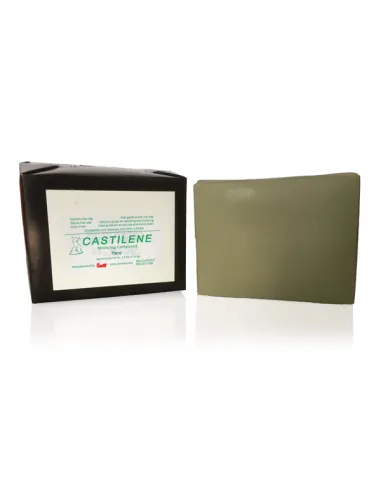
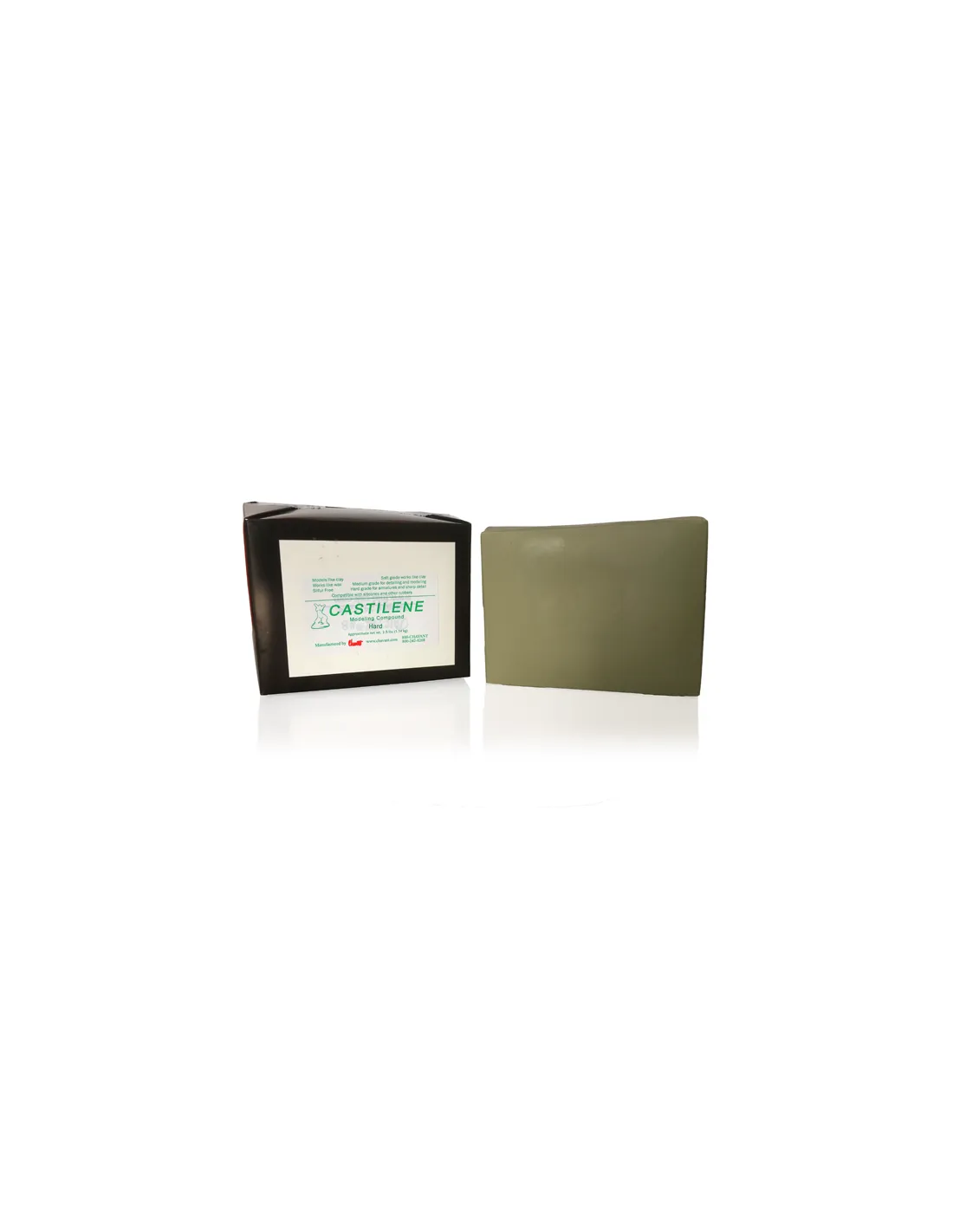
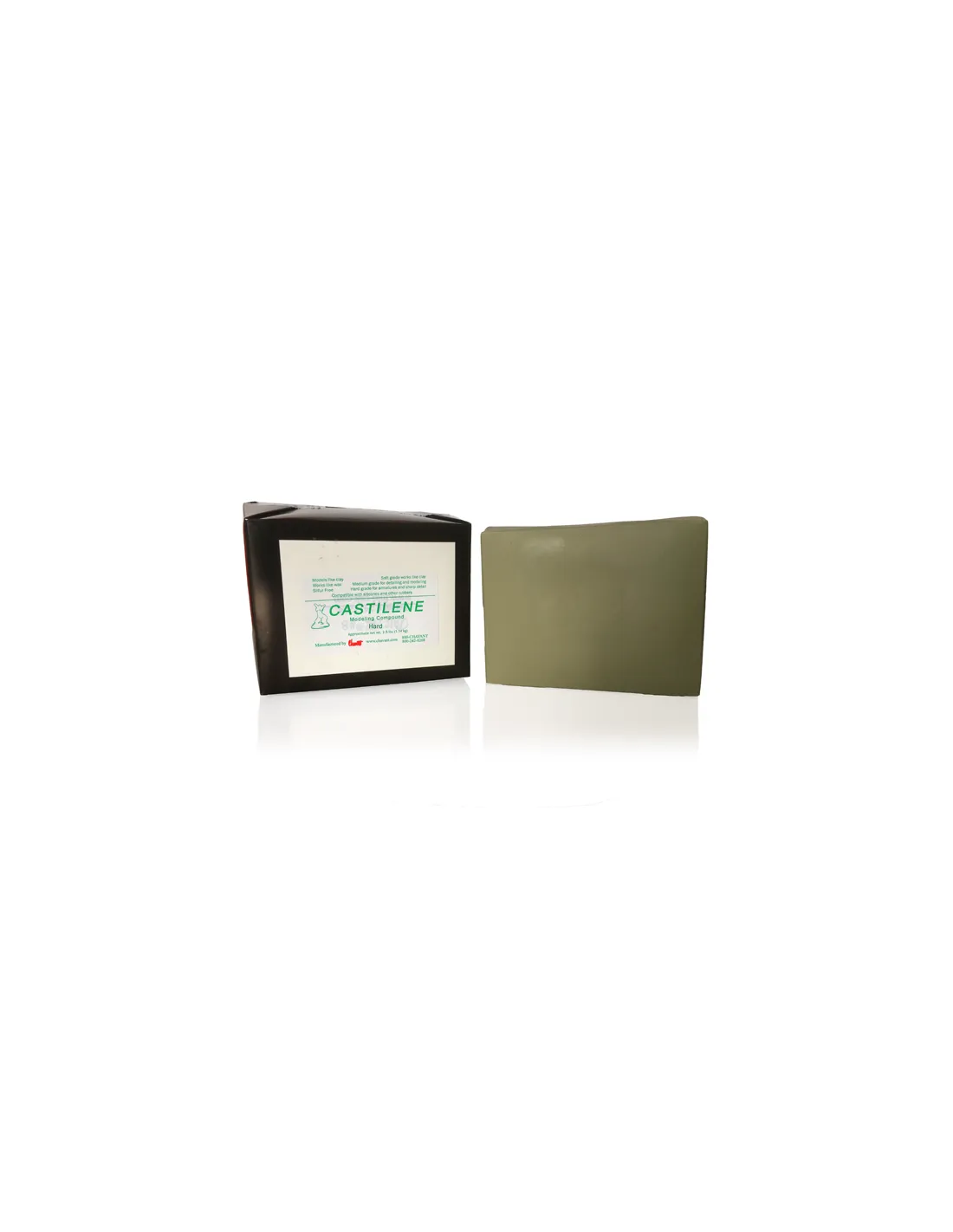
Castilene Hard is a professional high-hardness sulphur-free modelling compound that combines the versatility of clay with the texture and look of wax. It is formulated for sculptors, special effects modellers and industrial designers who need a precise, durable material fully compatible with platinum silicone moulds. It weighs 40% less than other professional modelling clays and holds its shape without an armature in most pieces.
Technical specifications
| Feature |
Data |
| Format |
1.14 kg block |
| Hardness |
High (Hard) |
| Sulphur content |
Sulphur-free |
| Weight vs conventional modelling clays |
40% lighter |
| Softening temperature |
Gentle heat (heat lamp, microwave, double boiler, heat box) |
| Melting / casting temperature |
Above 80 °C |
| Maximum recommended temperature |
80 °C (bubbles appear above this) |
| Direct flame |
Not recommended |
| Cross-hardness compatibility |
Compatible with Castilene Medium and Castilene Soft |
| Compatible with platinum silicone moulds |
Yes (no inhibition, sulphur-free) |
What it is used for
Castilene Hard is designed for high-precision professional modelling. Its elevated hardness makes it ideal for creating structural bases, internal armatures within a Castilene piece, and ultra-fine details that require a material that will not yield under tools. Being sulphur-free, you can model directly and make the silicone mould without any intermediate process.
- Artistic sculpture and high-definition figure modelling
- Industrial prototyping and product design
- Special effects: heads, busts, anatomical pieces and masks
- Structural base for large pieces without the need for a metal armature
- Ultra-fine details over previous models in Castilene Medium or Soft
- Creation of masters for platinum or tin silicone moulds
- Combined use with other Castilene hardness grades for different areas of the piece
How to use it
- Soften the material: use a heat lamp, heat box, microwave in short intervals or a double boiler. Never apply direct flame or exceed 80 °C.
- Check the temperature: the material should be pliable but not liquid. If bubbles appear, it is too hot; let it cool for a few minutes.
- Build the base shape: take advantage of the Hard's rigidity to create the main structure. In most pieces you will not need an armature.
- Work the detail: using modelling tools or slightly heated metal tools, sculpt the detail while the material remains warm.
- Combine hardnesses if needed: add Castilene Medium or Soft in areas that require greater malleability and return to Hard for the finest details. All three hardnesses are mutually compatible.
- Cool to burnish: let the piece cool to room temperature to achieve maximum hardness and apply the burnishing process with wax-compatible products.
- Make the mould: being sulphur-free, you can pour platinum silicone directly onto the piece with no risk of inhibition.
Usage tips
Temperature control: the secret to good modelling
Castilene Hard works best within a specific temperature range. Below room temperature it is very rigid and may crack if forced; properly warmed, it responds like the finest clay. Keep the piece in a heat box or under a lamp while working specific areas, and let the rest cool to serve as support. If you need to use it as a casting (above 80 °C), work in a temperature-controlled container and avoid prolonged overheating to prevent material degradation.
Strategic combination of hardnesses
The most efficient technique with Castilene is to use Hard as the structural core, add medium hardness variants in transition zones, and finish with Hard again for high-definition details. All three versions of Castilene (Hard, Medium and Soft) are fully compatible: they adhere to each other without visible seams and can be reworked together.
Finishing and polishing
Once cooled, the surface of Castilene Hard can be burnished with cotton cloths and wax polishing products. You can also run slightly heated metal tools over it to remove fingerprints or tool marks. If you intend to paint or seal the piece before moulding, make sure the product you use is wax-compatible and does not contain aggressive solvents that could attack the surface.
Frequently asked questions
Can I make silicone moulds directly on this material?
Yes. Castilene Hard is sulphur-free, so it does not inhibit the cure of addition (platinum) silicones. You can pour the silicone directly onto the modelled piece without any additional pre-treatment.
What is the difference between using a high hardness and a medium hardness for modelling?
High hardness allows finer details and a firmer surface under tools, especially for very defined edges and textures. Medium hardness is more comfortable for organic modelling and broad forms. On complex pieces, the usual approach is to combine both depending on the working area.
Do I need to make an armature for large pieces?
In most cases, no. The strength and lightness of Castilene Hard (40% lighter than other professional modelling clays) allows it to support itself. For very large-volume pieces or those with very pronounced overhangs, a light armature can help, but it is not essential.
How do I soften it correctly without damaging the material?
You can use heat lamps, heat boxes, microwave in short intervals, heat guns at a safe distance, or a double boiler. Never apply direct flame and do not exceed 80 °C: above that temperature the material starts to form bubbles and may degrade. Heat it progressively and check the texture before you start working.
Can it be used as a casting if melted?
Yes. Above 80 °C, Castilene Hard melts and can be poured into moulds. It is a useful technique for duplicating basic shapes or filling voids. Monitor the temperature with a thermometer to avoid overheating.
Is it compatible with other professional modelling clays on the market?
Castilene Hard is compatible with the other hardnesses in the Castilene range (Medium and Soft). When working in combination with other professional modelling clay families, such as Chavant Hard or Chavant Medium, adhesion between materials may vary; we recommend a preliminary test.
Which tools work best with this material?
Any traditional wax modelling tool works well: metal spatulas, styluses, loop tools and scrapers. Wooden tools are especially useful for organic textures. If you slightly heat the tool, the surface finish is cleaner.
How much material do I need for a life-size head or bust?
For a life-size head without an internal armature, the usual amount is between 4 and 8 kg depending on wall thickness. Castilene Hard weighs 40% less than other professional modelling clays, which makes handling large pieces much easier. If you need a more detailed estimate, contact the Feroca team.