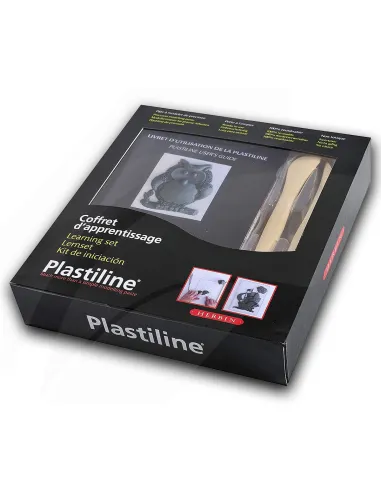
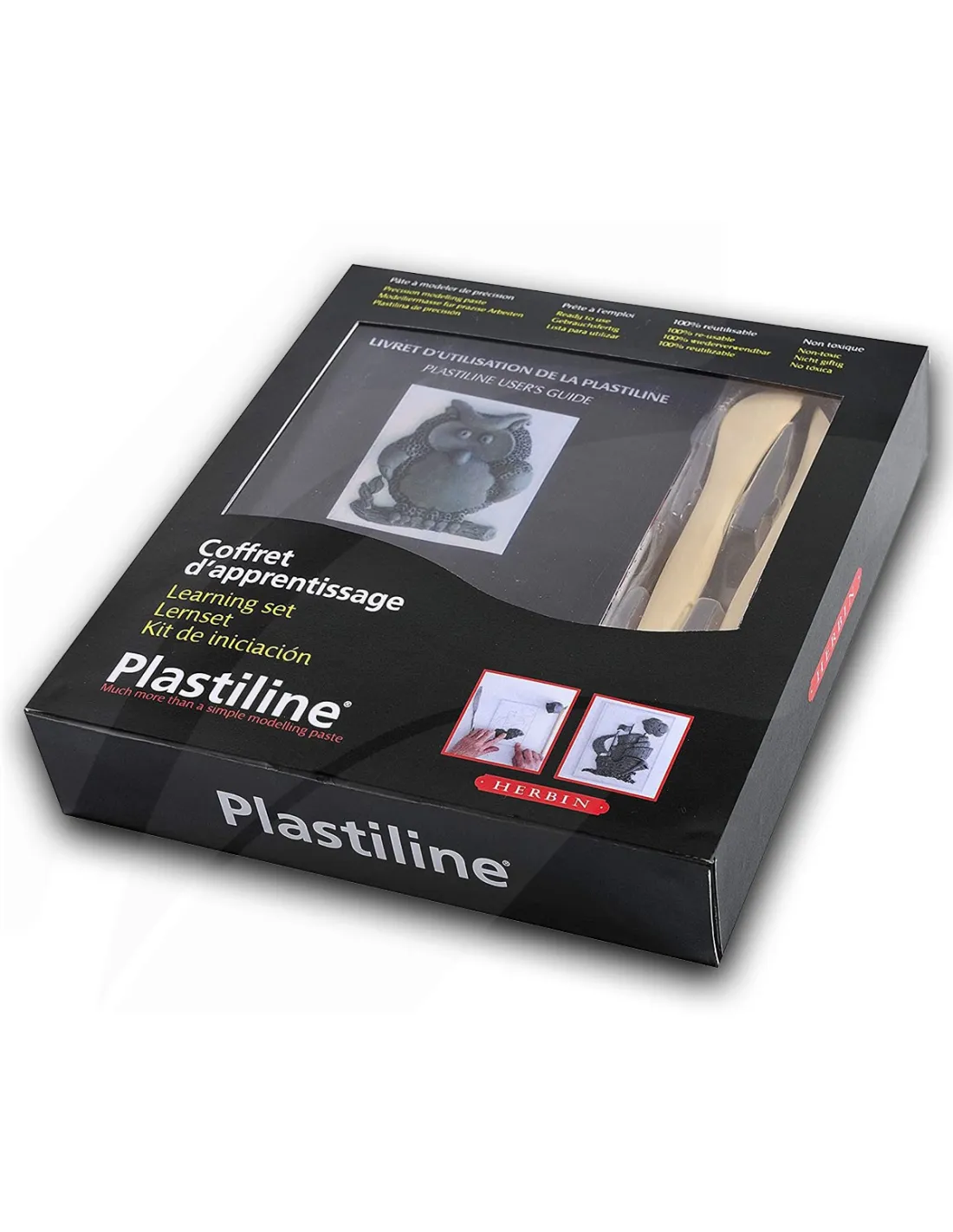
The J. Herbin modelling starter box brings together everything you need to start working with professional plastiline from day one: material, support board, armature, tools and a teaching guide all in one pack. Plastiline Herbin is not a school clay — it is the same material used by sculptors, product designers and special effects professionals, with over three centuries of history behind it and properties you won't find in any art supply store material.
Technical specifications
| Component / Parameter |
Detail |
| J. Herbin Plastiline included |
1 block of 350 g, dark grey colour |
| Work board |
1 MDF board |
| Modelling surface |
1 transparent plexiglass board |
| Armature |
3 m of wire |
| Wooden tools |
2 units |
| Teaching material |
Model reference cards + instruction manual |
| Colour |
Dark grey |
| Air dries |
No — indefinitely reusable |
| Melting point |
40–50 °C (bain-marie) |
| Recommended working temperature |
Ambient or slightly warmed with a heat gun / hair dryer |
| Melting cycles without loss of properties |
Up to 5 times |
| Paintable finish |
Yes — with acrylic paints or shellac diluted in alcohol |
| Origin |
France (brand founded in 1670) |
What it is used for
This kit is designed for anyone starting out in professional plastiline modelling who needs a complete starting point without having to source each element separately. Plastiline Herbin is a reference material in technical sculpture, industrial prototyping and special effects production: dimensionally stable, it does not harden in air and allows you to work with the level of detail that professionals demand.
- Learning basic sculpture and three-dimensional modelling techniques
- Creating concept models and prototypes for product design
- Modelling figures, busts and heads for artistic sculpture
- Making masters and original models for subsequent mould making
- Prototyping pieces for special effects and character work
- Training and introductory workshops in professional modelling
- Free practice with a material that never expires or hardens between sessions
How to use it
- Prepare the armature: use the included wire to build the internal structure of the piece. The armature supports thin areas (arms, necks, limbs) and prevents the weight of the material from distorting the whole.
- Condition the plastiline: at room temperature Plastiline Herbin is firm. If the studio is cold or you want to soften it for initial applications, warm it gently with a hair dryer or heat gun on low power for a few seconds — never put it directly in an oven without temperature control.
- Work on the plexiglass board: the transparent surface lets you see the profile of the piece from below and spot asymmetries. Rest the whole assembly on the MDF board for greater stability.
- Build in layers: apply the material in thick blocks first to define the overall volumes. Add thinner layers for detail once the basic form is established.
- Refine with the wooden tools: use the two included spatulas to smooth surfaces, define planes and work hard-to-reach areas. For greater precision, check out the 11-Piece Modelling Tool Set from Feroca.
- Consult the manual and reference cards: the included teaching material proposes progressive exercises. Follow the recommended sequence to build the fundamentals before tackling complex pieces.
- Recycle leftover material: Plastiline does not dry out. Offcuts and shavings can be reintegrated into the main block by melting them in a bain-marie (40–50 °C) up to a maximum of 5 times without loss of properties.
- Final painting (optional): if you want to preserve the finished piece with colour, apply a base coat of shellac diluted in alcohol and then paint with acrylics. This seals the surface and prevents the paint from reacting with the natural oils in the material.
Tips and advice
Temperature control in the studio
Plastiline Herbin responds very well to small temperature changes. In summer or in warm studios it can be somewhat soft for high-detail work — in that case, put the piece in the fridge for 10–15 minutes before the refining session. In winter or in cold studios, a brief blast of heat from a hair dryer on low power is enough to restore plasticity. Never exceed 50 °C in a sustained way or the material will temporarily lose cohesion.
Compatibility with silicones and moulds
If your ultimate goal is to obtain a mould from an original modelled in Plastiline Herbin, bear in mind that this material can inhibit the curing of platinum (addition) silicones due to the sulphur content in some plastiline formulations. Before pouring a platinum silicone over a Plastiline master, always carry out a cure test on a small, inconspicuous area. If you observe that the silicone does not cure at the contact zone, apply a sealing coat of shellac and allow it to dry completely before pouring. Tin (condensation) silicones do not present this problem and are a safe alternative for moulding directly over Plastiline.
Storage and longevity of the material
Store the Plastiline block wrapped in cling film or in an airtight bag when not in use. Although it does not harden in air, prolonged exposure to dust and studio dirt can contaminate the surface and make fine finishes more difficult. Stored correctly, Plastiline lasts indefinitely — the leftover material from this kit will serve you in future projects with no expiry date of any kind.
Frequently asked questions
What is the difference between professional plastiline and school clay?
School clays are formulated for children's use: they are soft, brightly coloured and not designed to hold detail. The J. Herbin Plastiline included in this kit is a studio material with a stable formulation, controlled hardness and the ability to retain fine edges and textures for weeks without deforming. It is the same type of material used in special effects studios, industrial design and technical sculpture.
Is this kit enough to make a full head or a bust?
The included 350 g is suitable for small-to-medium sized pieces: a head of 10–15 cm, a hand, a miniature torso or several small figures. For a life-size head or a bust up to the shoulders you will need at least 2–3 kg of additional material. In that case you can expand with loose blocks of Plastiline J. Herbin or explore options such as Chavant Hard or Chavant Medium for larger-volume pieces.
Can I take a mould directly from the original modelled with this material?
Yes. Plastiline is one of the most widely used materials as a master for mould making. It works without any issues with tin (condensation) silicones. If you use platinum (addition) silicones, apply a sealing coat (shellac) and wait for it to cure completely before pouring the silicone, as some sulphur-containing plastiline formulations can inhibit the curing of addition silicones.
Does the material harden if I leave a piece unfinished for several days?
No. Plastiline Herbin does not dry out or harden in air. You can leave a half-finished piece in the studio indefinitely and pick up the work exactly where you left off. Just make sure to cover it with cling film or a bag to prevent surface dust from accumulating.
How do you correctly warm it up to soften it?
The most controlled method is to apply gentle heat with a hair dryer or heat gun on low power for a few seconds, keeping your distance. You can also melt the entire block in a bain-marie between 40 and 50 °C, which allows you to fill cavities, reuse offcuts or reset the piece. Avoid the microwave or temperatures above 50 °C in a sustained manner, as these can cause the oils to separate and temporarily alter the consistency.
What tools work best with this material?
The kit includes two wooden spatulas for basic tasks. For more detailed and precise work, the 11-Piece Modelling Tool Set from Feroca significantly expands the possibilities: punches, loop tools, spatulas with different profiles and smoothing tools. The set of 6 loop tools are especially useful for removing material from concave areas or creating organic textures.
Can I paint the finished piece?
Yes. First apply a coat of shellac diluted in alcohol as a sealant and allow it to dry completely. You can then use acrylic paints normally. Without a sealant, the oils present in the Plastiline can interfere with paint adhesion or cause staining over time.
What other professional plastilines are there for when I want to progress?
Once you have mastered the basic techniques with this kit, you can explore other options depending on the type of work. Chavant Hard is aimed at high-detail pieces requiring great firmness. Chavant Medium offers a balance between detail and workability. For work that does not require moulds or preservation, the vegetable-based Industrial Plastiline is an economical and versatile option.