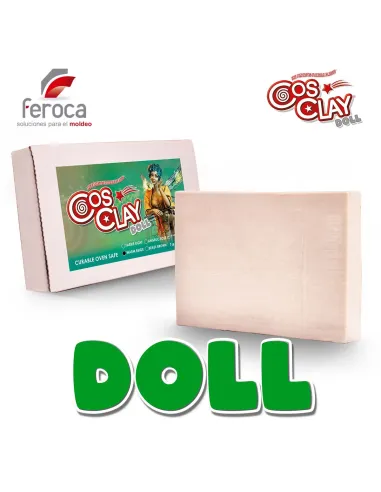
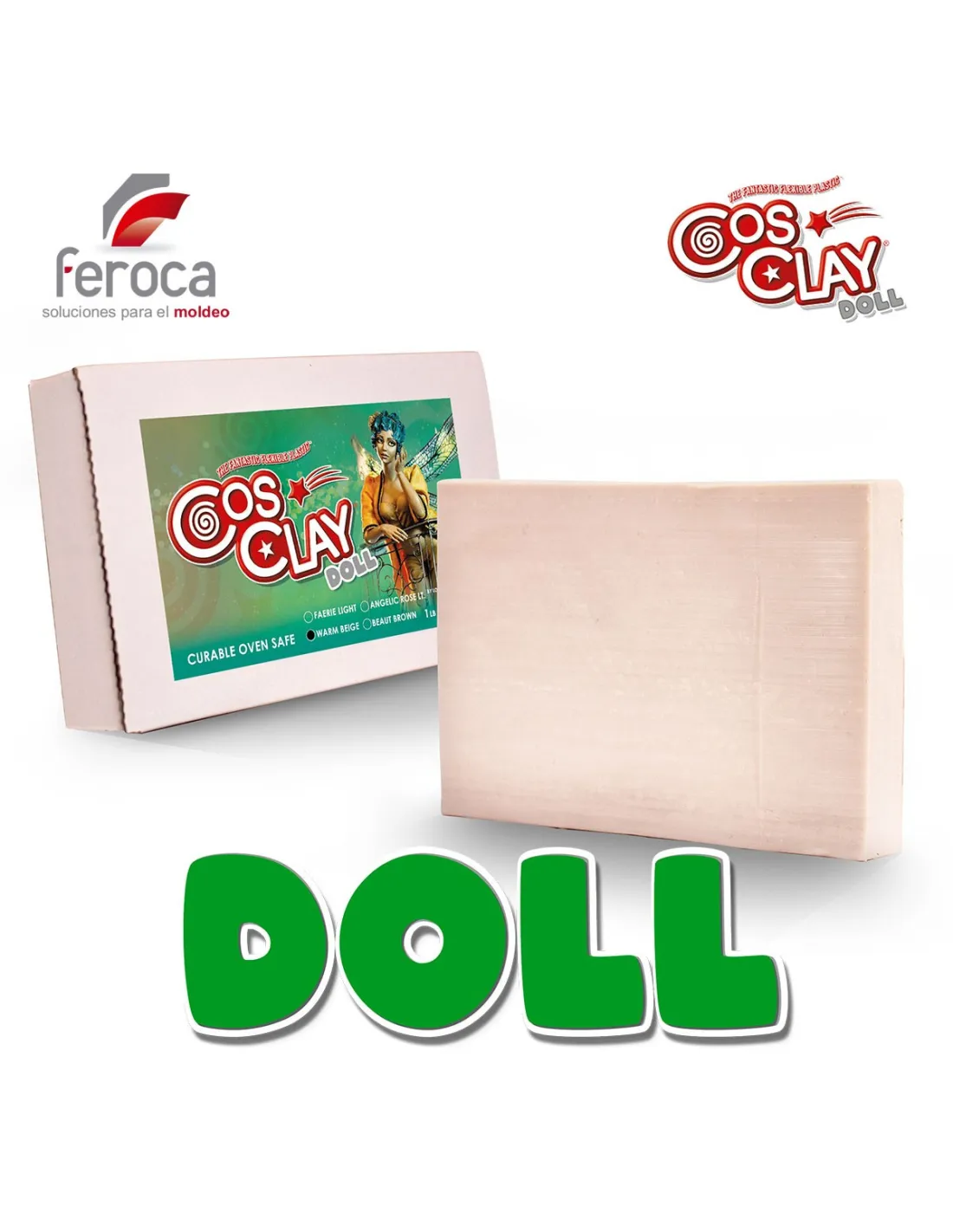
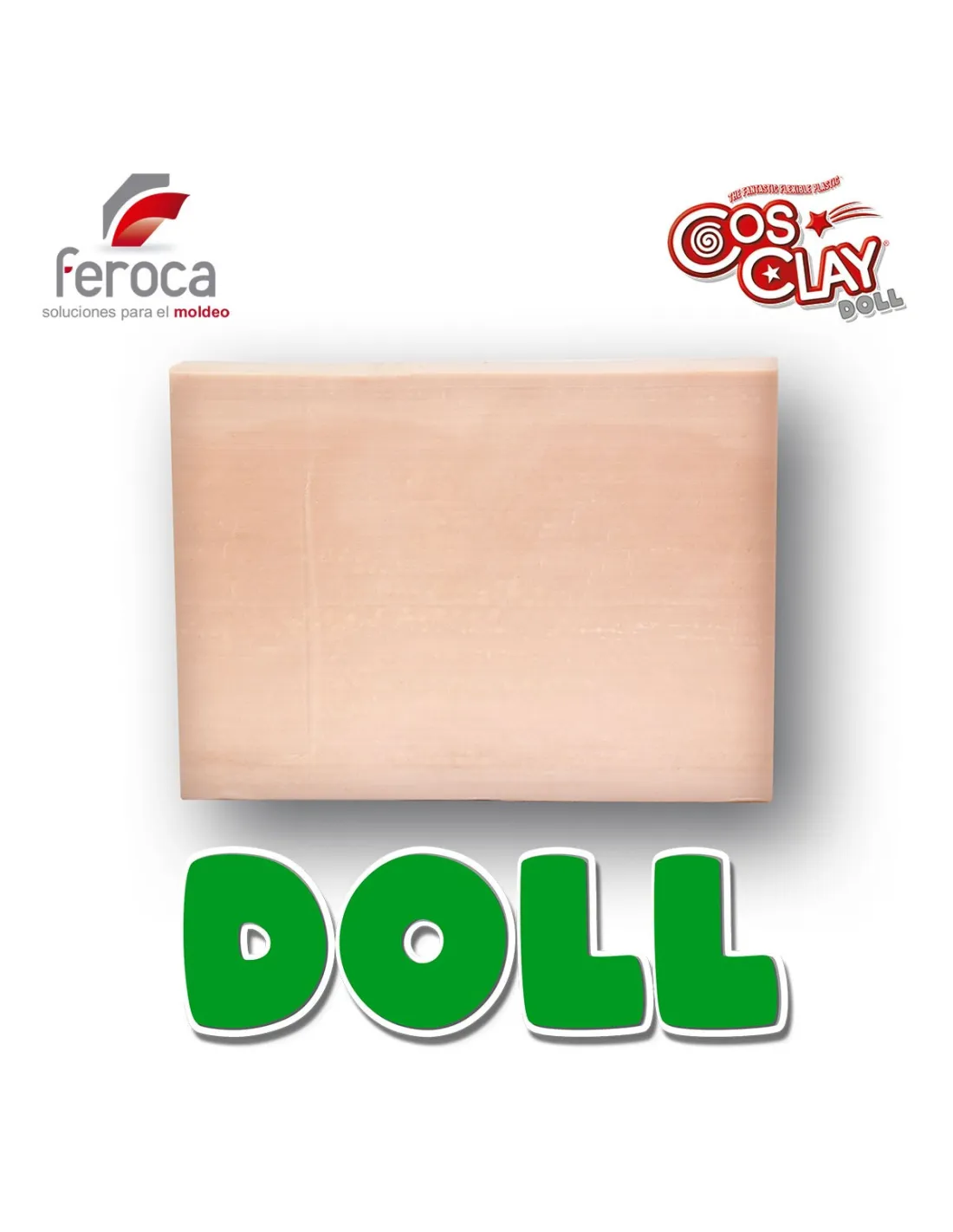
Cosclay Doll Warm Beige is a hybrid plastic/rubber polymer clay that, after oven curing at 135°C, retains exceptional flexibility without losing strength or detail. Unlike conventional polymer clays, it allows you to create thin and delicate pieces that won't break during handling, articulation or transport. Its warm flesh tone is specifically formulated for artistic doll work, realistic figures and animation characters where skin tone is the starting point.
Technical specifications
| Parameter |
Value |
| Material type |
Hybrid plastic/rubber polymer clay |
| Cure temperature |
135°C (275°F) |
| Indicative cure time |
15 min per 6 mm of thickness |
| Post-cure state |
Flexible and resistant solid |
| Shrinkage / expansion |
No shrinkage or expansion |
| Colour |
Warm Beige (warm flesh tone) |
| Format |
227 g block |
| Surface finish |
Accepts painting, sanding, polishing and texturing |
What it is used for
Cosclay Doll Warm Beige is designed for any application where the cured piece must withstand bending, articulation or continuous handling without breaking. Its warm flesh tone makes it especially practical for figurative projects without the need to mix pigments from scratch.
- Heads, hands and limbs for artistic dolls (OOAK dolls)
- Characters and puppets for stop motion animation
- Articulated figures with flexible joints
- High-fidelity miniatures for dioramas and display work
- Character prototyping where flexibility is required in fine detail areas
- Sculptural artworks combining structural rigidity and elastic zones
- Restoration and customisation of collectible dolls
How to use it
- Condition the clay: knead Cosclay Doll Warm Beige with your hands for 1–2 minutes until it is pliable and uniform. If it is very cold, warm it briefly between your palms or near a gentle heat source.
- Sculpt your piece: work directly with your fingers or use sculpting tools and modelling tool sets to add detail. Cosclay is compatible with standard polymer clay techniques: wire Armature, paper or aluminium cores, etc.
- Partial cure if you need to add layers: if the project requires multiple sessions, you can partially cure the piece (same temperature, reduced time) and add more material on top without losing adhesion between layers.
- Prepare the oven: preheat to 135°C (275°F). Use an independent oven thermometer to verify the actual temperature; domestic ovens often have significant variation.
- Cure the piece: bake for 15 minutes per 6 mm of thickness. Place the piece on baking paper or a ceramic surface to avoid marks on the base.
- Cool slowly: allow the piece to cool inside the switched-off oven or at room temperature. Avoid rapid cooling with water.
- Final finish: once cool, you can sand, polish, paint with acrylics or apply patinas. The surface accepts all types of finishes as long as the material is fully cured.
Usage tips
Temperature control: the most critical factor
Cure temperature is decisive for achieving Cosclay's characteristic flexibility. Below 135°C the piece will be brittle and fragile; above it, it may darken or become excessively rigid. Invest in an independent oven thermometer: it is the cheapest and most useful tool you can have in the studio when working with polymer clays.
Layered construction and internal cores
For large pieces or areas with significant thickness, build over a crumpled aluminium foil or aluminium wire core. This reduces the volume of material needed, shortens cure time and improves internal structure. Apply successive layers of 3–6 mm, curing between layers when necessary. Adhesion between cured layers and fresh clay is one of the key advantages of Cosclay over other polymer clays.
Mixing tones and compatibility with other polymer clays
Cosclay Doll Warm Beige can be mixed with other colours in the Cosclay range to adjust the skin tone or create colour variations. It is also compatible with Super Sculpey Beige to modify working firmness in the raw state, although the final result in terms of flexibility will be determined by the proportion of Cosclay in the mix. If you need greater firmness for sculpting very fine details before curing, consider mixing with Cosclay Sculpt Medium Firm Gray, which offers greater raw-state resistance while maintaining post-cure flexibility.
Frequently asked questions
How does a flexible polymer clay differ from a conventional one?
Conventional polymer clays cure to a rigid state and can break under bending or impact. Cosclay Doll Warm Beige is formulated with a hybrid plastic/rubber base that, after curing at 135°C, retains real flexibility: thin pieces bend without breaking, making it ideal for joints, slender limbs and pieces subject to frequent handling.
Can the same piece be baked more than once?
Yes. Cosclay accepts multiple bakings without degrading, as long as the temperature of 135°C is maintained. This feature is especially useful for projects that require adding layered details or correcting specific areas after an initial cure. Just make sure the oven temperature is stable in each cycle.
What happens if I bake the clay at a higher temperature than recommended?
If you significantly exceed 135°C, the piece may darken, lose some of its flexibility or even release irritating fumes. Always work with an independent oven thermometer and ventilate your workspace. If the piece burns, discard it and do not inhale the fumes.
Can I paint the piece once cured?
Yes. Cosclay Doll Warm Beige accepts acrylic paints, patinas and effect powders once fully cured and cooled. For areas that will undergo continuous flexing, use flexible acrylic paints or thin them slightly to prevent the paint layer from cracking with movement.
Can it be sanded and polished like other polymer clays?
Yes. Once cured, Cosclay can be sanded starting with coarse grit (220–400) and progressing to fine grits (800–2000) to achieve a polished surface. For a porcelain-like glossy finish, complete with a fabric burnisher. The flexible nature of the material makes wet sanding especially recommended to avoid marks.
How much material is needed to sculpt a standard-size doll head?
For a medium-size doll head (1/3 scale or similar, approximately 8–10 cm tall) built over an aluminium core, 227 g is usually sufficient for the complete head including detail layers. For larger projects or those including bust and shoulders, consider purchasing two units or supplementing with another colour from the range.
Is it compatible with internal wire armatures?
Yes, and it is the recommended way to work on articulated figures. The aluminium wire acts as a skeleton and reduces the volume of clay needed. Cosclay's adhesion to wire is good in the raw state and is maintained after curing. For added security in articulated pieces, wrap the wire with aluminium tape before applying the clay.
Can it inhibit the cure of platinum silicones if used as an original for mould making?
Polymer clays in general do not contain sulphur, so they do not typically inhibit platinum silicones. However, if you mix Cosclay with other modelling materials, always check compatibility by doing a cure test on a small area before pouring the full mould. If you notice the silicone remains tacky in contact with the piece, seal the surface with a water-based varnish and allow it to dry completely before mould making.