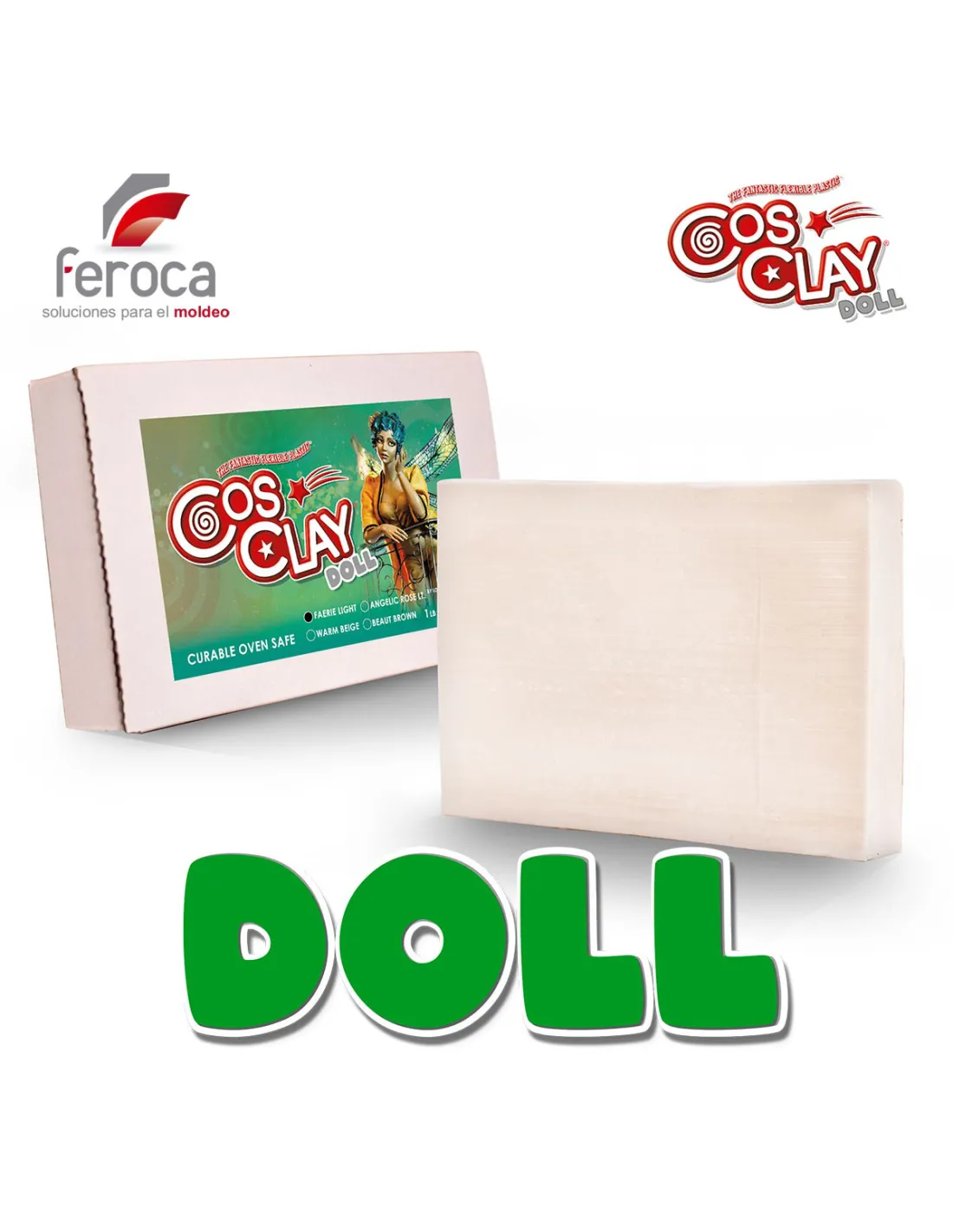
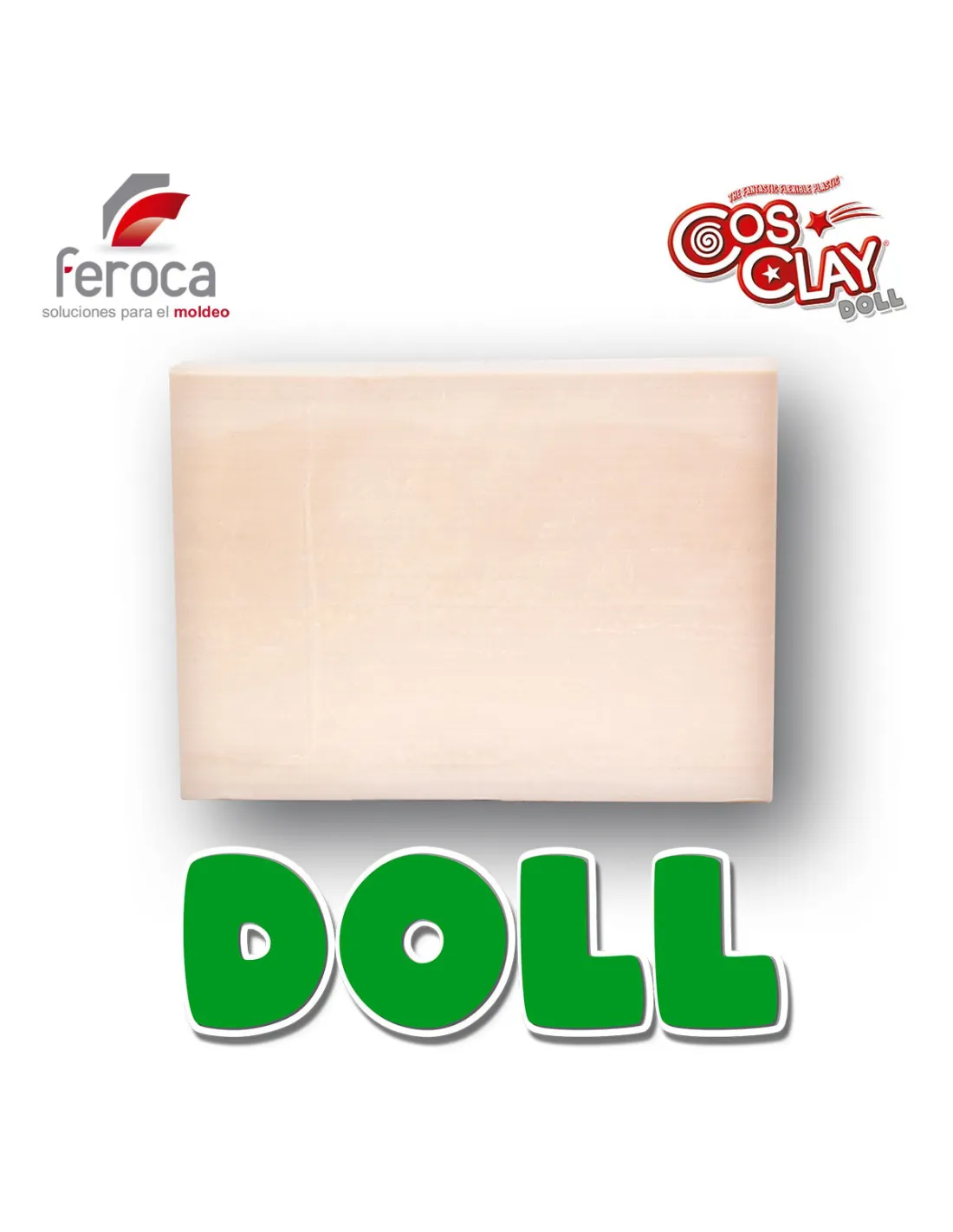
Cosclay Doll Faerie Light is a hybrid plastic/rubber polymer clay that, once baked at 135 °C, combines firmness and flexibility in the same piece: it won't crack or break when thin elements are bent. Its Faerie Light shade — a very light flesh tone with a fantasy profile — makes it the ideal base for fairy, elf and art doll sculptures where the starting colour shapes the final result.
Technical specifications
| Parameter | Value |
|---|
| Family | Hybrid polymer clay (plastic/rubber) |
| Colour | Faerie Light (very light flesh / fantasy tone) |
| Format | 227 g block |
| Cure temperature | 135 °C |
| Cure time | 30 min per 6 mm of thickness |
| Post-cure behaviour | Flexible and durable, not brittle |
| Shrinkage / expansion | None (100% solid) |
| Sag resistance | High (self-supporting during baking) |
What it's used for
Cosclay Doll Faerie Light is designed for any piece that must withstand bending, impact or repeated handling without breaking. Its light tone is an advantage when the base colour influences the final result with pigments or translucent paints.
- OOAK art dolls with fair or fantasy skin
- Stop-motion characters and puppets with flexible joints
- Articulated miniatures and figures for collecting or play
- Fairy, elf and fantasy creature sculptures with fine features
- Dioramas with thin, delicate elements requiring impact resistance
- Prototypes and study models where positions need to be revised after curing
How to use it
- Condition the clay: work a piece between your hands until it softens. If it is very cold, a few minutes in a warm place will help.
- Sculpt the piece: model with modelling tools or your fingers. Cosclay accepts both direct sculpting and layer-by-layer building. Modelling tools allow you to work fine detail.
- Correct and refine: use isopropyl alcohol to smooth surfaces or remove fingerprints before baking.
- Bake at 135 °C: place the piece in an oven dedicated to polymer clay or a domestic oven with an independent thermometer. Allow 30 minutes per 6 mm of thickness at the thickest point.
- Allow to cool: carefully remove the piece and let it cool on a flat surface before handling. The material reaches full strength as it cools.
- Finishing: sand, paint with acrylics, apply varnish, or add additional layers of uncured clay for a second bake if you need to add detail.
Tips and tricks
Temperature control
Domestic ovens often deviate ±10–15 °C from the dial setting. Always use an independent oven thermometer to verify you are reaching a true 135 °C. Above 160 °C the clay can burn and release unpleasant fumes: ventilate the space well and do not exceed the indicated temperature.
Layer building and internal Armature
For larger pieces — doll heads, busts — build over an aluminium wire Armature or a compacted aluminium foil core. This reduces the final weight, saves material and ensures even curing by avoiding excessively thick sections. Each additional layer added over already baked parts requires a new baking cycle; Cosclay handles this without adhesion issues between layers.
Colour mixing and compatibility
Faerie Light blends perfectly with all other Cosclay colours and with standard polymer clays to achieve the exact skin tone you need. If you want a firmer version for more detailed carving, combine it with Cosclay Sculpt Medium Firm Gray. For those used to working with more conventional clay references, Super Sculpey Beige is mix-compatible.
Frequently asked questions
What is the difference between a standard polymer clay and a hybrid plastic/rubber clay?
Conventional polymer clays cure as a rigid thermoplastic: they handle compression well but can chip or break when bent. Cosclay Doll Faerie Light incorporates rubber elastomers in its formulation, so the baked piece combines structural rigidity with the ability to flex. The result is that fingers, fairy ears or thin limbs can be bent without breaking — critical for articulated dolls and stop-motion.
Can I bake in a regular kitchen oven?
Yes, as long as you use an independent thermometer to verify the actual temperature. Dedicate the oven — or a specific tray — exclusively to polymer clay and ventilate the kitchen well during the process. Do not use a microwave: the heat is uneven and can burn the piece.
How long do I need to bake a piece?
The guideline is 30 minutes per 6 mm of thickness at the thickest point of the piece, at 135 °C. A doll head 12 mm thick at its thickest point will need approximately 60 minutes. If in doubt, it is better to bake longer than to underbake: underbaking leaves the piece fragile and brittle.
Can more clay be added over an already baked piece?
Yes. Cosclay accepts successive layer building: apply fresh clay over the already cured area, add detail and bake again. Adhesion between the new layer and the baked base is solid. This technique is common for adding fine details — eyelashes, veins, skin texture — over an already stabilised base form.
Can Cosclay be painted after baking?
Yes. The baked surface accepts acrylics, oils, water-based paints and varnishes without primer, although a thin coat of acrylic primer improves adhesion in areas of intense flexing. The Faerie Light tone, being very light, does not taint pigments and allows translucent finishes that mimic skin more naturally.
Does Cosclay inhibit platinum silicones if I want to make a mould of the original?
Polymer clays in general can contain additives that inhibit addition (platinum) silicones. To mould a Cosclay master, always seal the surface with acrylic lacquer or shellac and allow it to cure completely before applying the silicone. Alternatively, use tin condensation silicones, which do not present this problem.
How much clay do I need to sculpt a 1/4 scale doll head?
A hollow doll head at 1/4 scale (approximately 6–7 cm tall) typically requires between 80 and 120 g of clay when built over an aluminium foil Armature. With 227 g you have enough material for a complete head with room for corrections and additional details.
Does it have an expiry date or special storage requirements?
Store the clay in its original packaging, in a cool place away from direct sunlight. Prolonged heat can trigger partial pre-curing. Under proper conditions, shelf life exceeds 2 years. If the clay becomes very hard and crumbly before baking, you can soften it by working it with your hands or adding a plasticiser specifically formulated for polymer clay.