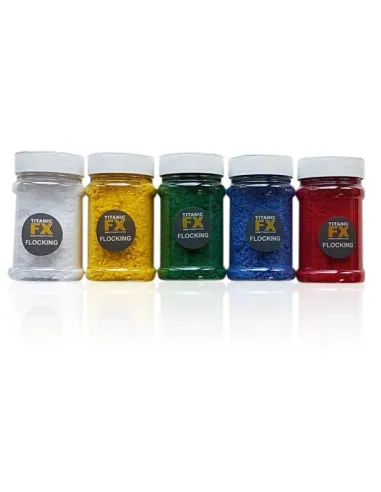
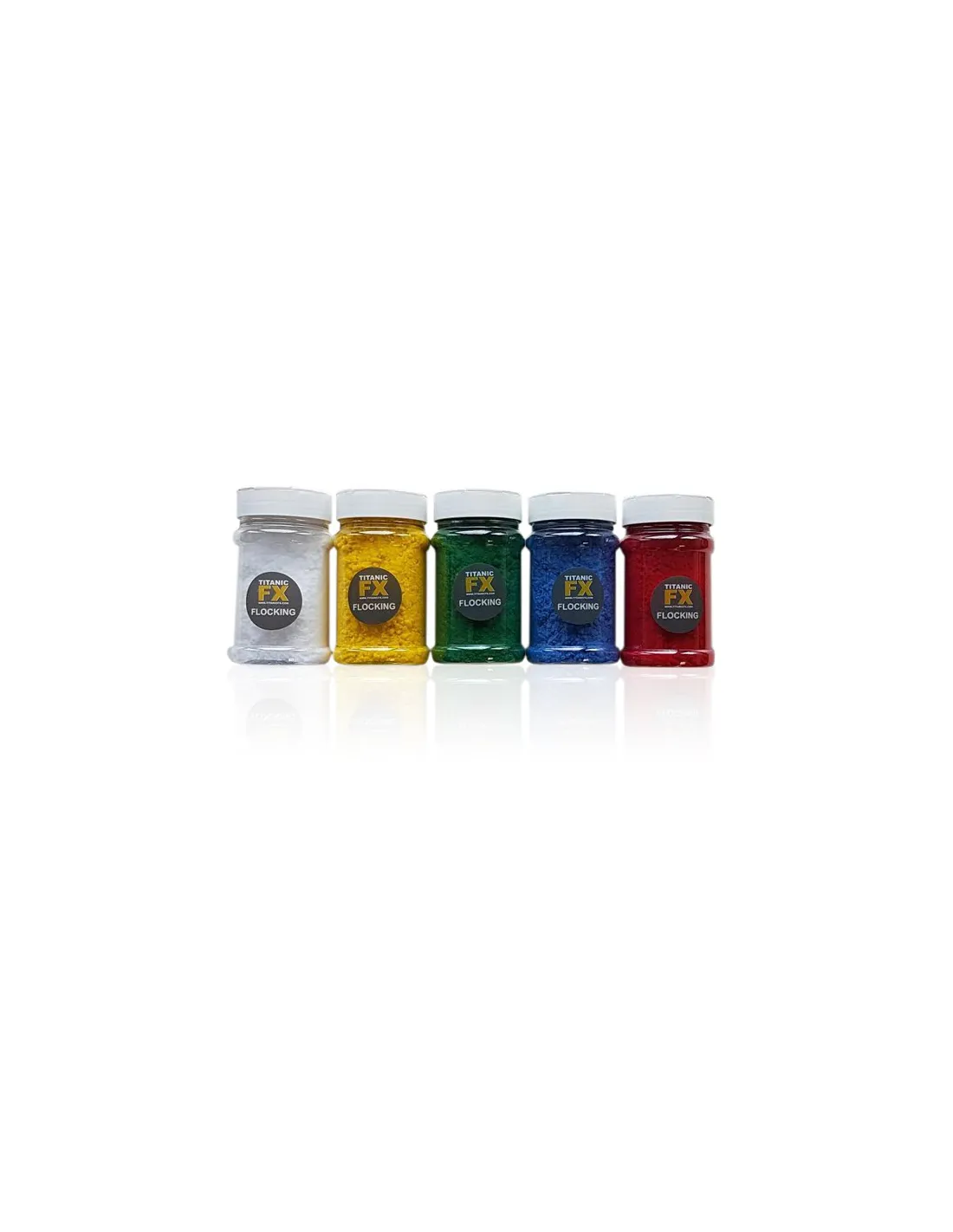
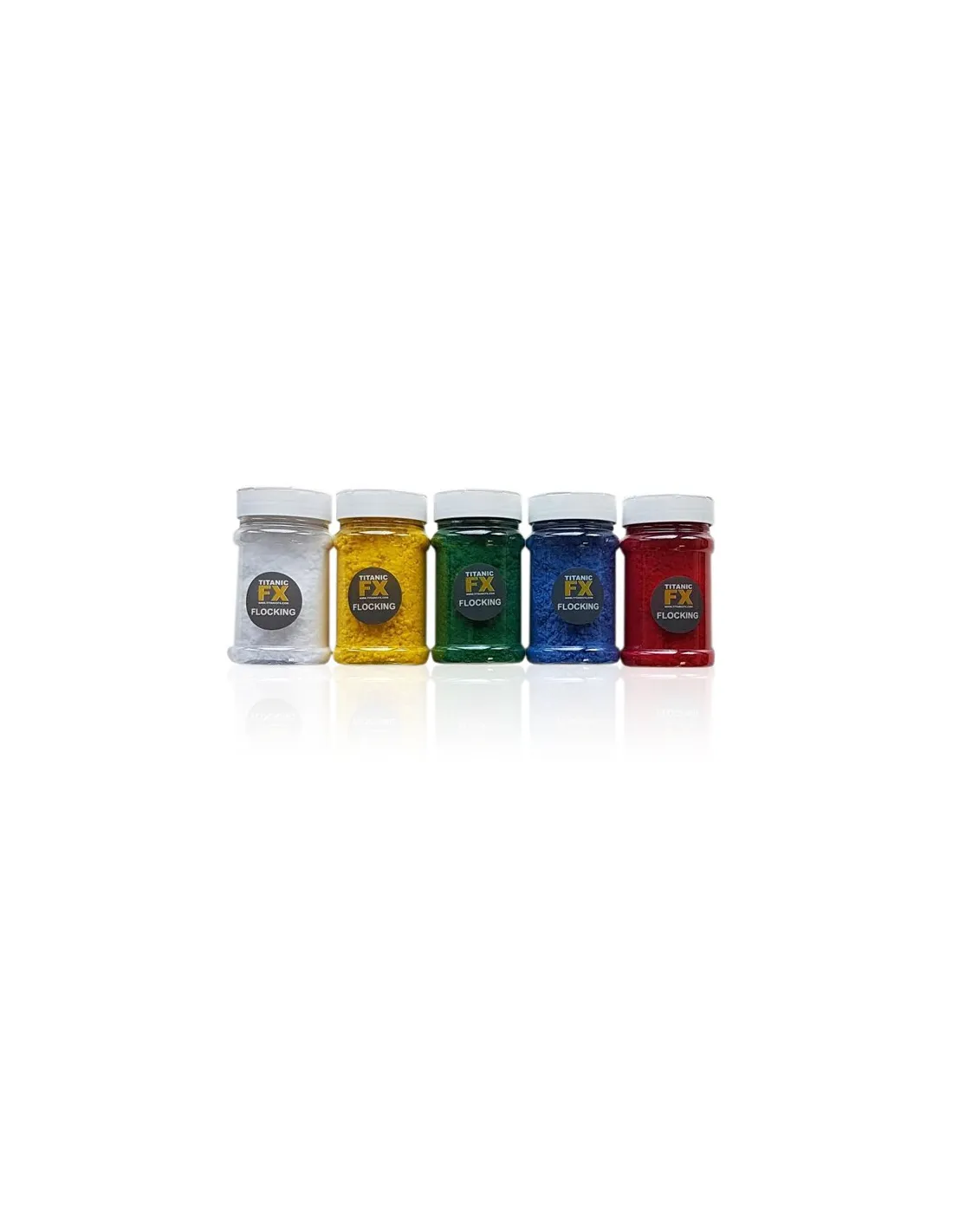
Titanic Fx Flocking is a micro-fibre pigment specifically designed to colour silicones and gelatines for special effects and prosthetics. Unlike paste or liquid pigments, the fibres float within the mix and create a colour depth that realistically mimics the internal structure of skin. This sample pack includes 5 x 100 ml containers in the essential primary colours so you can explore the full range before committing to larger quantities.
Technical specifications
| Format |
Pack of 5 colours |
| Content per container |
100 ml |
| Colours included |
White, Yellow, Green, Blue, Red |
| Pigment type |
Micro-fibres (Flocking) |
| Compatibility |
Silicones, gelatines and other flexible materials |
| Settling |
Very low — lightweight load that remains in suspension |
| Application |
Manual or with a flocking machine |
| Container |
Airtight with dual-speed dispensing cap |
| Brand |
Titanic Fx |
What it is used for
Flocking is designed to achieve skin and flesh colours with a depth and naturalness impossible to obtain with conventional pigments alone. The micro-fibres dispersed throughout the mass create subtle tonal variations that reproduce the internal texture of organic tissue. Its most common uses are:
- Intrinsic pigmentation of silicone prosthetics for special effects and prosthetic makeup
- Colouring of prosthetic gelatines for theatre, film and television
- Achieving custom flesh and skin tones, unique for their chromatic depth
- Mixing with other pigments to fine-tune shades that are difficult to achieve with solid or liquid colorants
- Application with a flocking machine onto surfaces for velvet finishes or surface texture
- Experimentation and development of your own colour palettes before committing to individual colours in larger quantities
How to use it
- Shake the container well before opening — although settling is minimal, the fibres may concentrate slightly at rest.
- Incorporate the Flocking directly into part A or B of your platinum silicone, or into the already-melted gelatine mass, before mixing or casting.
- Mix carefully until the fibres are evenly distributed. You can combine several colours to obtain intermediate shades.
- If you need a denser consistency for working in layers or on vertical surfaces, add a few drops of thixotropic additive to the silicone.
- Dispense using the dual-speed cap: slow position for small precision doses, fast position for larger amounts.
- Pour or apply the mixture into the mould previously prepared with release agent if the mould is not made of silicone.
- Allow to cure according to the base material's instructions. Flocking does not alter the cure times of the silicone or gelatine.
Usage tips
Colour mixing for skin tones
The pack palette (white, yellow, green, blue and red) covers the basic needs for formulating flesh tones. A common base starts with white as the dominant tone, with small additions of yellow and red. Green and blue allow you to neutralise redness or create shadows in deeper areas. Run tests on small amounts before mixing the full batch — once the fibres are incorporated into the cured material, there is no going back.
Combining with liquid or paste pigments
Flocking does not necessarily replace conventional pigments: it can be combined with them to achieve more complex results. Liquid or paste pigments provide colour saturation and uniformity, while the micro-fibres add visual texture and organic depth. Combining both types at low proportions is a common practice in professional prosthetics workshops.
Storage and container maintenance
Always store containers tightly sealed, away from heat sources and direct light. The dual-speed safety cap is designed to prevent accidental spills — make sure it is properly secured after each use. If the Flocking has been stored for a long time, shake the container vigorously before use to re-homogenise the fibres.
Frequently asked questions
Does this type of fibre pigment affect the cure time of silicone?
No. Titanic Fx Flocking is an inert filler that does not interfere with the chemical curing reaction. The gel and demould times of your silicone will be exactly as stated by the manufacturer.
How much Flocking should I add per 100 g of silicone?
There is no fixed dose: the amount depends on the desired colour intensity and the shade of the base silicone. As a starting point, a low proportion (1–3% by weight of the total mix) already produces visible results. It is recommended to run small-scale tests and record the proportions so you can reproduce the colour.
Can it be used in gelatines as well as silicones?
Yes. Titanic Fx Flocking is compatible with prosthetic gelatines. Incorporate it into the mass once melted, before pouring into the mould, stirring well to distribute the fibres evenly.
Do the fibres settle to the bottom over time?
Settling is very low thanks to the microscopic size of the fibres, but after prolonged storage a slight concentration at the bottom of the container may occur. Simply shake well before use to restore the uniform suspension.
Can it be applied with a flocking machine for surface finishes?
Yes. Titanic Fx Flocking is formulated to be compatible with both manual application (mass mixing) and electrostatic flocking machines, allowing velvet finishes or surface textures to be achieved on already-cured pieces.
Is a release agent necessary if the mould is made of silicone?
For silicone moulds a release agent is generally not necessary, as silicone does not adhere to itself. However, if the mould is made of another material (plaster, resin, wood), you must apply a suitable release agent before pouring the mixture.
What if I need a shade that is not in the sample pack?
The pack of 5 basic colours allows a wide range of intermediate shades to be mixed. In addition, Titanic Fx offers additional colours distributed by Feroca in Spain, so once you have identified the shades that work best for your projects you can purchase those specific colours in larger quantities.
Is Flocking suitable for prolonged direct skin contact?
Titanic Fx Flocking is designed for use in prosthetics and special effects applied to skin. However, final biocompatibility also depends on the base material (silicone or gelatine) used. If the application involves prolonged contact with sensitive skin, consult the safety data sheets for all materials involved.