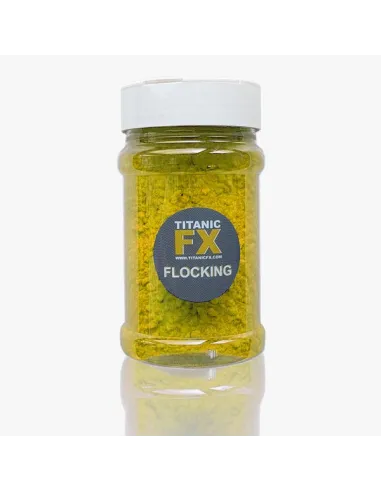
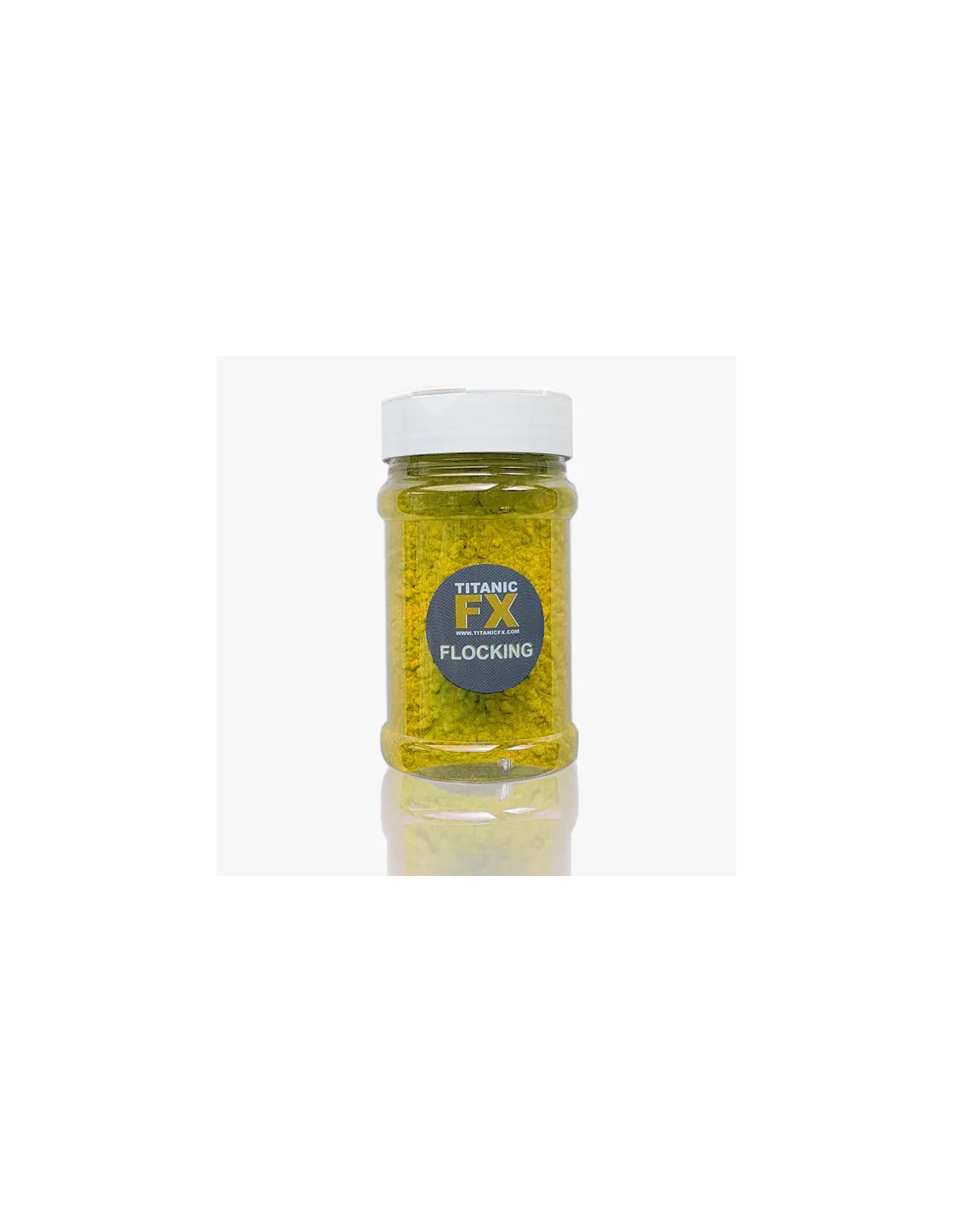
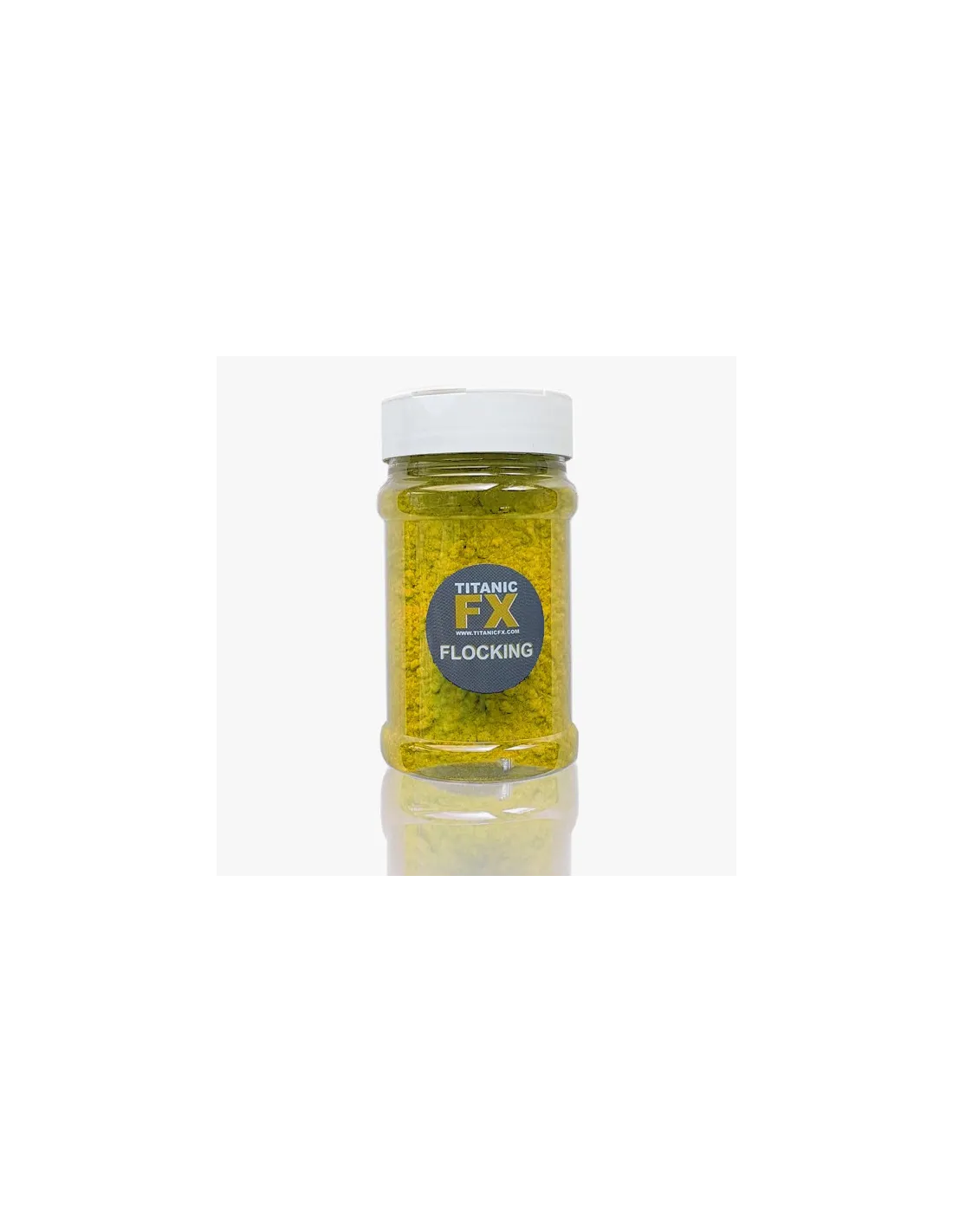
Titanic Fx Flocking Yellow are colour micro-fibres designed specifically to pigment silicones and gelatines for special effects and prosthetics. Unlike conventional paste or liquid pigments, the fibres float in the mix and create a colour depth that very convincingly imitates skin and soft tissue. The filler is so lightweight that it does not settle, ensuring uniform dispersion with every use.
Technical specifications
| Parameter |
Detail |
| Material type |
Flocking micro-fibres |
| Colour |
Yellow |
| Main application |
Pigmentation of silicones, gelatines and similar materials |
| Behaviour in mix |
Does not settle, uniform distribution |
| Application method |
Manual or with flocking machine |
| Packaging |
Airtight container with dual-speed dispensing lid |
| Brand |
Titanic Fx (distributed in Spain by Feroca) |
What it is used for
Titanic Fx Flocking Yellow is designed for special effects makeup professionals, prosthetics artists and flexible materials sculptors who need skin and tissue tones with a level of realism that conventional pigments cannot achieve. The micro-fibres interact with light differently from paste pigments, generating a translucency and depth characteristic of real skin.
- Pigmentation of platinum silicone and tin silicone prosthetics
- Colouring of gelatines for special effects
- Mixing with other Flocking colours to obtain custom flesh tones
- Creating visually deep colour layers in facial or body prosthetic pieces
- Use with a flocking machine for textile or decorative applications
- Combining with paste pigments to shade and enrich the base tone
How to use it
- Prepare the silicone or gelatine following the manufacturer's instructions. For platinum silicones such as PlatSil Gel-00 or PlatSil Gel-10, mix parts A and B first before adding the Flocking.
- Add a small amount of Flocking Yellow to the mix. Start with a small quantity; it is easier to add more than to correct an excess.
- Stir with a spatula until you achieve a homogeneous dispersion. The micro-fibres do not settle, so the mix remains stable.
- If you need to adjust the tone, combine with other Flocking shades or with paste pigments to modify the base yellow colour.
- If you want to adjust the viscosity of the silicone for layered applications or brush-on work, you can add Thixo Additive without affecting the cure time.
- Pour or apply the mix into the mould. To demould without damaging the piece, use a suitable release agent such as Ferosil V 32 on the mould before pouring.
- Allow to cure according to the base material's indicated times. The Flocking does not alter the cure time.
- Once the piece is demoulded, assess whether you need to add further colour layers with extrinsic paints to refine the finish.
Usage tips
Colour mixing for realistic skin tones
Yellow is one of the key tones in skin colour formulation. Mix Flocking Yellow with Flocking in flesh, pink or brown tones to build very convincing skin bases. Always start with small proportions and adjust progressively. The behaviour of the micro-fibres in the final mix may vary slightly depending on the translucency of the base silicone, so it is advisable to do a small test before tackling the full piece.
Dosing and storage
The dual-speed lid on the container allows precise dosing: use the small opening for minimal amounts in fine-tuning mixes, and the larger opening when working with large volumes of silicone. Always close the container airtight after each use to prevent ambient moisture from affecting the fibres. Store in a cool, dry place away from direct light.
Compatibility with platinum silicones
Titanic Fx Flocking is compatible with platinum (addition) silicones. It contains no sulphur or other agents that could inhibit the cure. If you are using accelerators such as Agente de Curado 81 VF, add it last, after the Flocking has been thoroughly dispersed in the mix, to ensure uniform distribution before the accelerated cure begins.
Notice — Inhibition in platinum silicones: If you use Flocking Yellow with platinum (addition) silicones, make sure that no other material in contact with the mix contains sulphur, tin, latex or amines. Sulphur-based clays, some adhesives and certain modelling materials can inhibit the cure of platinum silicone even though the Flocking itself does not present this problem. When in doubt, always perform a cure test with all the materials involved before working on the final piece.
Frequently asked questions
Does Flocking alter the cure time of silicone?
No. Titanic Fx Flocking Yellow is an inert filler that does not interfere with the chemical curing reaction. The cure time of your silicone or gelatine will be exactly the same as indicated by the base material manufacturer.
Can it be used in gelatines as well as silicones?
Yes. Titanic Fx Flocking Yellow is compatible with both special effects gelatines and platinum and condensation silicones. It is one of the preferred pigmenting agents among prosthetics artists working with gelatines, precisely because of the colour depth it provides.
How much Flocking should I add to the mix?
There is no universal fixed ratio because it depends on the desired tone and the translucency of the base silicone. The general recommendation is to start with very small amounts (a few tenths of a gram per 100 g of silicone) and increase progressively. It is always better to do a preliminary test on a small volume before working on the final piece.
Can it be combined with paste or liquid pigments?
Yes. Flocking and conventional pigments are compatible and complement each other very well. The pigment provides the base tone and saturation, while the Flocking micro-fibres add the depth and translucency that imitates the appearance of real skin. This combination is a common technique among special effects makeup artists.
Can Flocking be used with a flocking machine?
Yes. Titanic Fx Flocking Yellow is suitable for both manual application (direct mixing into silicone or gelatine) and use with an electrostatic flocking machine for textile or decorative applications.
Is the yellow colour stable over time?
The Titanic Fx Flocking micro-fibres are stable once integrated into the cured silicone or gelatine. To keep the product in its container in optimum condition, store it tightly sealed in a cool, dry place away from direct sunlight.
Is there a risk of the Flocking settling in the mix before the silicone cures?
No. One of the main advantages of Titanic Fx Flocking is that its filler is so lightweight that it does not settle in the mix. This guarantees a uniform colour distribution throughout the piece, with no more or less pigmented areas.
Can I use Flocking in platinum silicones without risk of inhibition?
Yes, Titanic Fx Flocking Yellow itself does not inhibit the cure of platinum silicones. It contains no sulphur or other inhibiting agents. However, make sure that the other materials you work with (moulds, modelling clays, gloves) do not contain these agents either, as inhibition can come from any element in contact with the mix.
How much product do I need?Calculate the exact amount before buying and avoid wasting material.
Go to the calculator →