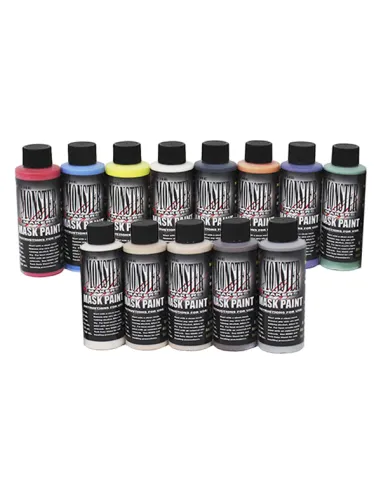
Mask Paint is a concentrated, premixed paint by Monster Makers, developed specifically for colouring masks, prosthetics and accessories made from latex, polyurethane foam and EVA foam. Its elastic formulation allows it to flex with the substrate without cracking or peeling, and its fast drying makes it especially useful in professional production and special effects environments.
Technical specifications
| Parameter |
Value |
| Format |
Individual 85 g jar |
| Base |
Concentrated latex paint |
| Flexibility |
High — does not crack or peel on elastic substrates |
| Drying |
Fast air drying |
| Application methods |
Airbrush (external mix), brush, sponge |
| Mixability |
Compatible between colours within the same range |
| Compatible substrates |
Moulding latex, casting latex, foam latex, polyurethane foam, EVA foam |
| Available colours |
Red, Yellow, Blue, Black, White, Brown, Light Flesh, Medium Flesh, Dark Flesh |
What it is used for
Mask Paint is designed to add colour to flexible pieces in the field of special effects, theatre, film and the manufacture of carnival or Halloween masks. It covers evenly, adheres to rubber and withstands the continuous deformation of the piece.
- Painting masks and face pieces made from masking latex
- Colouring foam latex prosthetics for theatrical and film character work
- Applying a colour base coat to flexible polyurethane foam pieces
- Painting EVA foam accessories and props
- Creating skin effects, shadows and glazes through layering
- Mixing colours together to achieve custom skin tones (flesh, terra, corpse grey, etc.)
- Airbrush application for fine gradients and realistic finishes
How to use it
- Make sure the latex or foam surface is clean, dry and free of release agent residue or talcum powder.
- If the piece comes from a mould with a release agent, wash it with water and mild soap and allow it to dry completely before painting.
- Shake the jar well before opening to homogenise the pigment.
- For custom tones, mix the colours on a palette or in a clean container before applying. Mask Paint colours are fully compatible with each other.
- Apply with an external-mix airbrush (thinning slightly if necessary with distilled water), a soft-bristle brush, or by stippling with a sponge for texture effects.
- Allow each coat to dry completely before applying the next. Drying is fast under normal temperature conditions.
- Build up layers to achieve greater colour depth and transparency. Fine glazes with thinned colours add realism to skin textures.
- Once the final coat has dried, the paint remains flexible and bonded to the substrate, ready to use.
Usage tips
Surface preparation
The most common adhesion problem on latex pieces is talcum powder or cornstarch used for demoulding. Before painting, clean the piece with warm water and a soft cloth. If the surface has residues of uncured liquid latex or tacky areas, allow it to cure completely in air before applying colour.
Thinning and airbrush
Mask Paint is formulated for use straight from the jar or with minimal thinning with distilled water (no more than 10–15%). If using an external-mix airbrush, start with low pressure and adjust accordingly. Excessive thinning can reduce coverage and compromise adhesion on highly flexible substrates. For opaque base coats, apply undiluted; for glazes and gradients, thin it slightly.
Colour mixing and skin tones
The nine available colours (especially the three flesh tones) make it possible to reproduce virtually any skin tone by mixing in small proportions. Add black or brown for shadows and cool tones; white or yellow to lighten. Always work on a palette and record the proportions if you need to reproduce the tone in a second session. Once mixed, the colour does not shift on drying: what you see on the wet palette is essentially what you get.
Frequently asked questions
Does this paint work on uncured latex?
No. Mask Paint must be applied over completely dry and cured latex. Masking or moulding latex cures by air evaporation and requires no additional process, but the piece must be fully dry before painting. Applying over wet latex prevents adhesion and can distort the paint layer.
Can this paint be used on rigid polyurethane foam?
Mask Paint is optimised for flexible substrates (latex, foam latex, flexible polyurethane foam, EVA). It can be applied to rigid polyurethane foam, but since the substrate does not flex, its main advantage is not exploited. In that case, make sure the surface is clean and dust-free before applying.
How many coats are needed for good coverage?
It depends on the base colour of the substrate and the desired effect. To cover white or flesh latex with a dark colour, 2–3 thin coats are usually sufficient. For light tones over dark latex, more coats may be needed. Working in thin, dry layers always gives better results than a single thick coat, which can crack when the piece is flexed.
Does the paint hold up to continuous use and perspiration?
Mask Paint offers good resistance under normal conditions of use. Prolonged perspiration can affect the adhesion of any latex paint, especially in high-friction areas. For greater durability, apply a coat of flexible sealer compatible with latex once the painting is complete.
Can it be mixed with paints outside the same range?
Mask Paint is compatible with Latex Paint Base and with water-based latex paints. Mixing with conventional acrylic paints that have no elastic base is not recommended, as they may lose flexibility and crack when the piece is bent.
Is it suitable for skin contact?
Mask Paint is formulated for painting accessories and masks, not as a direct body paint. If the mask will be in prolonged contact with skin, consult the product's safety data sheet and carry out a tolerance patch test on a small area before use.
How do you clean the airbrush after using this paint?
Clean the airbrush with warm water immediately after use, before the paint dries. If the paint has dried inside the airbrush, soak the disassembled parts in warm water for a few minutes. Avoid strong solvents that could damage the airbrush's rubber seals.
Do the colours shift in tone when drying?
As with most water-based paints, Mask Paint may appear slightly darker when wet and lighten slightly on drying. The variation is small and predictable: always work with dry samples to adjust the tone before painting the final piece.
How much product do I need?Calculate the exact amount before buying and avoid wasting material.
Go to the calculator →