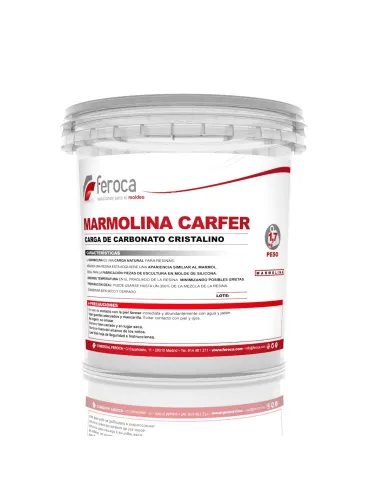
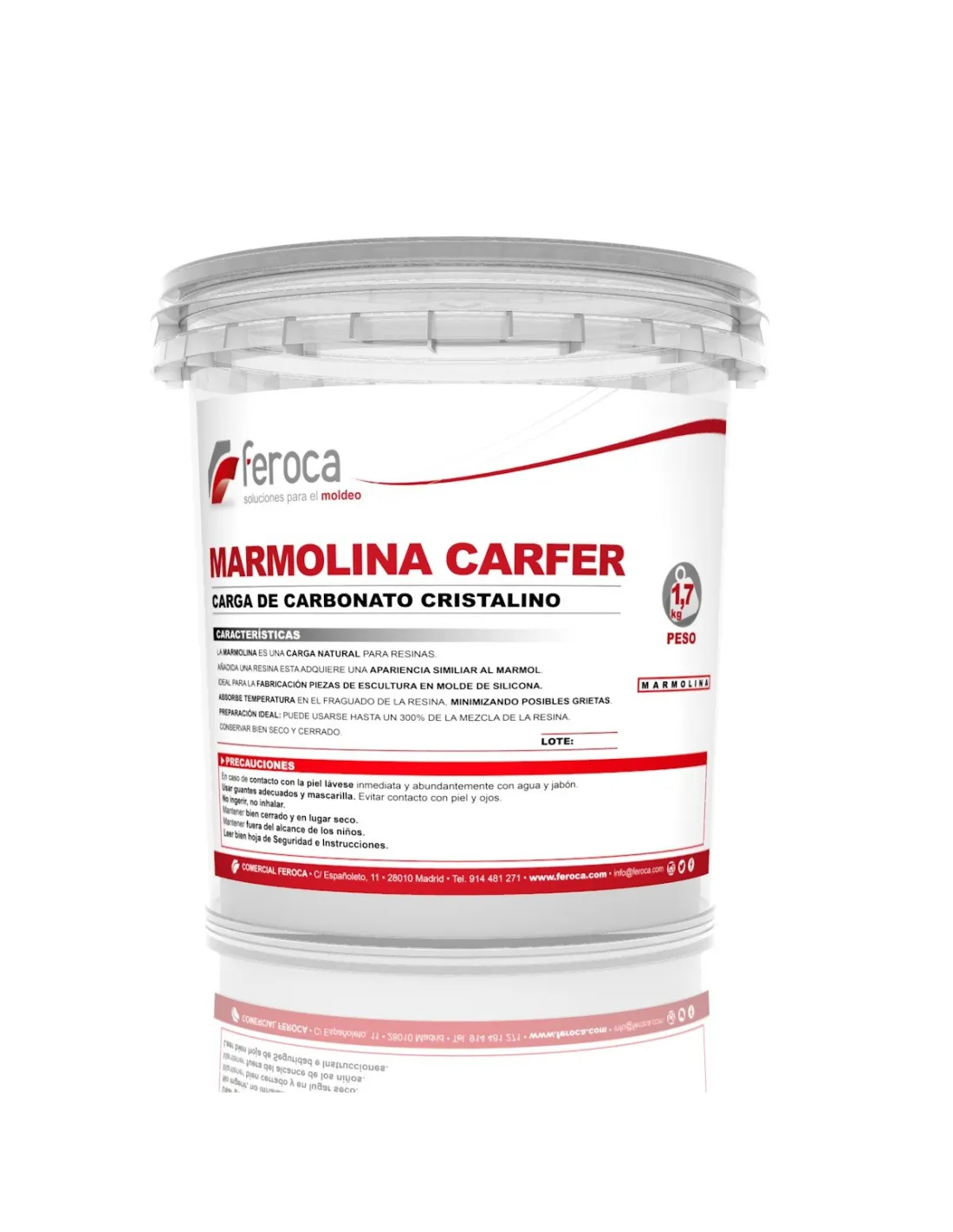
Carfer Carbonato Cristalino, known in the trade as marmolina, is a powdered mineral filler incorporated into polyester resins to achieve a visual appearance similar to marble. Beyond the aesthetic effect, it acts as a thermal absorber during the exothermic reaction of the resin, reducing the appearance of cracks during cure and final drying.
Technical specifications
| Property |
Value |
| Material type |
Crystalline calcium carbonate (marmolina) |
| Appearance |
White crystalline powder |
| Maximum recommended dosage |
Up to 300% by weight over resin |
| Compatibility |
Polyester resins (Ferpol family) |
| Main function |
Aesthetic filler and exotherm control |
What it is used for
Marmolina is primarily used in castings and laminates of polyester resin when a stony or marbled finish is sought, or when it is necessary to control the exothermic reaction to avoid defects in large-volume parts. Its most common workshop applications are:
- Manufacture of resin countertops, sinks and bathtubs with marble effect (artificial stone).
- Decorative reproductions of architectural elements: columns, mouldings, plinths and friezes.
- High-load castings for solid parts where shrinkage and exotherm reduction are required.
- Obtaining an opaque white powder to adjust the base colour of the resin before pigmenting.
- Reduction of material cost in castings where the filler does not compromise the required mechanical strength.
- Decorative pieces where increasing the specific weight and the tactile feel of natural stone is desirable.
How to use it
- Prepare the polyester resin (for example, Ferpol 3501 CV2,5 for castings or Ferpol 100 BSX15 DCPD for laminates) according to the manufacturer's instructions, without adding the catalyst yet.
- Incorporate the marmolina gradually into the base resin, stirring continuously with a spatula or mechanical mixer. Start with low proportions (50–100% by weight) and increase according to the desired result.
- Mix until a smooth, lump-free paste is obtained. Viscosity will increase considerably with each addition of filler.
- Once the desired consistency is achieved, add the catalyst (MEK peroxide) at the proportion indicated for the resin, and mix again uniformly.
- Pour or apply the mixture into the mould quickly, as pot life may be reduced by the accumulated mass. With high filler loads (200–300%), the thermal control effect is greater and the process is more manageable.
- Allow to cure under normal workshop conditions (ambient temperature between 18–25 °C). Demould once sufficient hardness is reached and allow to rest until fully cured before machining or finishing the part.
Usage tips
Dosage and consistency
Marmolina can be dosed from low proportions (50% by weight) up to a maximum of 300% over the resin. The more filler you add, the pastier the mixture will be and the lower the flowability. For mould castings, work in the 150–250% range. For mouldable paste or trowel-applied stone imitation, you can reach the maximum 300%. Always mix the filler into the resin before adding the catalyst to avoid premature reactions.
Exotherm control
Polyester resins generate heat during cure. In large-volume castings without filler, that accumulated heat can cause cracks or internal bubbles. Marmolina acts as a thermal sink: it absorbs part of that heat and distributes it, reducing temperature peaks. The higher the filler proportion, the more efficient this effect is. When working with thick or solid parts, use proportions close to 200–300% to minimise risks.
Combining with other fillers and pigments
Marmolina can be combined with other metallic fillers such as aluminium powder, bronze powder or copper powder to achieve more complex visual effects. It also accepts paste or powder pigments compatible with polyester, which can be incorporated during the mixing phase prior to the catalyst. Always carry out a small-scale test to verify behaviour and gel time before working at full scale.
Frequently asked questions
Can I use this filler with any polyester resin?
Carfer Carbonato Cristalino is compatible with Feroca's range of polyester resins (Ferpol family). For castings, the most common product it is combined with is Ferpol 3501 CV2,5. It is not formulated for epoxy or acrylic resins, where behaviour may not be as expected.
How much filler can I add without the part losing strength?
The maximum recommended dosage is 300% by weight over the resin. Beyond that percentage, the cohesion of the part may be compromised. For structural applications, keep the proportion below 200% and carry out prior tests. For purely decorative pieces, you can reach the maximum without issue.
What is the purpose of adding mineral filler to a resin?
Mineral fillers serve several functions at once: they provide an aesthetic effect (in this case, a marble appearance), reduce cure exotherm, decrease part shrinkage, increase weight and the feel of natural material, and reduce cost per volume of the final part.
How do you correctly mix the filler with the resin?
Add the marmolina to the base resin (without catalyst yet) in small amounts, stirring continuously. It is preferable to use a low-speed mechanical mixer to avoid incorporating air bubbles. Once the mixture is homogeneous, add the catalyst and mix again before pouring.
Does the filler absorb moisture or does it have a shelf life?
Calcium carbonate is hygroscopic under high-humidity conditions. Store the product in a dry place, with the container tightly closed and off the floor. Under correct storage conditions, its shelf life is long and it presents no chemical degradation issues.
Can this filler be used to obtain a white powder effect in resin?
Yes. Marmolina is white and opaque, so when added at medium proportions (100–150%) it provides a base white to the resin. It is an economical alternative to neutralise the yellowish colour of some polyester resins before pigmenting.
Can I combine marmolina with metallic fillers?
Yes, it is possible to combine Carfer Carbonato Cristalino with metallic fillers such as bronze powder or copper powder to achieve intermediate visual effects. Mix all fillers dry first and then incorporate them into the base resin. Adjust proportions through prior tests.
Does marmolina reduce the working time with the resin?
At low proportions, the effect on gel time is minimal. As the filler proportion increases, the total mass is greater and the exothermic reaction is more controlled, which can even stabilise the working time. However, the higher viscosity of the mixture means you need to work faster when pouring or applying. Plan the process carefully before adding the catalyst.