
Shopping Cart

FDA-certified platinum silicones
The three products you'll find below comply with FDA 21 CFR regulations, which govern materials in direct contact with food in the North American market and is the internationally recognized certification standard for these applications. They are formulated with a platinum catalyst, ensuring a clean cure with no migratory by-products. They are heat-resistant, inert, easy to demold, and reproduce fine detail with high fidelity — making them equally suitable for chocolate molds with fine relief, sugar or fondant figures, candle molds, and handmade soap molds.
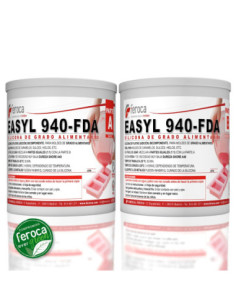 Easyl 940-FDA Pink
Shore A40, FDA 21 CFR, ideal for chocolate molds.
Easyl 940-FDA Pink
Shore A40, FDA 21 CFR, ideal for chocolate molds.
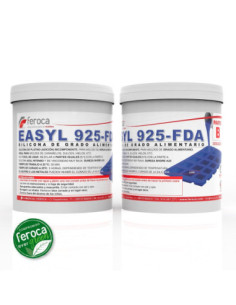 Easyl 925-FDA Blue
Shore A25, FDA, blue color for fragment detection.
Easyl 925-FDA Blue
Shore A25, FDA, blue color for fragment detection.
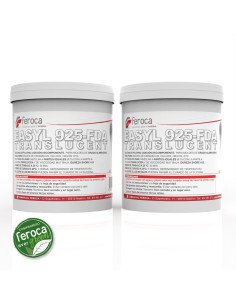 Easyl 925-FDA Translucent
Shore A25, FDA, translucent, resistant to extreme temperatures.
Easyl 925-FDA Translucent
Shore A25, FDA, translucent, resistant to extreme temperatures.
The blue version Easyl 925-FDA Blue has an added advantage in food production environments: the color allows you to visually detect any silicone fragments that might break off, thus complying with the standard HACCP protocols used in the food industry. The translucent version makes it easier to visually check mold fill during pouring.
Epoxy resins suitable for food contact
For coatings, encapsulations, or surfaces that will be in sporadic contact with food, epoxy resin is the most common technical choice. Feroca's food safe product is specifically formulated for this use and offers a colorless, hard, and cleaning-resistant finish.
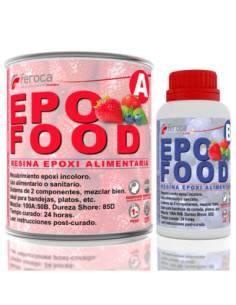 EpoFood
It's important to distinguish between a decorative transparent epoxy resin and a food safe epoxy resin. Resins in the ClearWater range, for example, are designed for jewelry, art, and decoration, and do not have certification for food contact. If your application involves surfaces that come into contact with food, use EpoFood exclusively.
What sets a food safe silicone apart from the rest?
Not every platinum silicone is automatically suitable for food contact. FDA 21 CFR certification means the formulation has been evaluated and meets the substance migration limits into food established by the regulations. This requires a specific selection of raw materials, including the platinum catalyst, fillers, and additives used. Platinum silicones without explicit certification may be inert and high-purity, but should not be used in food safe applications without that documentary backing.
In practice, for molds intended for professional use or for public sale in the food sector, always ask for the technical data sheet referencing FDA 21 CFR regulations — or the equivalent European standard (EC Regulation 1935/2004) — before putting any mold into production.
Most common applications
These are the most frequent uses of food safe materials among our customers:
- Chocolate and confectionery molds: figures, relief tablets, filled chocolates. FDA-certified platinum silicone captures fine detail and withstands continuous demolding cycles.
- Candle molds: although candles are not food, many artisan manufacturers prefer certified silicones for the purity of the material and its resistance to waxes at high temperatures.
- Handmade soap molds: especially when soaps contain natural additives that could react with lower-quality silicones.
- Sugar, fondant, and gelatin resin molds: working temperatures and prolonged contact require a truly inert material.
- Coatings for food-contact surfaces: EpoFood is applied over wood, concrete, or ceramic to seal and create a hygienic surface suitable for culinary use.
Frequently asked questions about food safe materials
Are tin (condensation-cure) silicones suitable for food contact?
No. Condensation (tin-cure) silicones release by-products during the curing process — mainly ethyl alcohol and other organic compounds — that make them incompatible with food contact. Only platinum (addition-cure) silicones with FDA 21 CFR certification or the European equivalent are authorized for this use. If you come across a tin silicone claiming to be food safe without documentary backing, be skeptical.
What does FDA 21 CFR certification actually mean for a silicone?
FDA 21 CFR refers to the United States Code of Federal Regulations, Title 21, which governs materials in contact with food. When a silicone is certified under this regulation, it means its components have been evaluated and meet the established migration limits for use in direct or indirect contact with food. It is the most internationally recognized reference for these applications, although in Europe there is also EC Regulation 1935/2004 as its own regulatory framework.
Can I use any transparent epoxy resin to coat a cutting board or a bowl?
No. Transparent epoxy resins for decoration, jewelry, or art (such as those in the ClearWater range) do not have food contact certification and must not be used for that purpose. For coatings in contact with food, the only valid product in the Feroca catalog is EpoFood, which has been specifically formulated for this use and comes with the corresponding technical documentation.
How many uses can an FDA silicone mold handle before needing to be replaced?
Feroca's FDA-certified platinum silicones are formulated for intensive use. Under normal working conditions, with careful demolding and cleaning with warm water and mild soap, a mold can exceed hundreds of cycles without significant loss of detail or material degradation. The most limiting factor is usually tearing in areas of very fine relief or contact with abrasive products. Avoid using harsh solvents when cleaning molds, as they can damage the silicone surface even if they don't affect its intrinsic certification.
Does the blue color of Easyl 925-FDA Blue affect food?
No. The blue pigment used in Easyl 925-FDA Blue has been selected to comply with the requirements of FDA 21 CFR certification, so it does not migrate into food under normal conditions of use. Its purpose is purely functional: to make it easier to visually detect possible silicone fragments in food production lines, which is especially relevant in HACCP food safety protocols. Food in contact with this mold does not take on any color or flavor.