
Shopping Cart
- Feroca
- Fibreglass
- 1 likes
- 10630 views
- 0 comments
Fibreglass is one of the most versatile reinforcement materials available. It's used to make everything from silicone mould shells to structural parts for industry, including swimming pool repairs, special effects dioramas and decorative panels. If you've landed here, it's because you want to understand how it works, which type to choose and how to get the most out of it. This guide covers everything you need to know, with the real products you'll find at Feroca.
The key to working well with fibreglass comes down to two decisions: choosing the right format (mat, woven fabric or sleeve) and the right weight for the application. From there, the lamination process is very repeatable and quick to learn.
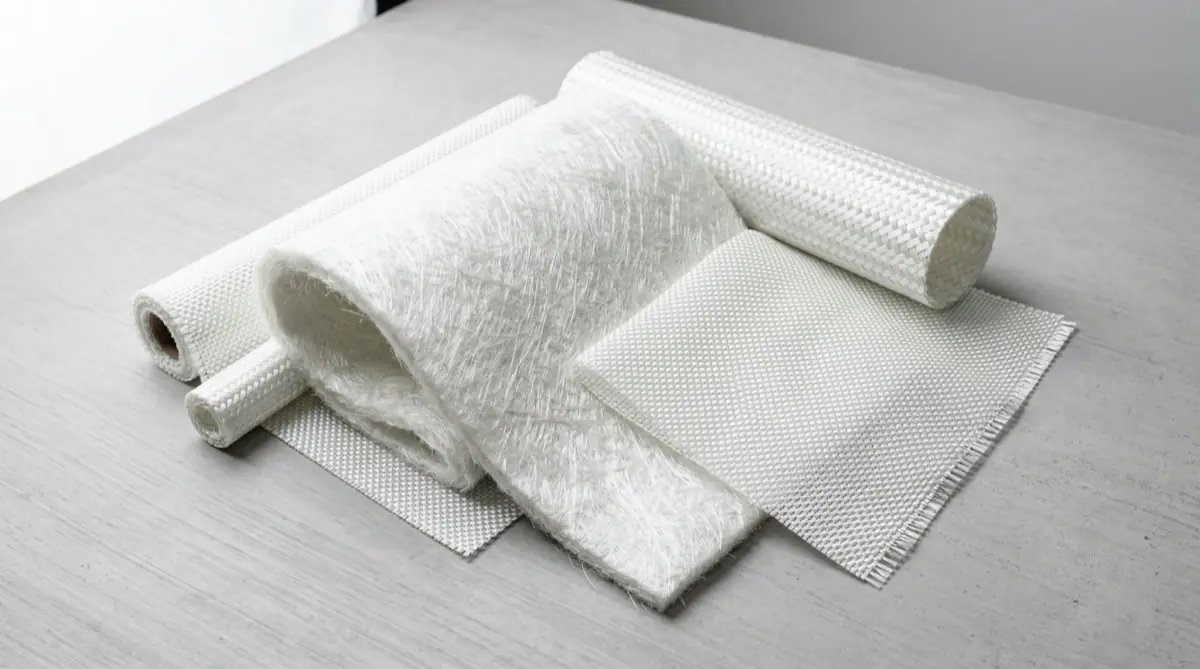
Types of fibreglass
Fibreglass is not a single product. It comes in several formats, each with different behaviour during lamination and a different result in the finished piece. Knowing them saves you costly mistakes.
Mat
Mat is a sheet of fibreglass strands distributed randomly and bonded together by a resin-soluble binder. It is the most common format for general-purpose structural laminates. It impregnates well with polyester and epoxy resin, and conforms to curves without tearing excessively.
At Feroca you'll find two variants. The Reinforcement Mat 300 g/m² is the standard for medium-thickness laminates: two well-impregnated layers produce a rigid, strong part. The Surface Veil 34 g/m² is the finishing layer: it is placed over the last mat layer and eliminates the rough texture, leaving a smoother surface. Without the veil, the finish of 300 g mat is rough and absorbent.
Plain woven fabric
Woven fibreglass fabric is made up of interlaced threads, like a textile. This gives it greater tensile strength than mat and better performance in parts that will receive loads in defined directions. It is the reinforcement used in aeronautics, wind turbines and marine applications.
The weights determine the thickness and rigidity each layer contributes:
| Weight | Main use | Product |
|---|---|---|
| 48 g/m² | Fine finishes, thin parts, first reinforcement over gel coat | Woven fabric 48 g |
| 105 g/m² | Intermediate layers, medium-strength parts | Woven fabric 105 g |
| 163–166 g/m² | Medium structural reinforcement, panels, mould shells | Woven fabric 163 g / 166 g |
| 300 g/m² | Maximum structural reinforcement in plain woven fabric | Woven fabric 300 g |
There is also the Quadriaxial Fabric, designed specifically for use with Jesmonite AC100. It has filaments on four axes stitched with fire-resistant Nomex, which produces very light and strong laminates with very little loose fibre. It is the go-to reinforcement for Jesmonite moulds and panels. And the Silionne Twill Fabric 86 g, with a silane treatment that improves moisture resistance and dimensional stability: useful when the part will be used outdoors or in humid environments.
Braided sleeve
Braided glass sleeve is not used for flat laminates: its function is to protect and reinforce cylindrical elements such as pipes, cables or rods. The braided structure allows it to expand and contract to adapt to the diameter of the element being protected.
Feroca stocks two diameters: the Sleeve 136g × 20mm for elements with a diameter of 10 to 25 mm, and the Sleeve 136g × 43mm for diameters of 20 to 55 mm. Both are high-quality E-Glass with a 45° braid angle.
Chopped strands
6 mm Chopped Strands are a structural filler, not a fabric. They are mixed directly with polyester or epoxy resin to create reinforced fillers or to give the mixture body before laminating. At high proportions they act as a fibred filler. They are compatible with Ferpol 100BSX15 and epoxy resins.
Other fibres and reinforcements
Although not strictly fibreglass, in the Other Fibres family you'll find materials that work alongside it or replace it in specific applications:
- Aramid Fabric 170g (Kevlar): exceptional impact and heat resistance. Used in ballistic protection applications, fire-resistant equipment and parts where weight is critical. Requires special scissors for cutting.
- PVA Fibres: an alternative to glass for cementitious systems such as Jesmonite. They are added directly to the liquid before mixing (ratio 2–10 g). They increase frost resistance in outdoor applications.
- Peel Ply: peelable nylon fabric. It is placed over the last laminate layer and peeled off once cured. It leaves the surface rough, uniform and free of excess resin, ready for further lamination or finishing treatment without sanding.
Which resins are used with fibreglass
Fibreglass is a reinforcement, not a self-supporting material: it needs a resin to impregnate it and cure, giving it rigidity. The choice of resin affects the working process, the final strength and compatibility with the fibre.
| Resin | Compatible fibres | Advantages / Notes |
|---|---|---|
| Ferpol 100BSX15 (polyester) | Mat 300g, woven fabrics, chopped strands, sleeve | Low styrene content (DCPD). The standard choice for fibre laminates. Compatible with swimming pools. |
| Epoxy | All woven fabrics, mat, chopped strands | Greater adhesion, no styrene odour. For rigid moulds and parts requiring a high surface quality. |
| Jesmonite AC100 (acrylic) | Quadriaxial fabric, PVA Fibres | Solvent-free, fire-resistant. The quadriaxial fabric impregnates better than mat with acrylic resins. |
Note on acrylic resins and mat: acrylic resins do not impregnate conventional fibreglass mat well. If you are working with Jesmonite or other acrylics, use the quadriaxial fabric or PVA Fibres, not the 300g mat.
Step-by-step fibreglass lamination process
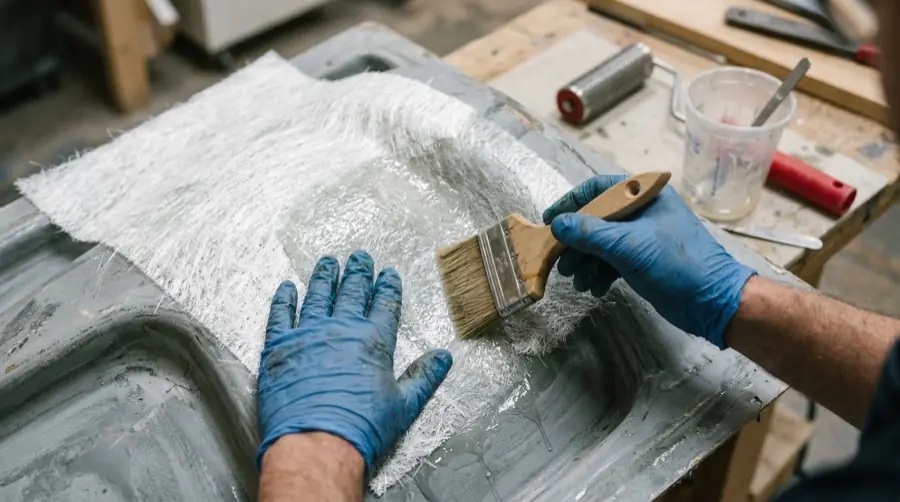
Hand lamination is the most accessible technique and the one used in moulding, repair and craft manufacturing workshops. The process is the same regardless of whether you use mat or woven fabric.
- Prepare the surface. Clean the mould or the surface to be reinforced. If it's a mould, apply a Release agent before laminating. Avoid damp areas: moisture prevents proper impregnation.
- Cut the fibre. Cut the mat or fabric pieces to the required size before mixing the resin. For aramid fabric, use scissors specifically designed for technical fibres. For conventional fibreglass, a good pair of scissors will do.
- Mix the resin. Prepare the resin according to the manufacturer's instructions (catalyst, ratio, temperature). Have everything ready before you start laminating.
- Impregnate the fibre. Thoroughly saturate the fibre with resin. Use a laminating brush or a de-airing roller to remove trapped air bubbles. The fibre should become translucent when properly impregnated.
- Apply layers. For a standard part: 2 well-impregnated layers of 300g mat are sufficient for mould shells or general reinforcement parts. For greater strength, alternate layers of mat and woven fabric.
- Finishing veil. If you want a smoother surface, place a layer of Surface Veil 34g over the last layer and impregnate it with resin. This eliminates the characteristic roughness of 300g mat.
- Peel Ply (optional). If the part needs further lamination or will receive a subsequent finish, apply the Peel Ply over the last layer. When peeled off, it leaves a rough, clean surface without the need for sanding.
- Demould. Allow the resin to cure fully before demoulding. Do not force the part out before it has cured completely.
Main applications of fibreglass
Shells and counter-moulds
The most common application in special effects and moulding workshops is the rigid shell for a silicone or latex mould. The process involves applying the silicone over the original model in several layers, and once cured, reinforcing it with a fibreglass and resin shell that holds it in the correct shape during casting.
For this use, the standard approach is 2 layers of Mat 300g with polyester or epoxy resin. The result is a rigid, lightweight and durable shell that can be assembled and disassembled without distorting the mould.
Structural repairs
Fibreglass is the standard material for repairing swimming pools, baths, shower trays, vehicle bodywork and any polyester part that is cracked or broken. You prepare the area to be repaired, cut two pieces of fibre of different sizes (to step the patch and avoid an abrupt thick edge), impregnate them with Ferpol 100BSX15 and finish with the veil to even out the surface. More resistant and durable than filler alone.
Structural parts and panels
For manufacturing panels, tanks, pipes, turbine blades or any part that requires strength and low weight, plain woven fabric offers better performance than mat because it distributes loads according to the orientation of the threads. The Quadriaxial Fabric with Jesmonite is particularly efficient for decorative and construction panels: lightweight, fire-resistant and with a clean mineral finish.
Scenography, special effects and dioramas
In the SFX and modelling world, fibreglass appears in the making of masks and armour (rigid shell over soft silicone), in the creation of rocks and surfaces for sets, and in the construction of dioramas with structural elements that need to bear weight. Hessian with plaster is the simpler alternative for scenographies that do not require as much strength.
Required tools and accessories
In addition to the fibre and resin, you'll need a few basic tools to work effectively:
- Laminating brush: designed to avoid losing bristles in the resin and to distribute it evenly through the fibre.
- De-airing roller: removes air bubbles trapped between layers. Essential for quality laminates. Resistant to cleaning solvents.
- Suitable scissors: for conventional fibreglass, a good pair of scissors. For aramid fabric (Kevlar), use specific scissors with micro-serrated blades.
- Peel Ply: if the part will receive more layers or finishes, it saves sanding work.
Safety: mandatory PPE
Fibreglass releases micro-particles during cutting and handling that irritate the skin, eyes and respiratory tract. It is not a hazardous material, but it does require basic protection:
- P2/FFP2 mask when cutting fibre. Glass particles are very fine and can easily be inhaled without noticing.
- Nitrile gloves whenever you handle fibre or resin. Glass micro-particles irritate the skin, especially on the wrists and forearms.
- Safety goggles when cutting, to prevent splashes.
- Adequate ventilation. If you are using polyester resin (Ferpol), work in a well-ventilated space. Styrene has a distinctive odour and air circulation is essential.
- Do not eat, drink or smoke while handling. Wash your hands when finished.
Frequently asked questions
What type of fibreglass is used with polyester resin?
For laminates with polyester resin such as Ferpol 100BSX15, the standard approach is to use 300 g/m² Mat as the main reinforcement. If you want more strength, you can alternate it with woven fabric and finish with the 34g Veil to improve the surface finish.
How many layers of fibreglass do I need for a mould shell?
Two well-impregnated layers of 300g mat are sufficient for most medium-sized silicone mould shells. For large moulds or those that will see heavy use, add a third layer or combine with woven fabric. Always finish with the 34g Veil for a cleaner result.
Can fibreglass be used with acrylic resins like Jesmonite?
Conventional fibreglass mat does not impregnate well with acrylic resins. For Jesmonite AC100, use the Quadriaxial Fabric, which is designed specifically for this system and impregnates much better. PVA Fibres are another alternative for Jesmonite when reinforcement without fabric is needed.
Does fibreglass dissolve in water or degrade?
No. Fibreglass does not dissolve in water. Once cured with resin, the laminate is moisture-resistant. For prolonged exposure to water or outdoor use, the Silionne Twill Fabric with silane treatment offers better dimensional stability than standard fabrics.
Can polyurethane rubbers be laminated with fibreglass?
It is not recommended. Fibreglass reinforcements are designed for rigid materials. In flexible materials such as polyurethane, the fibre cannot deform at the same rate as the matrix and ends up delaminating or causing premature cracking.
What is Peel Ply used for?
Peel Ply is a nylon fabric applied over the last laminate layer while the resin is still wet. Once cured, it peels off cleanly and leaves the surface rough, uniform and free of excess resin. It is useful when you want to add more layers later or apply a finish without sanding.
How do you cut aramid fabric (Kevlar)?
Aramid fabric does not cut well with conventional scissors. You need scissors specifically designed for carbon fibre, Kevlar and aramid, with micro-serrated blades on both sides that make it easier to cut these high-strength fibres. With ordinary scissors, the fabric frays and the blades deteriorate quickly.
Can I use fibreglass to reinforce a plaster mould?
Yes, but it is not the usual approach. Plaster has low adhesion to polyester resin, so the reinforcement works better as an outer shell than as internal reinforcement. A simpler alternative for plaster moulds is hessian impregnated in plaster, which provides strength without needing resin.
Comments (0)