Shopping Cart



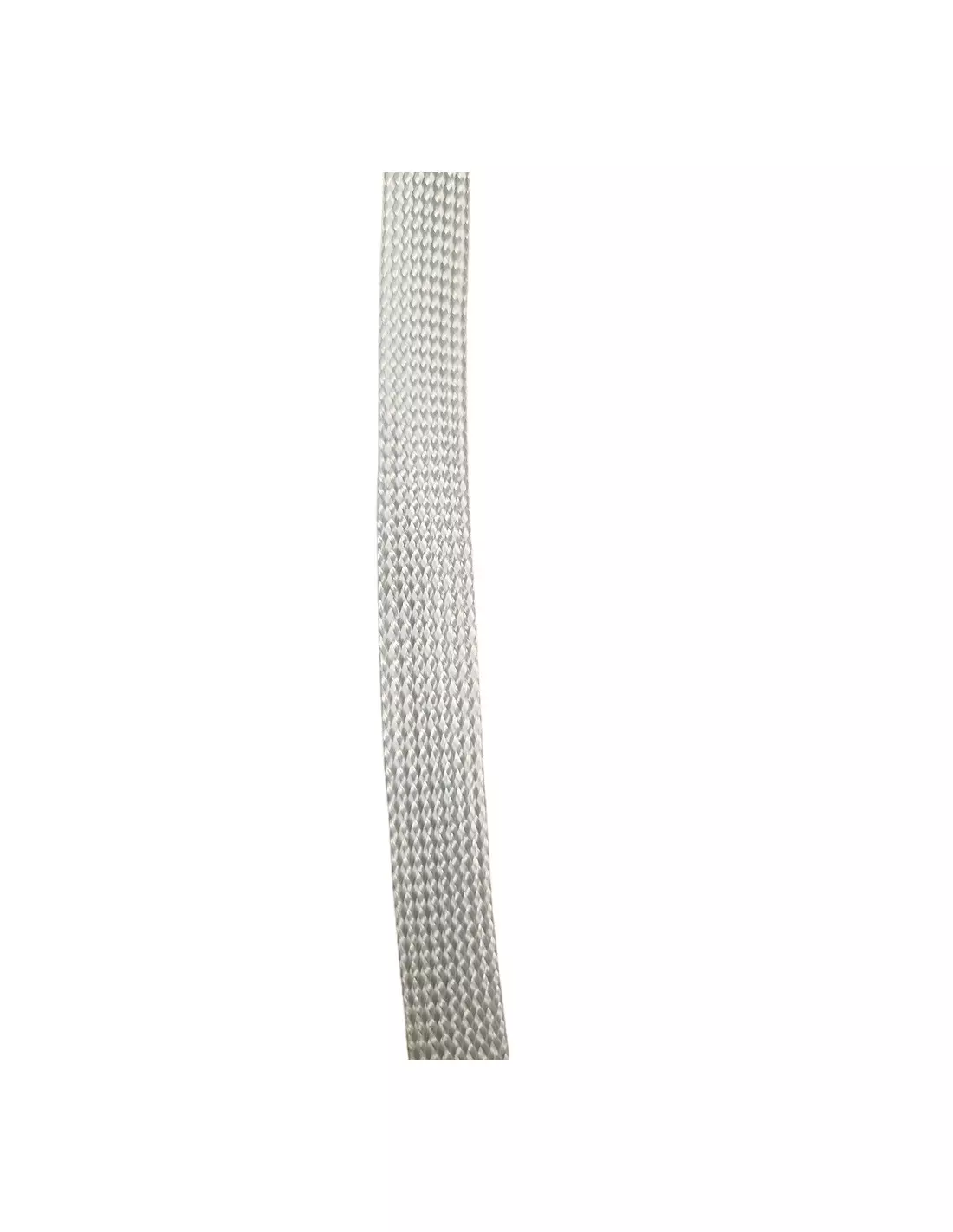
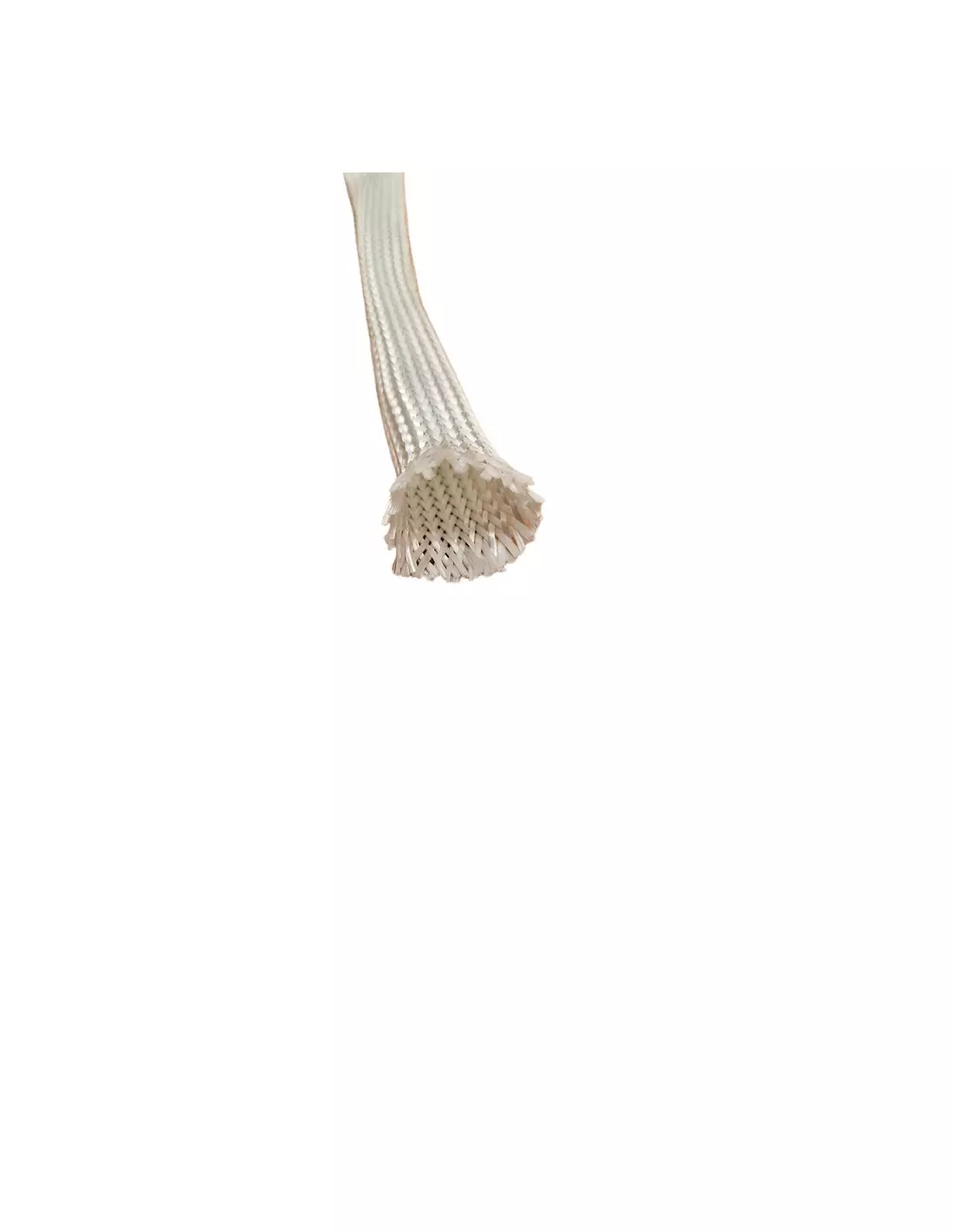
Braided Fibreglass Sleeve 20mm
103180101
€2.00
2,42 € Tax incl.
2,42 € Tax incl.
Braided E-Glass fibreglass sleeve. 20 mm diameter and 27.70 g/m linear weight at 45°; 14 mm at 30° and 24.2 mm at 60°. Minimum 8 mm when fully stretched.
The 20mm braided fiberglass sleeve is a reinforcement and protection solution made from E-Glass fibre, braided in 144 ends at 45°. Its braided structure opens or closes with the braid angle and covers diameters of about 14 mm at 30°, 19.7 mm at 45° and 24.2 mm at 60° (down to 8 mm fully stretched), combining mechanical, thermal and abrasion resistance with straightforward seamless, adhesive-free installation.
Technical specifications
| Property | 30° | 45° | 60° | Stretched |
|---|---|---|---|---|
| Diameter | 14 mm | 19.7 mm | 24.2 mm | 8 mm |
| Flat width | 21.9 mm | 31 mm | 38 mm | 12 mm |
| Linear weight | 22.6 g/m | 27.7 g/m | 39.2 g/m | 21 g/m |
| Weight per m² | 1031.6 g/m² | 893.4 g/m² | 1031.6 g/m² | — |
| Material | E-Glass | |||
| Number of threads | 144 | |||
Reference configuration of this product: braided at 45° → approx. 20 mm diameter and 27.70 g/m linear weight. The 30° and 60° figures show how far the same sleeve can be closed or opened by changing the braid angle. Stretched to the maximum, the sleeve closes down to 8 mm diameter (12 mm flat width) with a linear weight of 21.00 g/m.
What each figure means
Braid angle (°)
This is the inclination of the threads relative to the long axis of the sleeve. Changing that angle opens or closes the sleeve and therefore changes its diameter: the larger the angle, the larger the diameter it covers.
Diameter (mm)
The approximate diameter of the sleeve when it is fitted in tubular form. For example, at 45° → 19.7 mm diameter.
Flat width (mm)
The width the sleeve would have if you opened it out and laid it completely flat. For example, at 45° → 31 mm flat width.
Linear weight (g/m)
How much 1 metre of dry sleeve weighs, without resin. For example, at 45° → 27.7 g per metre. This is the figure to use when working out how much fibre you need to buy.
Surface weight (g/m²)
How much the fibre would weigh spread over a 1 m² surface. For example, at 45° → 893.4 g/m². It is useful for comparing the sleeve with flat fabrics, not for working out how many metres you need.
Stretched condition
This is the state of the sleeve when it is stretched lengthwise as far as it will go: the threads close towards the axis, the diameter drops to 8 mm and the flat width to 12 mm, with a linear weight of 21.00 g/m. It is the smallest diameter it can cover.
The key points
To know which diameter you can cover, look mainly at the diameter of the sleeve for each braid angle:
- 8 mm → sleeve stretched to the maximum
- 14 mm → 30° configuration
- 19.7 mm → 45° configuration (reference for this product)
- 24.2 mm → 60° configuration
And to work out how much fibre you need, use the linear weight (g/m), i.e. the grams each metre of sleeve weighs. At 27.70 g/m:
- 1 metre → 27.70 g
- 2 metres → 55.40 g
- 5 metres → 138.50 g
- 10 metres → 277 g
Do not confuse linear weight (g/m) with surface weight (g/m²): the first refers to one metre of sleeve length, the second to one square metre of spread-out fibre.
What it is used for
This sleeve is designed both to protect existing components and to act as structural reinforcement in composite laminates. Its tubular geometry makes it especially useful in applications where cylindrical profiles need to be wrapped quickly and without complex cuts.
- Reinforcement of tubes, rods and cylindrical profiles with polyester or epoxy resin
- Protection of cables and hoses against abrasion and mechanical damage
- Localised repair of pipes or tubular composite structures
- Mould shells and structural reinforcements in fibreglass parts
- Thermal protection in low and medium temperature industrial installations
- Reinforcement of handles, shafts and elements subject to repeated torsion or bending
How to use it
- Measure and cut the required sleeve length with scissors or a cutter. A diagonal cut makes it easier to insert onto the substrate.
- Check that the diameter of the element to be reinforced or protected is within the 8 to 24.2 mm application range.
- Slide the sleeve over the tube, rod or cable. The 45° braided structure allows it to be expanded or contracted to match the exact diameter.
- If using it as structural reinforcement, saturate the sleeve with a suitable laminating resin (polyester, vinylester or epoxy) using a brush or roller, ensuring full wet-out with no air bubbles.
- Apply uniform pressure to remove excess resin and consolidate the laminate against the substrate.
- Allow to cure according to the resin manufacturer's instructions, keeping the part immobilised throughout the process.
- Once cured, sand, trim or over-laminate as required by the project.
Usage tips
Correct resin impregnation
The 45° braid angle promotes uniform wet-out, but the high areal weight (893 g/m²) requires a low-viscosity resin — or slight warming — to ensure all 144 filaments are fully saturated. Work in layers if greater thickness is needed: two well-impregnated passes are preferable to a single dry layer. For polyester resin laminates, combine this sleeve with flat fibreglass woven fabrics to reinforce adjacent flat areas.
Diameter adjustment and handling
The sleeve expands when stretched lengthwise and contracts when compressed. For diameters close to the lower limit (down to 8 mm when fully stretched), stretch the sleeve before fitting it; for diameters near 24.2 mm (braided at 60°), push the sleeve over the substrate without stretching. Wear work gloves when handling it dry: loose glass filaments can irritate the skin.
Cutting and end finishing
To prevent cut ends from fraying, apply a small amount of resin or fast-curing adhesive to the edge immediately after cutting. If the sleeve is to remain exposed (without a resin coating), you can finish the ends with fibreglass thread or high-temperature sealing tape to keep the braided structure intact during use.
Frequently asked questions
Which diameter can I cover with this sleeve?
It depends on the braid angle you fit it at. The same sleeve covers about 14 mm at 30°, about 19.7 mm at 45° (the reference configuration of this product) and up to about 24.2 mm at 60°. Opening it towards larger diameters shortens the sleeve; closing it towards smaller diameters makes it longer. Stretched lengthwise as far as it will go, it closes down to about 8 mm.
How do I calculate how much sleeve I need?
Use the linear weight: 27.70 g per metre of sleeve. So 1 metre weighs 27.70 g; 2 metres, 55.40 g; 5 metres, 138.50 g; and 10 metres, 277 g. Then multiply by the number of layers you plan to apply and add a small margin for the overlaps at the ends.
Can this sleeve be used with any type of resin?
Yes. The E-Glass braided fiberglass sleeve is compatible with polyester, vinylester and epoxy resins. The choice of resin depends on the mechanical and chemical requirements of your project: epoxy offers greater adhesion and chemical resistance, while polyester is the more economical option for standard applications. What matters is that the viscosity is low enough to properly wet out all 144 braid ends.
How many layers do I need for a strong structural reinforcement?
It depends on the load and the application, but as a general reference, two well-impregnated layers of this sleeve provide solid reinforcement for pipe repairs or shaft protection under normal use. For high mechanical demand applications, three or more layers are recommended, alternating orientation where possible or combining with flat fibreglass woven fabrics in the highest-stress areas.
Does fibreglass degrade with moisture or water?
E-Glass fibre does not dissolve or degrade on contact with water. However, prolonged exposure to moisture without a resin coating can slightly reduce its mechanical properties over time. For applications in permanent contact with water or outdoors, it is recommended to impregnate the sleeve with resin to protect the filaments and seal the surface.
Can I use it to protect cables without impregnating with resin?
Yes. The sleeve can be installed dry directly over cables or hoses as protection against abrasion, chafing and light mechanical damage, without the need for resin. In this case it acts as a protective sheath. For additional electrical protection, note that fibreglass on its own is non-conductive, but it is not a certified electrical insulator: consult applicable regulations if the use is electrically regulated.
What is the difference between this sleeve and a flat fibreglass woven fabric?
The main difference is geometry. The braided sleeve is designed to wrap cylindrical profiles continuously and seamlessly, conforming to the diameter of the element. Flat fibreglass woven fabrics are more versatile for flat or open curved surfaces, and allow layers to be cut and orientated with greater freedom. For tubes and rods, the sleeve is more practical; for flat surfaces or complex moulds, woven fabric is the standard choice.
How is a fibreglass mould shell made?
A mould shell or mother mould is built by applying several layers of fibreglass fabric impregnated with resin over the exterior of a flexible mould (silicone, for example). You start with a gel coat or neat resin layer for the surface finish, then continue with fabric layers until the thickness required for the shell to be rigid and self-supporting is reached. This braided sleeve can be used on the tubular areas or rounded edges of the mould where flat fabric is difficult to conform.
Is it compatible with acrylic or water-based resins?
Compatibility with acrylic resins depends on the specific resin formulation. For laminates with acrylic resins, quadriaxial fabrics that wet out more easily are usually recommended. For this braided sleeve, polyester, vinylester and epoxy resins are the most common and guarantee optimal wet-out of all filaments.
Can I cut the sleeve into strips to use it as a flat fabric?
Technically yes, you can flatten it and cut it, but it is not the most efficient approach. Flattening the braided sleeve gives you a double-layer fabric with fibres oriented at 45°, which can be useful for diagonal reinforcements. However, for flat surfaces it is more practical and economical to use a flat fibreglass woven fabric with the areal weight suited to your application.
No reviews
Tap to zoom