Shopping Cart


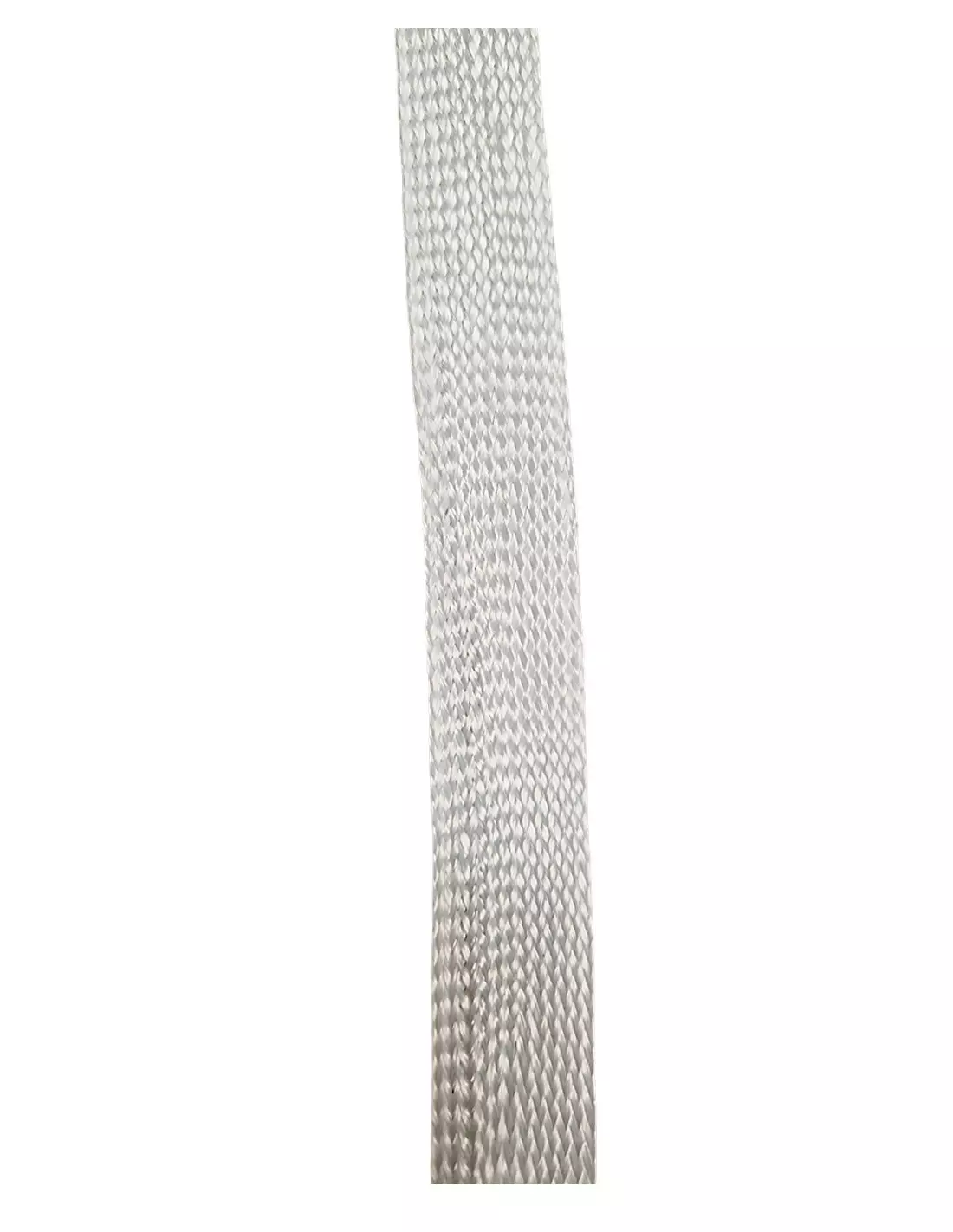
Braided Fibreglass Sleeve 43mm
103180201
€2.80
3,39 € Tax incl.
3,39 € Tax incl.
Braided E-Glass fibreglass sleeve. 43 mm diameter and 36.90 g/m linear weight at 45°; 30.6 mm at 30° and 53 mm at 60°. Minimum 10 mm when fully stretched.
The 43mm braided fibreglass sleeve is a tubular E-Glass fibre reinforcement designed to protect, reinforce and consolidate tubular profiles, hoses, cables and cylindrical structures with polyester, vinylester or epoxy resins. Its braided structure can be closed or opened depending on the braid angle, covering diameters of about 30.6 mm at 30°, 43.3 mm at 45° and 53 mm at 60° (down to 10 mm fully stretched), which makes impregnation and uniform lamination easier on complex geometries.
Technical specifications
| Property | 30° | 45° | 60° | Stretched |
|---|---|---|---|---|
| Diameter | 30.6 mm | 43.3 mm | 53 mm | 10 mm |
| Flat width | 48.1 mm | 68 mm | 83.3 mm | 16 mm |
| Linear weight | 30.2 g/m | 36.9 g/m | 52.2 g/m | 27 g/m |
| Weight per m² | 627.1 g/m² | 543.1 g/m² | 627.1 g/m² | — |
| Material | E-Glass | |||
| Number of threads | 192 | |||
Reference configuration of this product: braided at 45° → approx. 43 mm diameter and 36.90 g/m linear weight. The 30° and 60° figures show how far the same sleeve can be closed or opened by changing the braid angle. Stretched to the maximum, the sleeve closes down to 10 mm diameter (16 mm flat width) with a linear weight of 27.00 g/m.
What each figure means
Braid angle (°)
This is the inclination of the threads relative to the long axis of the sleeve. Changing that angle opens or closes the sleeve and therefore changes its diameter: the larger the angle, the larger the diameter it covers.
Diameter (mm)
The approximate diameter of the sleeve when it is fitted in tubular form. For example, at 45° → 43.3 mm diameter.
Flat width (mm)
The width the sleeve would have if you opened it out and laid it completely flat. For example, at 45° → 68 mm flat width.
Linear weight (g/m)
How much 1 metre of dry sleeve weighs, without resin. For example, at 45° → 36.9 g per metre. This is the figure to use when working out how much fibre you need to buy.
Surface weight (g/m²)
How much the fibre would weigh spread over a 1 m² surface. For example, at 45° → 543.1 g/m². It is useful for comparing the sleeve with flat fabrics, not for working out how many metres you need.
Stretched condition
This is the state of the sleeve when it is stretched lengthwise as far as it will go: the threads close towards the axis, the diameter drops to 10 mm and the flat width to 16 mm, with a linear weight of 27.00 g/m. It is the smallest diameter it can cover.
The key points
To know which diameter you can cover, look mainly at the diameter of the sleeve for each braid angle:
- 10 mm → sleeve stretched to the maximum
- 30.6 mm → 30° configuration
- 43.3 mm → 45° configuration (reference for this product)
- 53 mm → 60° configuration
And to work out how much fibre you need, use the linear weight (g/m), i.e. the grams each metre of sleeve weighs. At 36.90 g/m:
- 1 metre → 36.90 g
- 2 metres → 73.80 g
- 5 metres → 184.50 g
- 10 metres → 369 g
Do not confuse linear weight (g/m) with surface weight (g/m²): the first refers to one metre of sleeve length, the second to one square metre of spread-out fibre.
What it is used for
This sleeve is the go-to solution for consolidating, repairing or reinforcing parts with circular or irregular cross-sections that do not easily accept flat fabrics. By sliding it over the profile and saturating it with resin, it forms a continuous, seamless structural layer that provides mechanical strength and rigidity.
- Reinforcement of industrial pipes, hoses and conduits
- Repair of damaged or cracked cylindrical profiles
- Manufacture of rods, tubes and hollow composite structures
- Consolidation of handles, shafts and elongated elements in marine, automotive and light aeronautical applications
- Rigid shells for silicone moulds on tubular parts
- Reinforcement of columns or pillars in industrial restoration
- Protection against abrasion and mechanical damage on cables and hoses
How to use it
- Clean and degrease the surface to be reinforced; if necessary, sand lightly to improve adhesion.
- Cut the sleeve to the desired length, leaving a small margin at each end for overlap.
- Slide the sleeve over the profile or mandrel. If the diameter is at the lower limit of the range (down to 10 mm when fully stretched), the sleeve will tension slightly and fit snugly.
- Prepare the chosen laminating resin (polyester, vinylester or epoxy) according to the manufacturer's instructions.
- Impregnate the sleeve with a brush or roller, making sure all threads are saturated and free of air bubbles.
- If greater thickness or strength is required, add additional layers of sleeve or supplement with flat fabric in the areas under highest stress.
- Allow to cure according to the resin's instructions before handling or trimming the part.
- Once cured, trim the ends and sand or polish to the required finish.
Usage tips
Adjust the number of layers to the expected load
A single layer of sleeve provides a lightweight and flexible laminate; if you need real structural rigidity, work with a minimum of two or three overlapping layers. For high-load parts, combine the sleeve with a heavier flat fabric at critical points.
Control sleeve tension during impregnation
If the sleeve is overstretched, the threads lose part of their deformation capacity and impregnation becomes more difficult. Always work within the indicated application range (10-53 mm depending on the braid angle and stretching) and, when possible, use a mandrel that keeps the sleeve at its natural working diameter to facilitate uniform saturation.
Temperature and humidity affect resin curing
Fibreglass itself is not sensitive to ambient humidity during lamination, but the resin is. Below 15 °C curing slows down considerably; above 70% relative humidity, adhesion problems may arise with polyester resins. Always work under controlled conditions and respect the resin's pot-life times.
Frequently asked questions
Which diameter can I cover with this sleeve?
It depends on the braid angle you fit it at. The same sleeve covers about 30.6 mm at 30°, about 43.3 mm at 45° (the reference configuration of this product) and up to about 53 mm at 60°. Opening it towards larger diameters shortens the sleeve; closing it towards smaller diameters makes it longer. Stretched lengthwise as far as it will go, it closes down to about 10 mm.
How do I calculate how much sleeve I need?
Use the linear weight: 36.90 g per metre of sleeve. So 1 metre weighs 36.90 g; 2 metres, 73.80 g; 5 metres, 184.50 g; and 10 metres, 369 g. Then multiply by the number of layers you plan to apply and add a small margin for the overlaps at the ends.
What resins are compatible with this type of tubular reinforcement?
The 43mm braided fibreglass sleeve is compatible with polyester, vinylester and epoxy resins. The choice depends on the application: polyester is the most cost-effective option for general use; epoxy offers better adhesion, lower water absorption and superior mechanical properties for more demanding applications.
How many layers do I need for a strong reinforcement?
For basic protection against abrasion and mechanical damage, one layer is sufficient. For real structural reinforcement in load-bearing pipes or profiles, a minimum of two or three well-impregnated layers is recommended, overlapping each layer relative to the previous one to distribute stresses evenly.
Can it be used outdoors or in contact with water?
E-Glass fibreglass does not dissolve or degrade in water. In outdoor applications or prolonged water contact, the limiting factor is the laminating resin: epoxy and vinylester resins offer better resistance to moisture and hydrolysis than standard polyester. Choose the resin according to the working environment.
Can it be used with flexible polymers such as polyurethane?
It is not recommended. Fibreglass fabrics and sleeves are designed to work with rigid matrices (thermoset resins). With polyurethane rubbers or elastomers, the reinforcement does not bond correctly and may delaminate under load, as the stiffness of the glass is incompatible with the elongation of the elastomer.
How do I cut the sleeve without it fraying?
The simplest approach is to mark the cut line with adhesive tape, cut along it with fibre scissors or a cutter, and leave the tape in place until you are ready to use the piece. You can also consolidate the end with a small amount of resin before cutting, allowing it to gel enough to fix the threads in place.
What is the difference between a braided sleeve and a flat fibreglass fabric?
Flat fabric (such as the 105 g/m² fibreglass fabric) is suitable for flat surfaces or those with gentle curves. The braided sleeve naturally conforms to cylindrical and tubular profiles without the need for cuts or overlaps, simplifying the process and improving lamination uniformity on those geometries.
How do you make a rigid shell over a tubular silicone mould?
Apply the silicone over the master in several layers until the required thickness is achieved. Once cured, slide the braided fibreglass sleeve over the outside of the silicone mould, saturate with epoxy or polyester resin and allow to cure. The result is a rigid shell that maintains the mould's geometry and makes it easier to handle during casting.
Can I combine this sleeve with lighter-weight fabrics for a finer finish?
Yes. A common strategy is to use the sleeve for the inner structural layers and finish with one or two layers of lightweight 48 g/m² fabric to achieve a finer surface finish that requires less sanding and finishing work.
No reviews
Tap to zoom