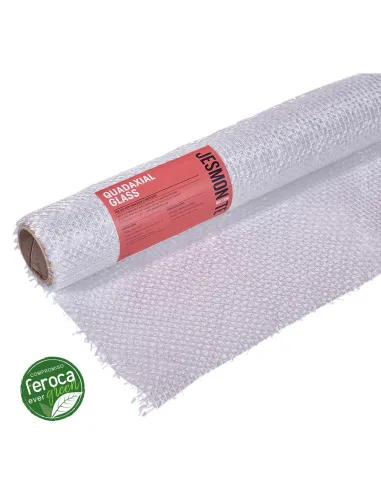
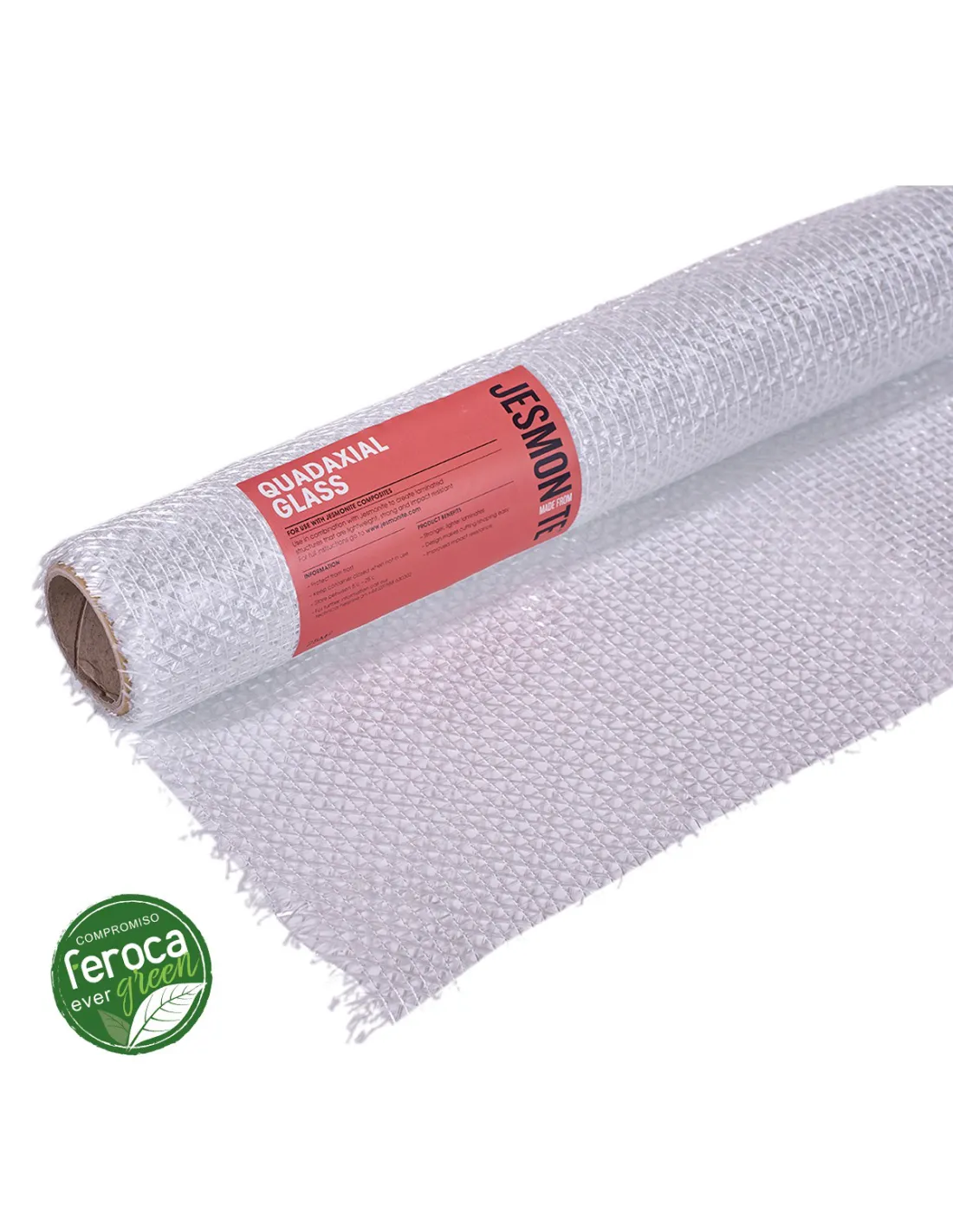
Quadriaxial fibreglass fabric is a high-performance technical reinforcement designed specifically for laminates with acrylic resins. With its continuous filaments arranged on four axes and stitched with flame-retardant Nomex®, it offers an exceptional combination of lightness, mechanical strength and fire resistance, with very few loose filaments for comfortable and safe workshop handling.
Technical specifications
| Weight | 180 g/m² |
|---|
| Reinforcement type | Multiaxial — four axes (quadriaxial) |
|---|
| Stitching material | Nomex® (flame-retardant) |
|---|
| Construction | Continuous glass filaments loop-stitched |
|---|
| Fire resistance | Yes, via Nomex® stitching |
|---|
| Main application | Laminating |
|---|
| Recommended resin | Jesmonite AC100 and acrylic resins |
|---|
What it is used for
This fabric is optimised for reinforcing acrylic laminates where a high strength-to-weight ratio is required. Its multiaxial architecture makes it ideal for complex geometries and parts that require structural behaviour without excess mass. Common workshop applications:
- Manufacturing laminated panels with Jesmonite AC100 for architecture and decoration
- Building rigid mother moulds and shells over silicone or latex moulds
- Reinforcing acrylic castings in large-format parts that require dimensional stability
- Creating lightweight decorative elements with a stone effect, combined with Jesmonite AC730
- FX and scenography parts where weight is a critical factor
- Reinforcing laminates with Acrystal Prima + Basic Crystal for high-strength applications
How to use it
- Plan before mixing. Cut the required fabric sizes and pre-weigh resin mixes before starting. Once Jesmonite AC100 is mixed, working time is limited.
- Prepare the mould or surface. Make sure the surface is clean, dust-free and treated with a Release agent if you intend to demould the part afterwards.
- Apply the first coat of resin. Spread a layer of Jesmonite AC100 over the surface with a brush or roller, covering the entire area to be reinforced. If you need more working time, use Jesmonite Retarder.
- Place the fabric. Lay the quadriaxial fabric onto the wet resin. Conform the fabric to the mould's curves, taking advantage of its flexibility; you can make angled cuts to fit corners and complex shapes.
- Wet out the fabric. Using a brush or roller, fully saturate the fabric with resin. Quadriaxial fabric wets out easily with acrylic resins; make sure to eliminate air bubbles by pressing with the roller.
- Add more layers if needed. For greater structural strength, repeat steps 3 to 5 with additional layers of fabric and resin while the previous layer is still wet (wet-on-wet laminating).
- Allow to cure. Let the laminate cure completely at ambient temperature before demoulding or handling the part.
Usage tips
Cutting the fabric
Use scissors specifically designed for fibreglass: quadriaxial fabric is dense and standard scissors blunt quickly. Always cut before mixing the resin and prepare pieces of different sizes for the edges — staggered layers eliminate thickness steps and improve mechanical adhesion between layers.
Managing working time with acrylic resins
Jesmonite AC100 has a relatively short working time at ambient temperature. For large or complex laminates, incorporate Jesmonite Retarder to extend the application window without compromising final mechanical properties. If working with Acrystal, the Retardante Acrystal serves the same purpose.
Complete wet-out: the key to a good laminate
Poorly wetted fabric creates dry spots that act as fracture points. Use a degassing roller rather than a brush on flat surfaces — it is more efficient and removes trapped air between filaments. In hard-to-reach areas or heavily contoured parts, Tixotropante Acrystal can help you control resin run-off on vertical surfaces.
Frequently asked questions
What is the difference between a quadriaxial fabric and a fibreglass mat?
A mat is a blanket of randomly arranged chopped fibres bound together with a binder. Quadriaxial fabric, on the other hand, consists of continuous filaments oriented on four axes and stitched together. The result is far superior mechanical strength per unit weight, easier wet-out with acrylic resins and a cleaner finish with fewer loose filaments. For laminates with Jesmonite AC100, quadriaxial fabric is the recommended choice.
Can this fabric be used with epoxy or polyester resin?
It is designed and optimised for use with acrylic resins such as Jesmonite AC100 and Acrystal. Although fibreglass is technically compatible with other resins, the multiaxial architecture of this fabric delivers its best performance with acrylic resins. For polyester resin laminates, 300 g/m² fibreglass mats are typically the industry standard choice.
How many layers of fabric do I need for a strong panel?
It depends on the end use and target thickness. For lightweight decorative panels with Jesmonite AC100, two layers of quadriaxial fabric interleaved with resin are usually sufficient. For structural or higher-load applications, add additional layers. The key is always complete wet-out of each layer before adding the next.
Does fibreglass degrade with moisture or water?
Fibreglass itself does not dissolve or degrade in water. Once laminated and impregnated with cured resin, the resulting panel is moisture-resistant. However, the quality of the acrylic resin cure and complete fabric wet-out are critical for long-term durability in humid environments.
Can it be used to reinforce a silicone mould with a rigid shell?
Yes. One of the most common applications is building mother moulds or rigid shells. Quadriaxial fabric with acrylic resin is applied directly onto the fully cured silicone, forming a rigid structure that holds the shape of the soft mould during casting. It is important that the silicone is completely cured before applying the reinforcement.
What safety precautions should I take when handling fibreglass?
Although quadriaxial fabric has very few loose filaments thanks to its stitched construction, it is advisable to wear gloves and long sleeves when handling and cutting it. Glass microparticles can irritate skin and the respiratory tract. Work in a ventilated space and wear a mask if you are cutting or sanding the cured material.
Can it be used outdoors or in applications exposed to high temperatures?
The Nomex® stitching of the quadriaxial fabric gives it fire resistance, making it suitable for applications where a degree of fire behaviour is required. For outdoor use, durability will depend primarily on the resin used. Consult the Jesmonite AC100 specifications for its temperature and UV exposure limits.
How does the fabric conform to curved or complex shapes?
Quadriaxial fabric has good conformability for gentle curves. For more complex geometries with sharp angles, the standard technique is to make V-cuts or angled cuts at the fabric edges so that pieces overlap without wrinkles or tension. Plan the cuts before mixing the resin and check that the fabric conforms correctly dry before starting the laminate.
How much product do I need?Calculate the exact amount before buying and avoid wasting material.
Go to the calculator →