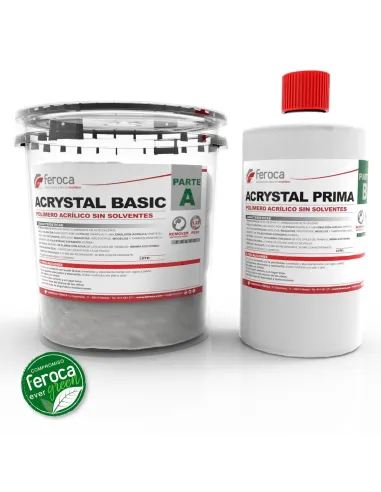
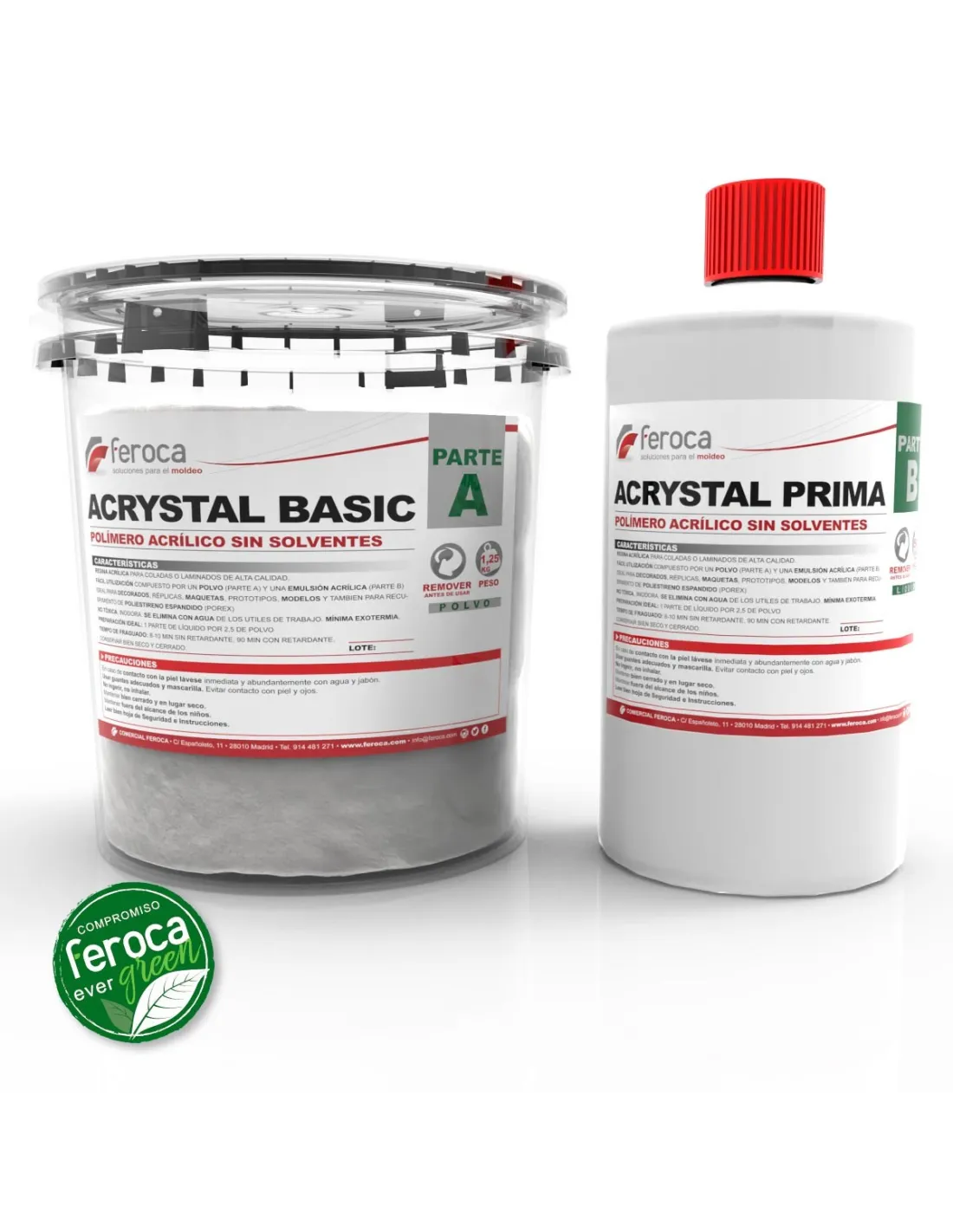
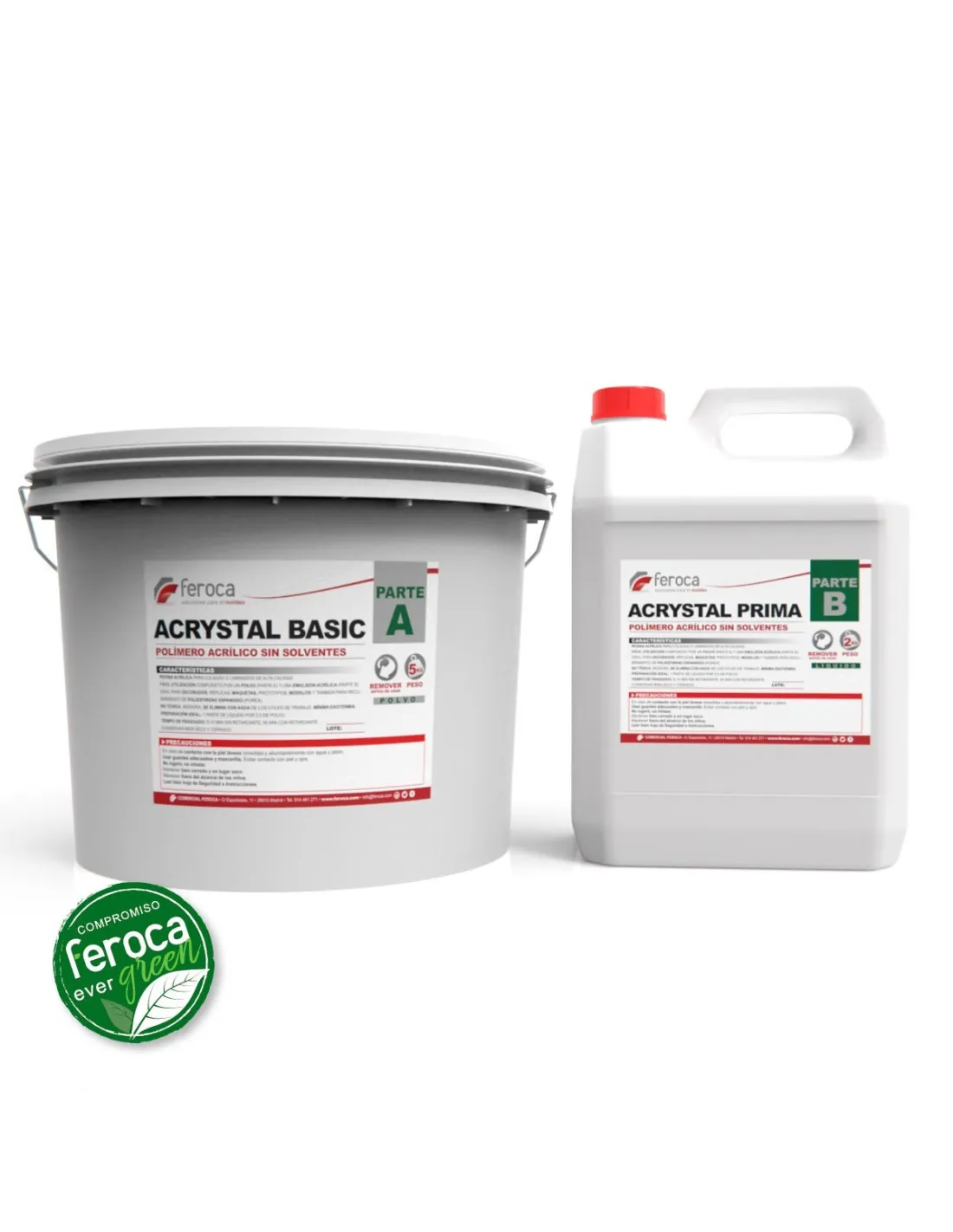
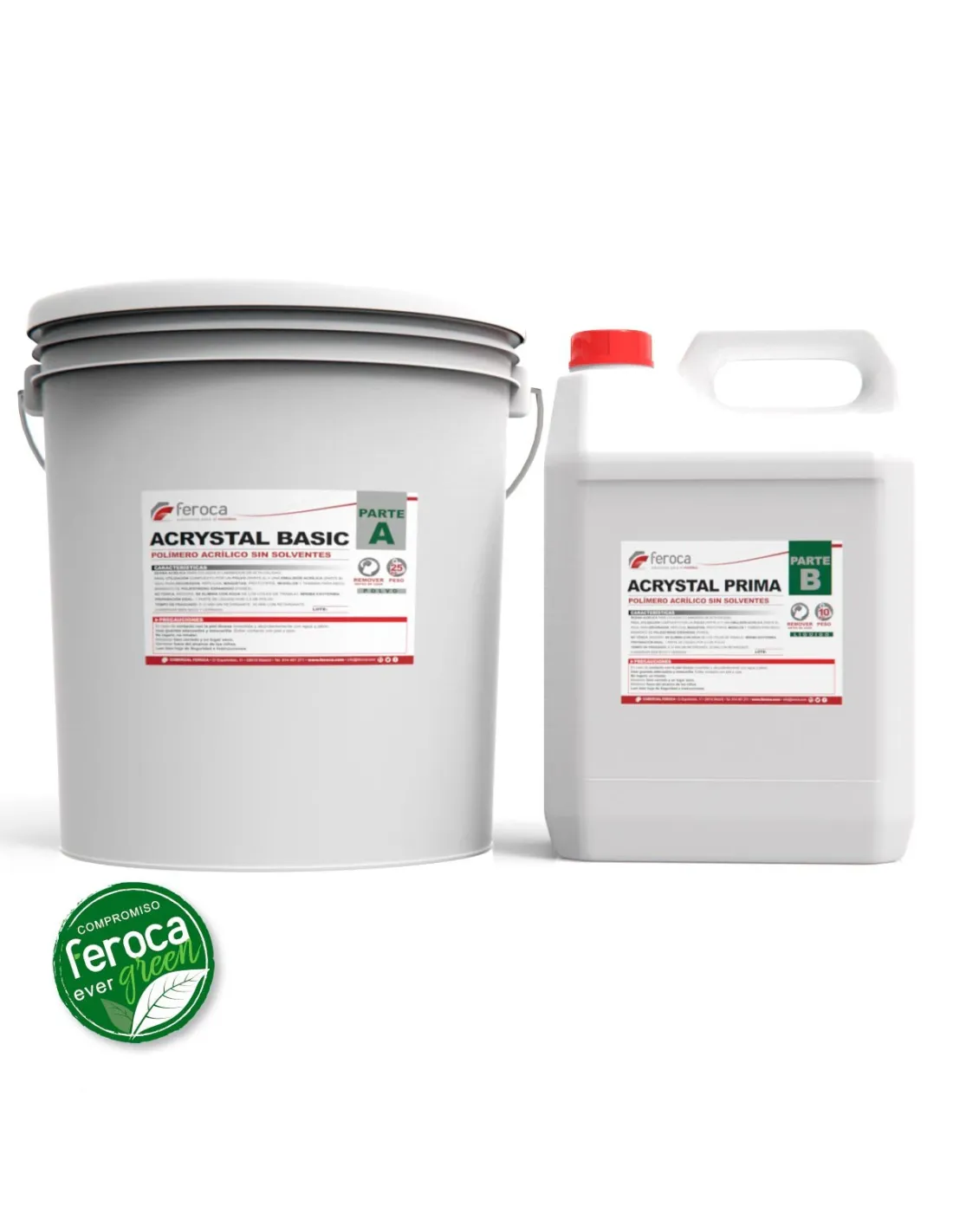
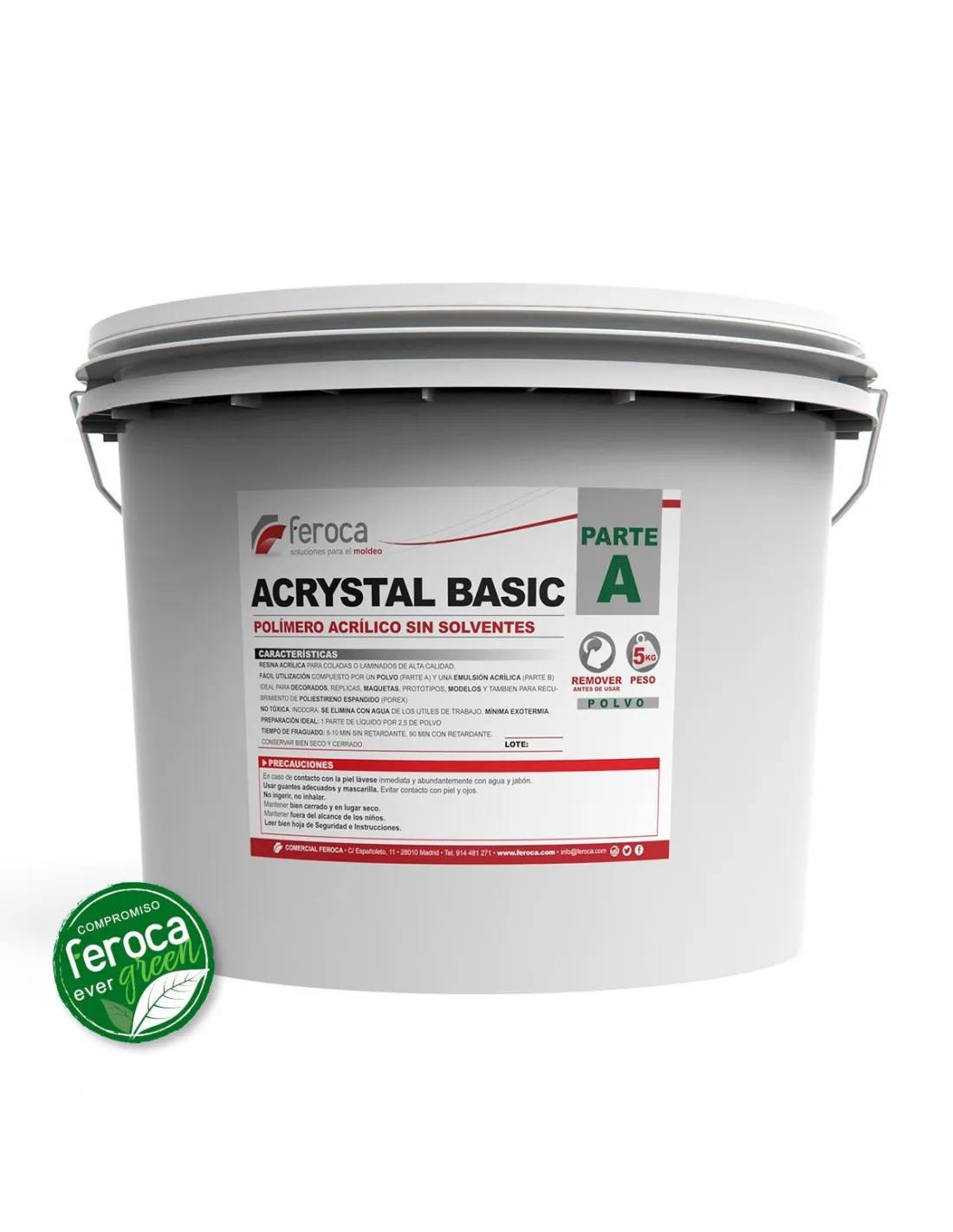
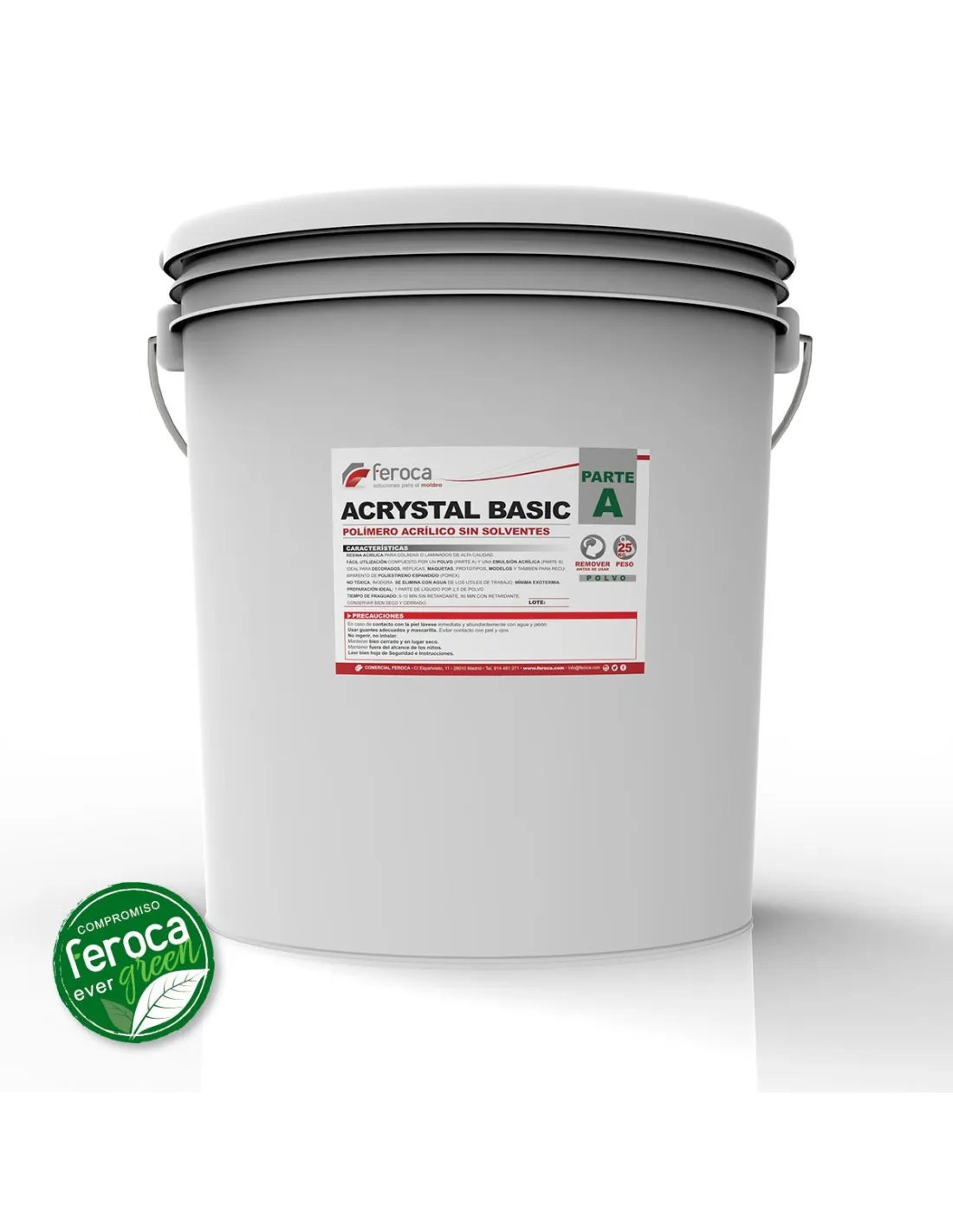
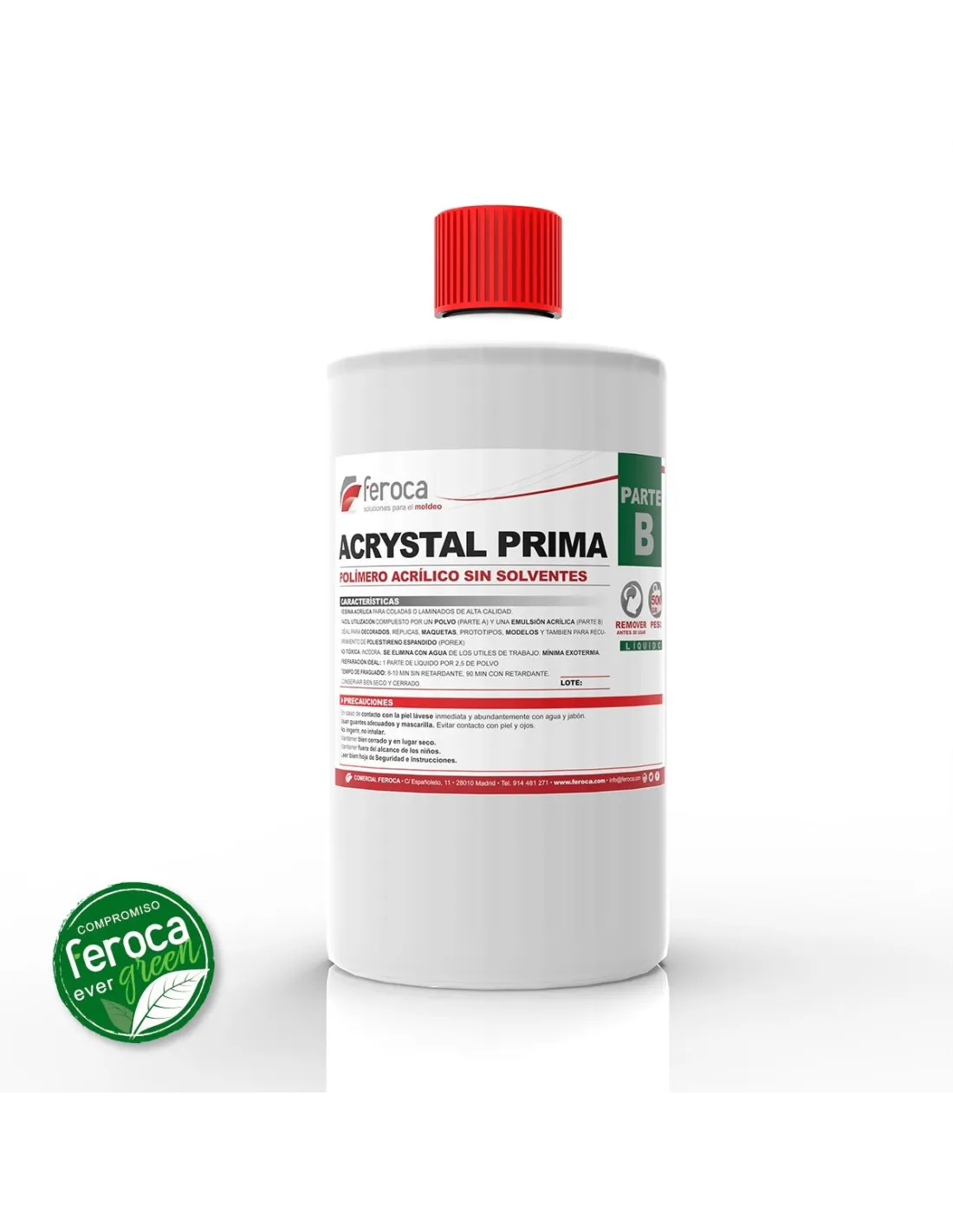
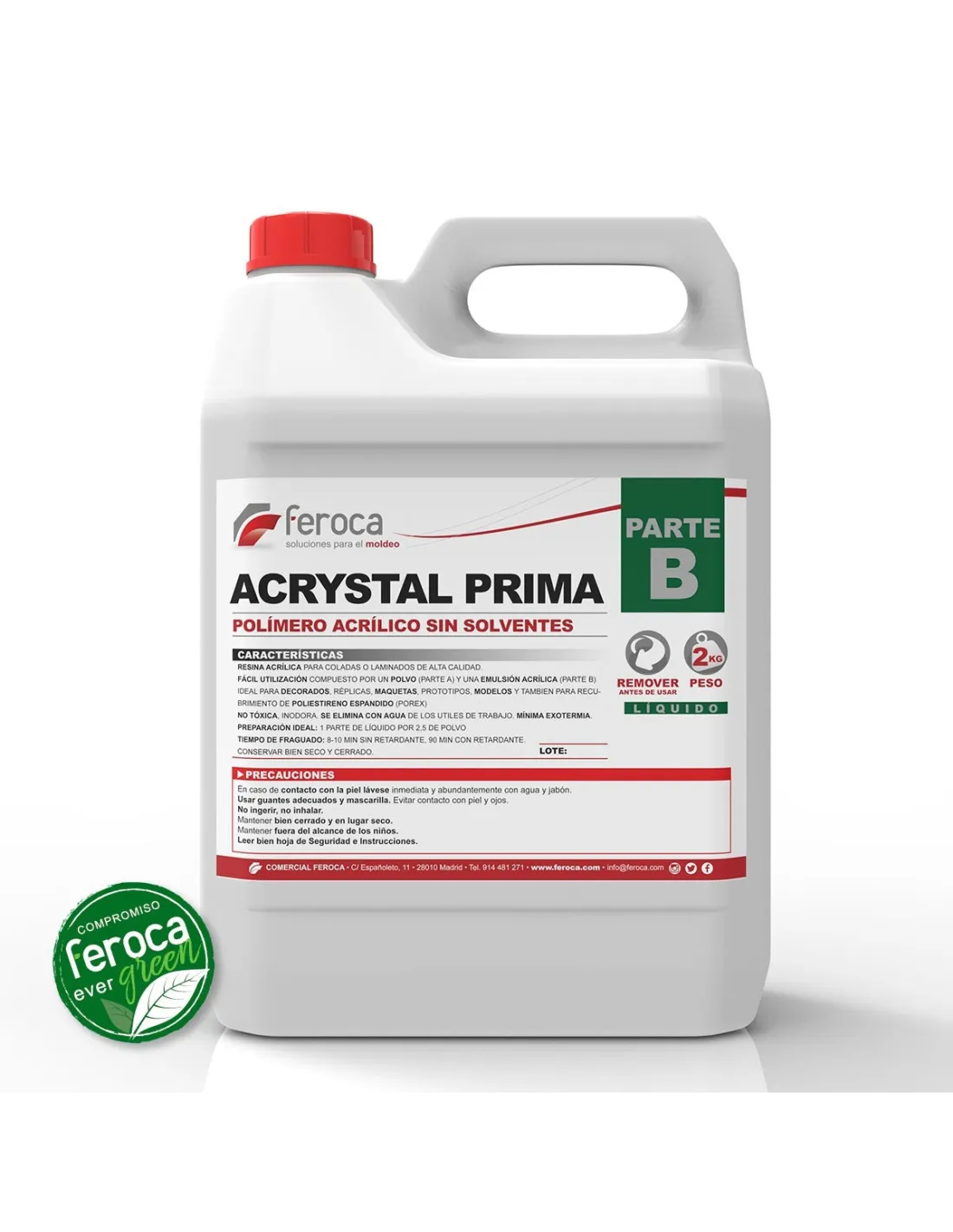
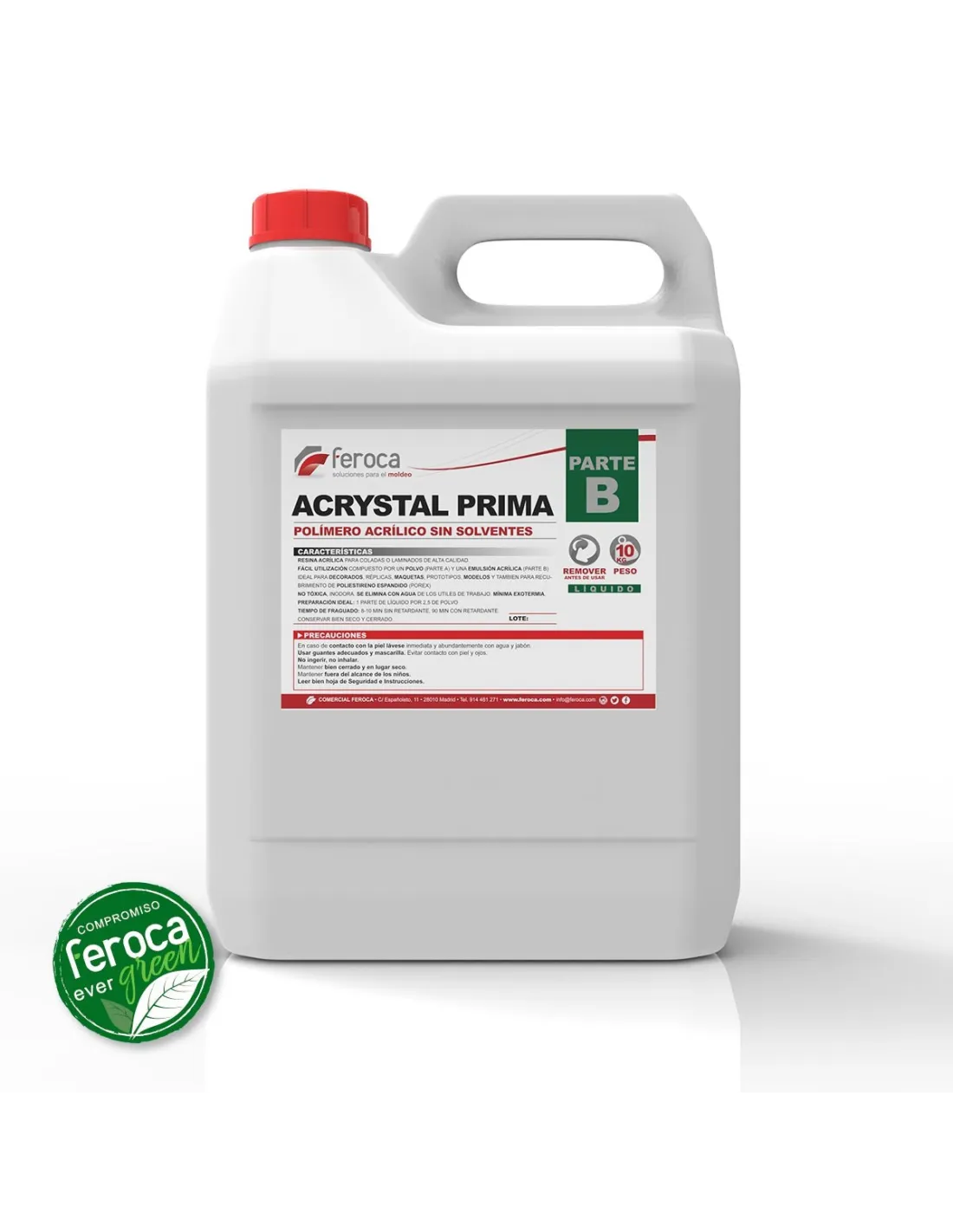
Acrystal Prima + Basic Crystal is a two-component acrylic resin system with no solvents, no odour and no hazardous components: a liquid acrylic emulsion (Acrystal Prima) mixed with a mineral powder (Basic Crystal) to obtain a castable or laminable paste. It is the safest alternative to polyester or polyurethane resins when working in spaces without forced ventilation, educational environments or artistic production studios where zero toxicity is not an option but a requirement.
Technical specifications
| Parameter |
Value |
| System |
Two-component acrylic resin (liquid + powder) |
| Component A |
Acrystal Prima (liquid acrylic emulsion) |
| Component B |
Basic Crystal (mineral crystal powder) |
| Mix ratio by weight |
1 part liquid : 2.5 parts powder |
| Pot life (17-20 °C) |
8-10 min (without retarder) |
| Pot life with retarder |
Up to 90 min |
| Cure time |
10 min |
| Colour on cure |
White |
| Application |
Casting, laminating, spraying, machining |
| Exothermic reaction |
No |
| Toxicity |
No hazardous components, no toxic emissions |
| Cleanup |
Water (before cure) |
What it is used for
Acrystal Prima + Basic Crystal is a versatile material covering a wide range of artistic and light technical applications. Its main competitive advantage is the complete absence of toxicity and odour, making it the go-to resin for enclosed workshops, art classrooms and special effects studios. With no exothermic reaction, it is gentle on silicone moulds and considerably extends their service life compared to conventional resins.
- Casting in silicone moulds for reproduction of sculptures, reliefs and decorative pieces
- Laminating with quadraxial fibreglass fabric for rigid shells and lightweight structures
- Coating and hardening of expanded polystyrene (EPS foam) without attacking the substrate
- Artistic series production: sets, props, accessories and scenery
- Educational environments and workshops without forced air extraction
- Rapid prototyping of machinable parts
- Spray application for coatings on large volumes
How to use it
- Weigh the components. Use a precision scale: 1 part Acrystal Prima (liquid) to 2.5 parts Basic Crystal (powder) by weight. Do not work by eye; the ratio is critical for correct curing.
- Pour the powder onto the liquid. Add the Basic Crystal to the liquid emulsion in a clean, dry container — not the other way around. Use the mixing paddle to blend without lumps.
- Mix until homogeneous. Stir vigorously for 1-2 minutes until a smooth, uniform paste is obtained, with no streaks of dry powder at the bottom.
- Adjust viscosity if needed. For fluid castings, slightly reduce the amount of powder. For vertical applications or laminating, add Acrystal thixotropic agent to prevent sagging.
- Apply within the pot life. You have 8-10 minutes at 17-20 °C. If you need more time, incorporate Acrystal retarder before mixing to extend the pot life up to 90 minutes.
- Demould after cure. The piece will be ready in approximately 10 minutes. Carefully remove from the mould and allow to rest until it reaches its final hardness.
- Clean tools immediately. Before the resin cures, clean spatulas, paddles and containers with running water. Once cured, cleaning must be done mechanically.
- Apply a finish if desired. To seal, protect or add gloss to the piece, use Acrystal Finition, the solvent-free acrylic varnish specifically designed for this system.
Usage tips
Temperature control and pot life
The 8-10 minute pot life is calibrated for 17-20 °C. Above 25 °C curing accelerates significantly and the working window shrinks to 5-6 minutes. In summer or in warm workshops, work in small batches and keep Acrystal retarder close at hand. Below 15 °C curing slows down and the mix may become lumpy; in that case, bring the liquid to room temperature for a few minutes before mixing.
Laminating with fabric: why quadraxial makes the difference
If your project requires laminating, quadraxial fibreglass fabric is the most compatible reinforcement with Acrystal Prima: its multidirectional structure impregnates evenly with the consistency of this resin, unlike conventional fibreglass mats which present impregnation problems. For reinforcement in high-tensile areas, you can also incorporate PVA fibres directly into the mix before casting.
Coating EPS foam: correct technique
Acrystal Prima does not attack expanded polystyrene, making it the ideal resin for hardening volumes carved from EPS foam. For thin coatings, apply a first brushable layer with a slightly more fluid consistency (slight reduction of powder) and allow to cure. Then apply a second layer at standard viscosity. This two-coat system avoids pinholes and ensures a uniform surface ready for sanding, painting or varnishing with Acrystal Finition.
Frequently asked questions
Is it necessary to wear gloves or a mask with this resin?
Acrystal Prima + Basic Crystal contains no hazardous components and emits no toxic vapours, so it does not require a respirator with organic vapour filters. Even so, nitrile gloves are recommended to avoid prolonged contact with the acrylic emulsion, and it is good practice to wear safety glasses when mixing the powder to avoid inhaling airborne particles.
Can I use this resin in silicone moulds?
Yes, it is one of its most common applications. Acrystal Prima + Basic Crystal generates no exothermic reaction, eliminating the risk of heat-degrading the mould. This significantly extends mould service life compared to polyurethane or polyester resins. No release agent is required for silicone moulds, although it may be advisable for long production runs.
What is the difference between this resin and other acrylic resins on the market?
Acrystal Prima + Basic Crystal delivers a smoother, more sealed finish than other mineral acrylic resins. Its liquid + mineral powder system provides a more compact surface, whereas similar formulations can be somewhat more porous. Both types are non-toxic and acrylic-based, but the final finish and compatibility with certain coatings and varnishes may vary.
Can I add pigments or fillers to change the colour or effect?
Yes, you can incorporate powder or paste pigments compatible with water-based systems directly into the liquid emulsion before adding the Basic Crystal. Mixing metallic powders (such as bronze or brass) directly into the resin is not recommended, as they may interfere with curing and the final finish. For metallic effects, Feroca carries specific acrylic resins with that finish.
How can I extend the pot life if 10 minutes is not enough?
By adding Acrystal retarder to the liquid emulsion before mixing with the powder, you can extend the pot life up to 90 minutes. The exact amount depends on ambient temperature and mix volume; consult the retarder's technical data sheet for recommended proportions.
Is this resin suitable for pieces in contact with water?
Acrystal Prima + Basic Crystal offers acceptable resistance to ambient humidity, but is not formulated for continuous immersion or permanent contact with water. For decorative pieces used outdoors or with high humidity exposure, sealing with Acrystal Finition is recommended to improve surface resistance.
How do you clean up if the resin has already cured on the tools?
Once cured, Acrystal Prima cannot be dissolved with water or conventional solvents. Cleanup must be done mechanically: scraper, spatula or sanding. This is why it is essential to clean all tools (paddles, containers, brushes) with running water immediately after use, before the mix cures.
Can it be mixed with fibres to increase strength?
Yes. You can incorporate PVA fibres directly into the mix to increase tensile strength and reduce the tendency to crack in thin-walled pieces. For structural laminates, work in layers alternating resin and quadraxial fibreglass fabric, which is the most compatible reinforcement for this system.
How much product do I need?Calculate the exact amount before buying and avoid wasting material.
Go to the calculator →