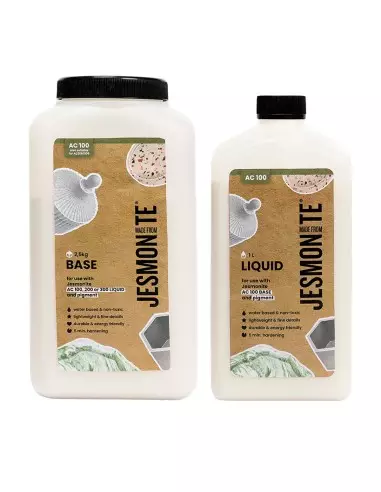
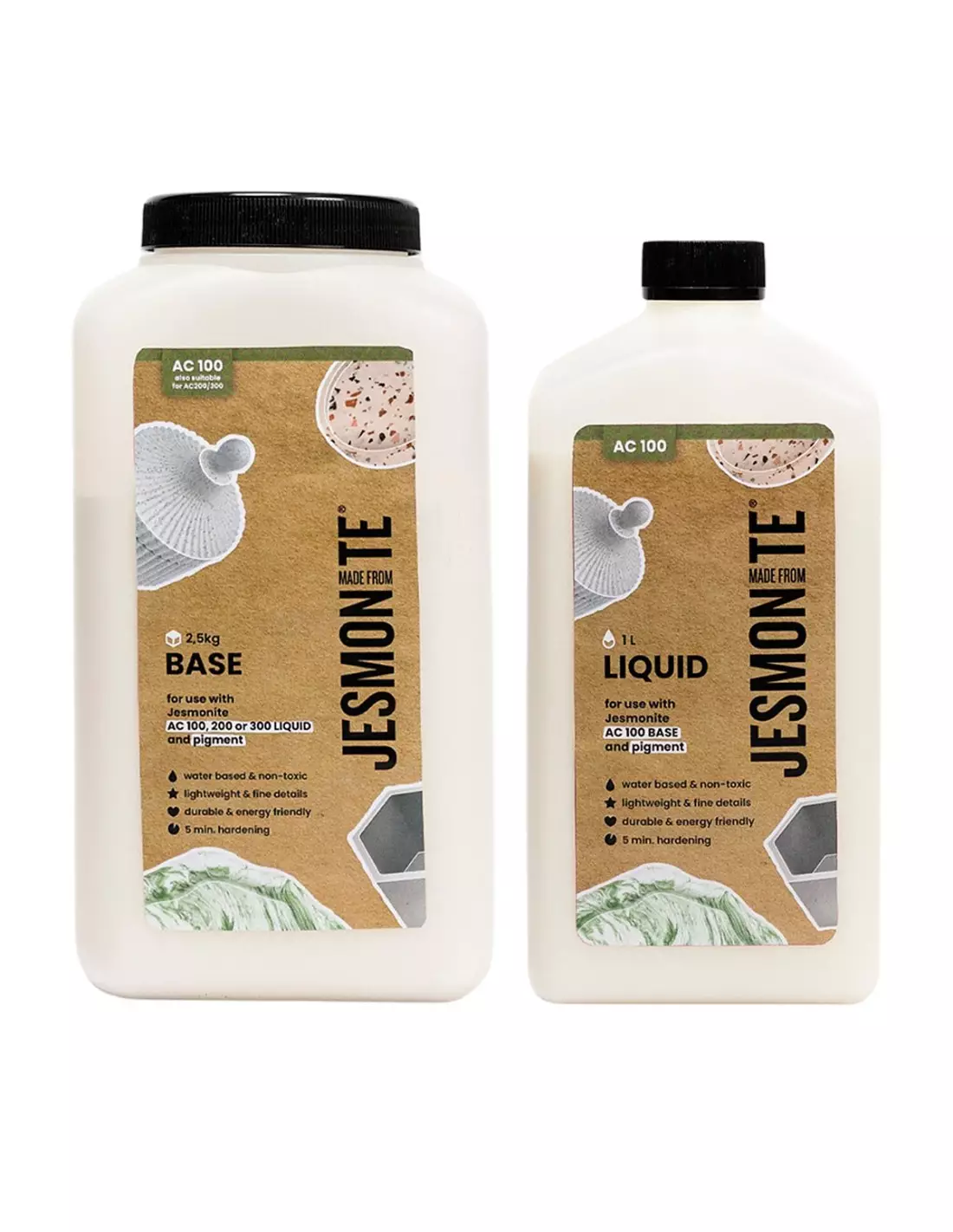
Jesmonite AC100 is a water-based acrylic resin designed for casting and fibreglass-reinforced laminates. It contains no solvents or volatile organic compounds (VOC), making it one of the safest options on the market for working in enclosed workshops. Its versatility makes it suitable for reproducing virtually any surface, colour or texture, by combining it with pigments, fillers and specific additives from the Jesmonite system.
Technical specifications
Property
Value
Resin type
Water-based acrylic
Base colour
White
Mix ratio (by weight)
2.5 parts base to 1 part liquid
Solvents / VOC
None
Fire resistance
Yes
Impact resistance
High
Application methods
Casting and laminating
What it's used for
Jesmonite AC100 is the reference material for creating high-quality decorative pieces with a mineral or stone-like appearance. It can be used both in direct casting and in laminating with Quadriaxial Fibreglass Cloth to obtain lighter and stronger pieces. It is the ideal choice when you need a moulding material without the risks associated with polyester or epoxy resins.
Mould boxes and rigid counter-moulds over silicone moulds
Decorative architectural elements (cornices, reliefs, appliqués)
Fibreglass-reinforced laminates for lightweight and strong pieces
Display, props and special effects pieces
Reproductions of natural textures (stone, concrete, wood)
How to use it
Prepare the mould by applying a coat of APM WAX Release Wax and allow it to dry before buffing. This aids demoulding and protects the mould surface.
Weigh the components in the correct ratio: 2.5 parts base powder to 1 part acrylic liquid, by weight.
Pour the liquid into the mixing container and gradually add the base powder, stirring with a spatula or paddle mixer until a smooth, lump-free mixture is obtained.
If pigmenting, add the Jesmonite Pigments at this stage and mix thoroughly until a uniform colour is achieved.
For laminating: apply a first gel coat layer with a brush over the mould, allow to gel, then apply the Quadriaxial Fibreglass Cloth saturated with more AC100. Smooth with a brush to eliminate bubbles.
For casting: pour the mixture directly into the mould and gently agitate to release trapped air.
Allow to cure at room temperature. Working and cure times vary depending on workshop temperature; if you need more working time, use Jesmonite Retarder.
Once cured, carefully demould the piece and carry out any necessary finishing (sanding, painting, sealing).
Usage tips
Working time control
Workshop temperature directly affects the cure speed. Above 25 °C the material may gel faster than expected. If you are working in summer or in warm spaces, use Jesmonite Retarder to extend the working time without compromising the final properties of the piece. Always mix in manageable quantities to prevent the material from curing in the container.
Bubble-free laminating
For quality laminates, apply the first layer of AC100 as a gel coat with a fine brush and wait until it loses its surface shine before applying the cloth. If you need to work on vertical surfaces or ceilings, add Jesmonite Thixotrope to increase viscosity and prevent the material from running. Brush in multiple directions to eliminate air bubbles trapped between the cloth and the resin.
Pigmentation and finishes
Jesmonite Pigments are specifically formulated for the AC100 system and guarantee uniform dispersion without affecting the cure. You can create marble, terrazzo or stone effects by partially mixing different colours in the container before pouring. Bear in mind that AC100 gives a slightly porous finish; if you want a smoother, sealed result, apply a coat of acrylic sealer once the piece has cured and been sanded.
Frequently asked questions
Can I use this resin without fibre reinforcement, just as a cast?
Yes. Jesmonite AC100 can be used directly in casting without any reinforcement, producing solid pieces with a mineral appearance. Fibreglass cloth reinforcement is used when you want to reduce the weight of the piece or increase its structural strength, but it is not required for standard decorative applications.
How many laminate layers are needed for a strong piece?
For most decorative applications, one gel coat layer plus two laminate layers of Quadriaxial Fibreglass Cloth is sufficient. For pieces that need to withstand greater mechanical stress, additional layers can be added. Each layer must gel before applying the next to ensure good adhesion between plies.
Does this resin mix with water?
No. Although it is a water-based resin, the two components of the Jesmonite AC100 system are the base powder and the acrylic liquid. No water is added during the mixing process. Mixing with water would alter the component ratio and compromise the cure and mechanical properties of the material.
Is it safe to work with this resin in enclosed spaces?
Jesmonite AC100 contains no solvents or VOC, making it considerably safer than conventional polyester or epoxy resins for indoor use. Even so, it is recommended to maintain basic ventilation and wear a particle mask when handling the base powder to avoid inhaling fine dust.
Can I add pigments or other colourants to the material?
Yes, and this is one of the great advantages of the system. Jesmonite Pigments are formulated to integrate seamlessly into the mix without affecting the cure or final properties. Avoid using oil- or solvent-based pigments, as these can interfere with the material's cure.
What is the difference between this resin and other acrylic resins on the market?
The Jesmonite AC100 system offers a finish with a certain porosity that is reminiscent of natural materials such as stone or plaster, which makes it highly valued in decoration and art. Other acrylic resins, such as Acrystal Prima, tend to give smoother, more sealed finishes. The choice depends on the desired final effect and the type of application.
How can I slow down the cure if I need more working time?
You can use Jesmonite Retarder, the specific retarder for the AC100 system. Always work in small quantities and in the coolest temperature conditions possible. Never modify the mix ratio in an attempt to extend the working time, as this negatively affects the mechanical properties of the cured material.
Do I need a release agent to use this resin with silicone moulds?
With silicone moulds, demoulding usually occurs without a release agent thanks to the non-stick nature of silicone rubber. However, when working with moulds made from other materials (wood, plaster, metal, fibreglass), it is essential to apply APM WAX Release Wax to ensure clean demoulding and protect the mould.
How much product do I need?Calculate the exact amount before buying and avoid wasting material.
Cookies on this site are used to personalise content and ads to deliver social media features and to analyse traffic. We also share information about your use of the site with our social media partners for advertising, personalisation and web analytics.. More information.