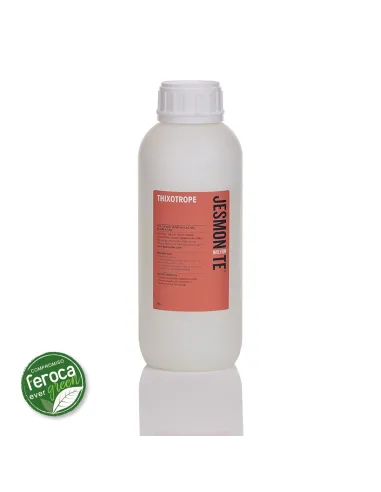
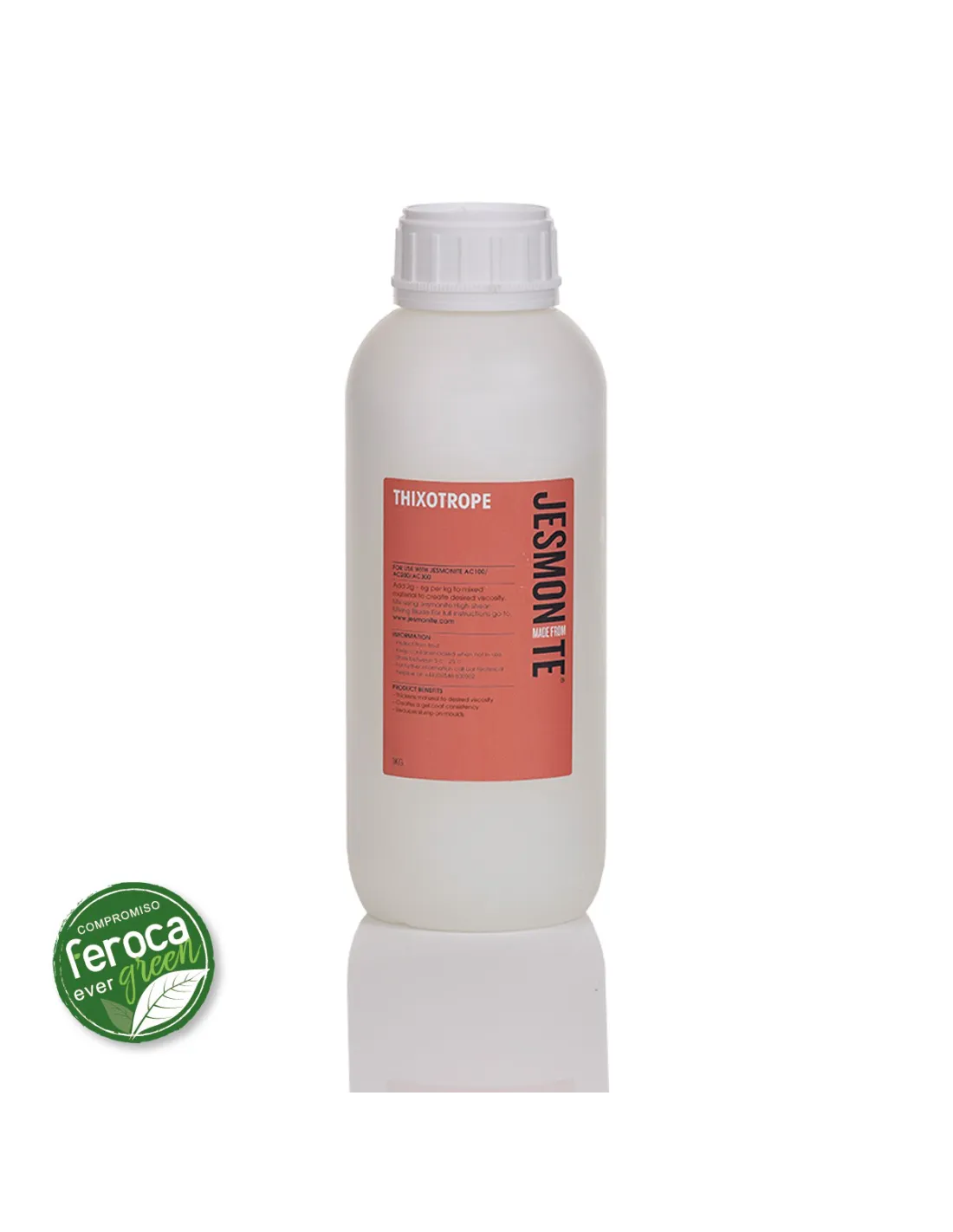
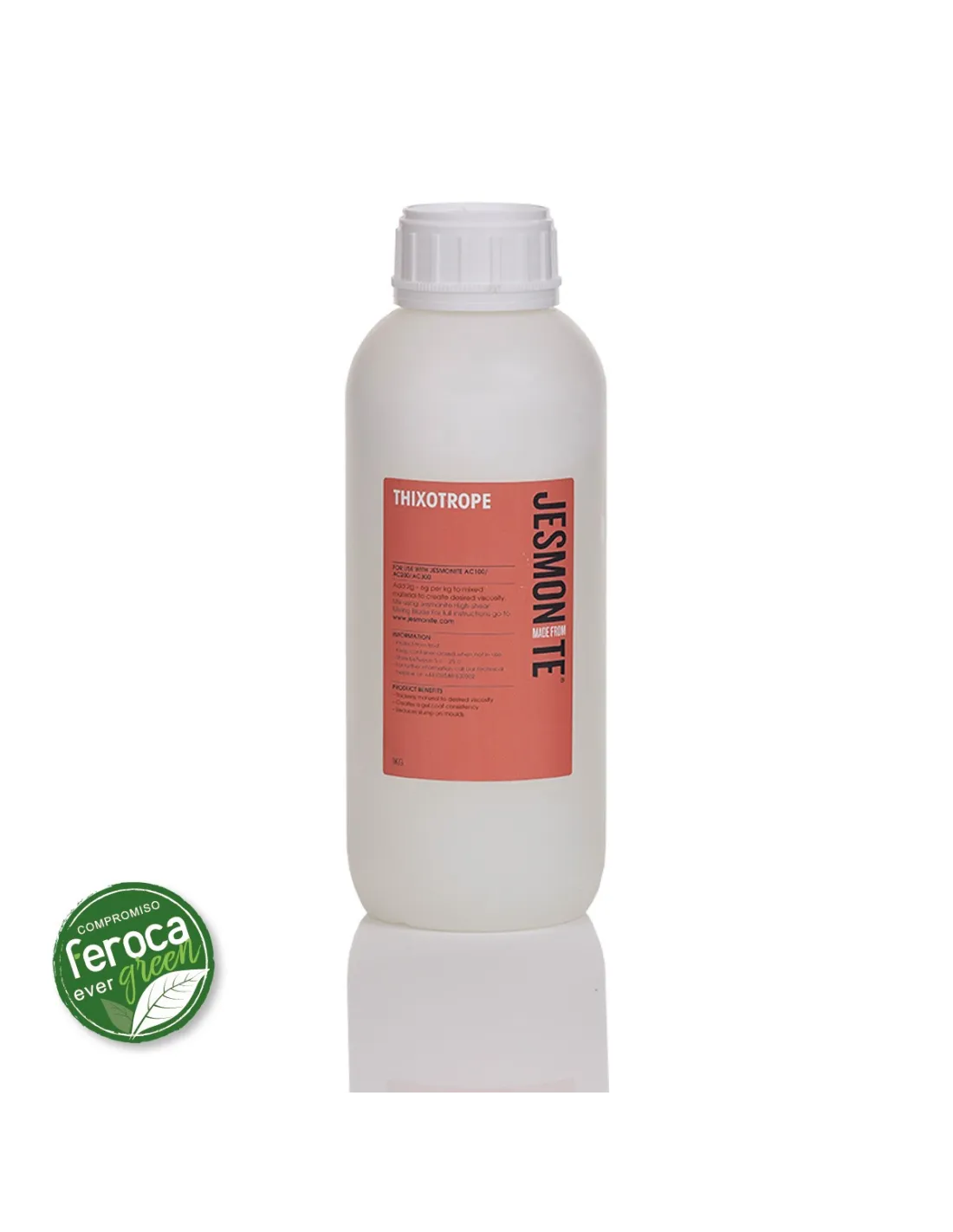
Jesmonite Thixotrope is a thixotropic additive designed specifically for Jesmonite resins that transforms the fluid consistency of the mix into a gel coat-type paste, ready to apply with a brush or spray. Essential when working on vertical surfaces or complex geometries where the material tends to run before gelling.
Technical specifications
| Parameter |
Value |
| Additive type |
Thixotropic |
| Compatibility |
Jesmonite resins (AC100, AC730 and similar) |
| Recommended dosage |
2 g – 6 g per kg of mix |
| Incorporation method |
Drop by drop after mixing base + liquid |
| Mixing tool |
High-shear mixing paddle |
| Effect achieved |
Viscosity increase up to gel coat consistency |
What it is used for
Jesmonite Thixotrope is used whenever you need the Jesmonite resin to stay where you apply it, without running. It modifies the rheology of the mix in a controlled way, allowing you to adjust the viscosity to the exact point each job requires.
- Applying gel coat layers on moulds with vertical faces or overhangs
- Brush lamination on non-horizontal surfaces without material loss
- Spray gun projection of thickened Jesmonite mixes
- Creating controlled surface textures and reliefs
- First skin coat on complex moulds before filling with fluid casting of Jesmonite AC100
- Restoration or repair work where the resin must remain localised
How to use it
- Prepare the base mix of Jesmonite AC100 or Jesmonite AC730 following the manufacturer's specified ratios.
- Once the base and liquid are combined, begin adding the Thixotrope drop by drop into the mix.
- Mix vigorously with the high-shear mixing paddle after each addition.
- Assess the consistency: for brush application, aim for a texture similar to thick paint; for spray gun, slightly more fluid.
- Continue adding Thixotrope gradually until the desired viscosity is reached. Do not exceed 6 g per kg of mix unless you need a very dense paste.
- Apply the thickened mix to the mould with a brush, spatula or spray gun before the gelling process begins.
- Allow to cure according to the base resin's instructions. The Thixotrope does not alter cure times.
Usage tips
Exact dosage according to application
Always start with the minimum dose (2 g/kg) and work up. With 2–3 g/kg you get an ideal consistency for a thick brush; with 4–6 g/kg you achieve a paste that holds on steep verticals and even on inverted surfaces. Exceeding 6 g/kg can hinder uniform mixing and generate visible lumps in the finished piece.
High-shear mixing: key to homogeneity
The Thixotrope only works correctly if dispersed homogeneously. Always use the mixing paddle at medium-high speed and mix for at least 30 seconds after each addition. Poor dispersion creates zones of irregular viscosity and can cause marks or streaks on the surface of the piece.
Compatible with pigments and other additives
You can combine the Thixotrope with Jesmonite pigments without issue: add the pigment to the base mix first, then incorporate the thickener. If you are working with Jesmonite AC730 for stone effects, the Thixotrope lets you apply the first coat with a brush with full control, especially in silicone moulds with deep textures. If you need to extend the working time, combine it with Retardante Acrystal to gain more margin on large pieces.
Frequently asked questions
Does the thixotropic additive alter the cure time of the resin?
No. Jesmonite Thixotrope only modifies the viscosity of the mix. The gel time and cure time of the base resin (AC100, AC730) remain the same as without the additive. If you need more working time, use a retarder specifically designed for acrylic resins.
What is the difference between a thixotropic agent and a simple thickener?
A thickener increases viscosity permanently regardless of how the material is handled. A thixotropic agent like Jesmonite Thixotrope creates a viscosity that decreases under mechanical stress (when mixing or brushing) and recovers its thick consistency at rest. This makes application easier and ensures the material stays where you place it.
Can I use this additive with acrylic resins from other brands?
Jesmonite Thixotrope is formulated and tested for the Jesmonite resin range. For acrylic resins from other ranges, Feroca offers the Tixotropante Acrystal, specifically developed for Acrystal resins.
What tool do I need to incorporate the thixotropic agent correctly?
You need a high-shear mixing paddle, ideally attached to a drill at medium-high speed. Manual mixing with a spatula does not generate enough shear to disperse the additive homogeneously and can result in an uneven consistency.
How much thixotropic agent do I need for working on vertical surfaces?
For standard vertical surfaces, a dosage of 3–4 g per kg of mix is usually sufficient. On surfaces with negative inclination (vault or pronounced overhang type) increase to 5–6 g/kg. Always do a small test before preparing a large batch to fine-tune the dose to your workshop conditions.
Does the thixotropic agent affect the surface finish of the piece?
If dispersed correctly, the finish is practically identical to that of the resin without additive. Excessive dosage or poor mixing can produce a slightly more matte texture or micro-streaks. For pieces requiring a very smooth finish, work with the minimum effective dose.
Can the thickened material be applied with a spray gun?
Yes, as long as the viscosity is not excessive. For spray gun projection, use doses in the lower range (2–3 g/kg) and adjust the nozzle to an appropriate size for medium-viscosity materials. Carry out a flow test before applying to the final mould.
How much product do I need?Calculate the exact amount before buying and avoid wasting material.
Go to the calculator →