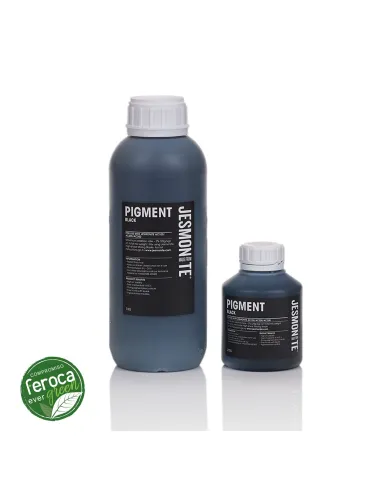
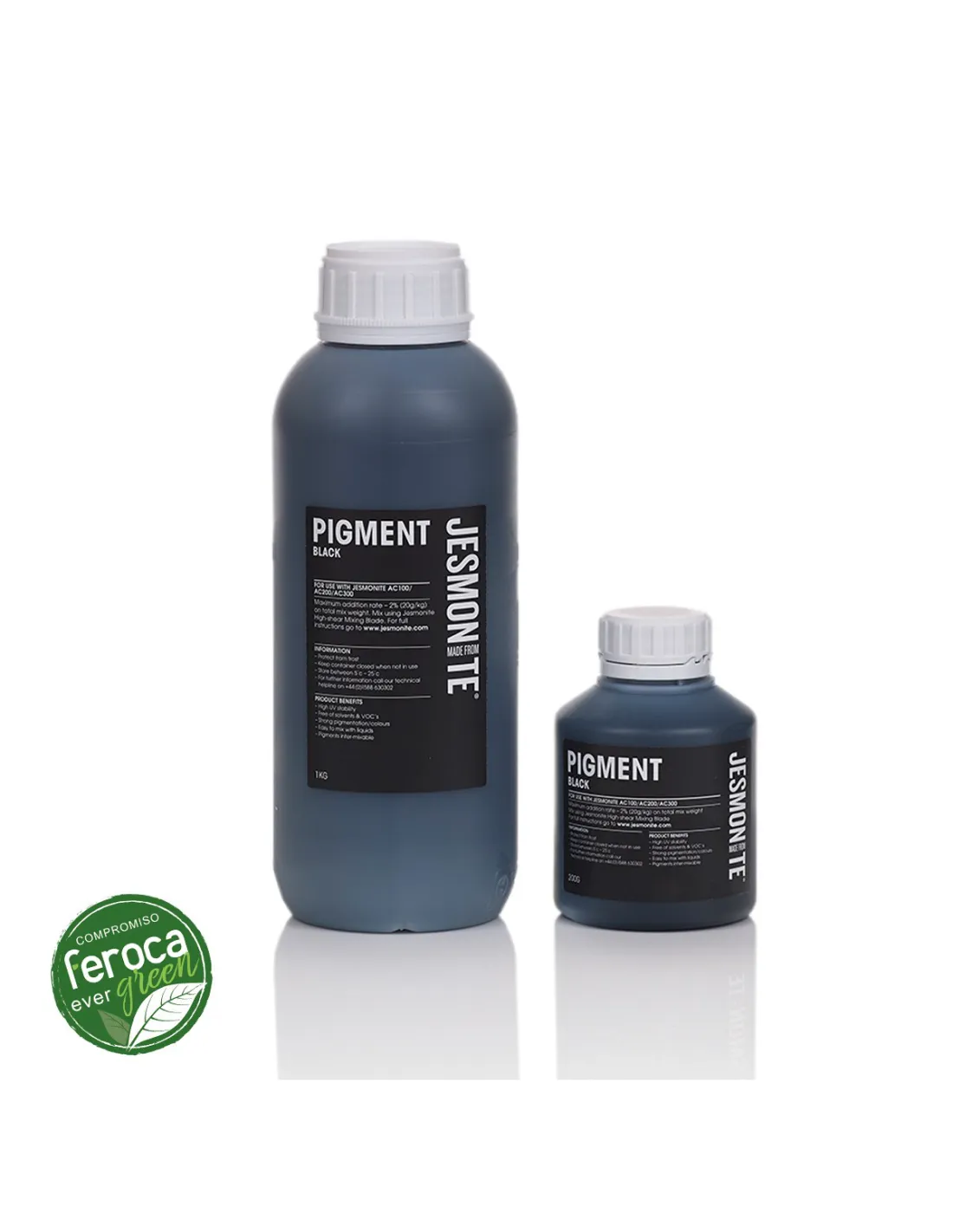
Jesmonite pigments are high-quality aqueous dispersions specifically formulated to colour Jesmonite range compounds. They offer UV resistance, excellent chemical and thermal stability, and seamless integration with Jesmonite acrylic resins without affecting the cure or the mechanical properties of the base material.
Technical specifications
Parameter
Value
Type
Acrylic aqueous dispersion
Compatibility
Jesmonite resins and compounds (AC100, AC730 and similar)
Maximum dosage
2% by weight of the total mix
UV resistance
Yes
Chemical stability
High
Thermal stability
High
Available formats
200 g / 1 kg
What it is used for
These pigments are designed for mass colouring of Jesmonite compounds, both in decorative and structural applications. By integrating directly into the liquid component before mixing, the colour remains uniform throughout the full thickness of the piece, with no surface layers that could flake off or wear away.
Casting of decorative figures, bowls, vases and interior design pieces with Jesmonite AC100
Colouring of boards, claddings and laminated architectural elements
Chromatic blending to achieve intermediate or custom shades
Series production where exact colour reproducibility is required
Outdoor applications thanks to UV resistance
How to use it
Shake the container well before use, as the dispersion may settle slightly at rest.
Weigh the liquid component of your Jesmonite compound according to the manufacturer's formulation.
Add the pigment directly to the liquid at a maximum ratio of 2% by weight of the total mix (liquid + powder). Do not exceed this dosage or you could affect the cure and final strength.
Mix the pigment with the liquid until a completely homogeneous colour is obtained, with no streaks or lighter areas.
Add the Jesmonite powder at the indicated ratio and mix according to the base compound instructions.
Pour, laminate or apply the coloured material according to your project technique.
For the most vivid and saturated colours, use the pigment with Jesmonite AC100, which has the highest acrylic resin content in the range.
Usage tips
Chromatic blending and reproducibility
If you need a specific shade that does not exist in the standard range, blend several pigments together before incorporating them into the liquid. Always record the exact grams of each pigment used relative to the total mix. The aqueous dispersion facilitates homogeneous integration, but exact proportions are key to reproducing the same colour across different castings.
Dosage and colour saturation
More pigment does not always mean more colour: exceeding 2% by weight can compromise the mechanical strength of the piece and alter the cure time. For maximum chromatic intensity, work with AC100 (higher acrylic resin content) and keep the dosage within the recommended limit. Light shades require less; dark and saturated tones may approach the 2% cap.
Storage and preservation
Store containers tightly closed in a cool place away from direct sunlight. As these are aqueous dispersions, avoid sub-zero temperatures: freezing can irreversibly alter the pigment stability. Before each use, check that the dispersion is uniform; if lumps remain after shaking, discard that batch.
Frequently asked questions
Can I use these pigments with any acrylic resin or only with Jesmonite?
They are specifically formulated and tested for Jesmonite compounds. They may be compatible with other water-based acrylic resins, such as Acrystal Prima, but we recommend doing a small-scale trial first to verify compatibility and colour behaviour before using them in production.
What happens if I add more than 2% pigment?
Exceeding 2% by weight can inhibit or slow down the cure, reduce the mechanical strength of the final piece and cause uneven colour. Always respect the maximum recommended dosage. If you need more intensity, work with Jesmonite AC100 which, due to its higher resin content, delivers more vivid colours at the same dosage.
At what point in the process do I add the pigment?
Always to the liquid component, before adding the powder. Mix the liquid and pigment until the colour is completely homogeneous and only then add the Jesmonite powder. This order ensures uniform colour distribution throughout the entire mass.
Are they suitable for outdoor use?
Yes. Thanks to their UV resistance, Jesmonite pigments are suitable for outdoor pieces. The colour will not yellow or degrade prematurely from exposure to solar radiation, provided the chosen base compound is also formulated for outdoor use.
Can I mix colours together to obtain custom shades?
Yes. Jesmonite pigments are miscible with each other. Blend the desired colours in the liquid before adding the powder. Always record the exact grams of each pigment so you can reproduce the same shade in future castings.
How long do they last once opened?
When kept tightly closed and stored in a cool place, away from direct light and without exposure to frost, the pigments retain their properties for an extended period. Shake before each use and verify that the dispersion is uniform. If lumps appear that do not break up when shaken, the product may be degraded.
Do they affect the cure time or the strength of the piece?
When used at the recommended dosage (max. 2% by weight), the pigments do not significantly alter the cure time or the mechanical properties of the compound. If you need to adjust the working time, do so with a specific retarder and not by increasing the pigment dosage.
Are they suitable for pieces in contact with food?
Jesmonite pigments are not certified for direct food contact. For any application involving food contact, consult the safety data sheet of the specific pigment and the restrictions of the base compound you are using.
How much product do I need?Calculate the exact amount before buying and avoid wasting material.
Cookies on this site are used to personalise content and ads to deliver social media features and to analyse traffic. We also share information about your use of the site with our social media partners for advertising, personalisation and web analytics.. More information.