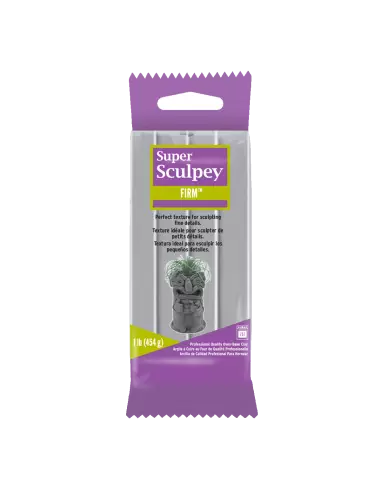
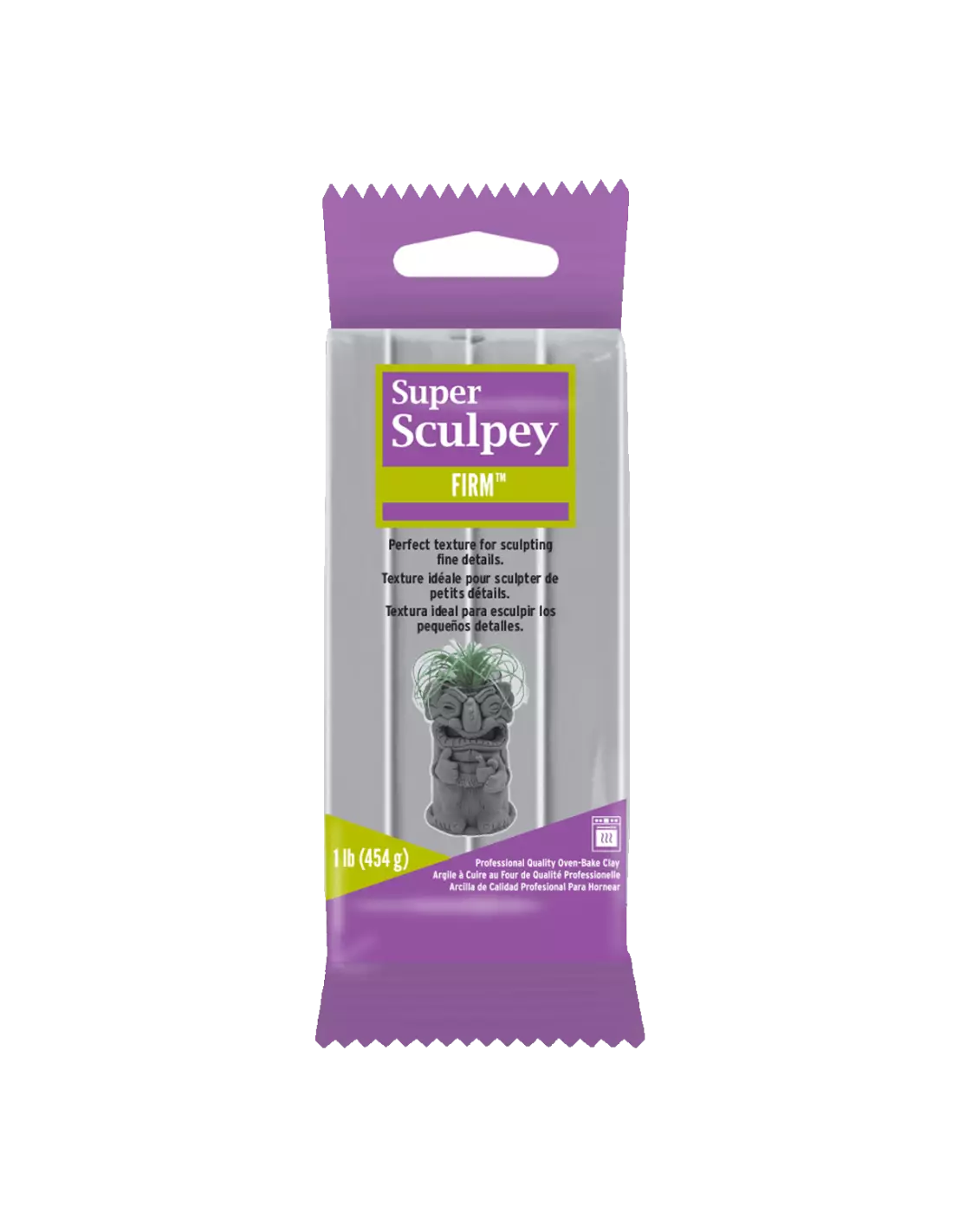
Super Sculpey Firm Gray is a firm-consistency, neutral grey polymer clay designed for fine-detail technical sculpting. Its superior firmness holds edges, textures and volumes without deformation during modelling, and cures permanently in a domestic oven at 130 °C. If you need a material to work precise masters for subsequent moulding in silicone or resin, this is your go-to reference.
Technical specifications
| Property |
Value |
| Material type |
Polymer clay (PVC plastisol) |
| Colour |
Neutral grey |
| Content |
454 g |
| Consistency |
Firm |
| Baking temperature |
130 °C (275 °F) |
| Baking time |
15 minutes per 6 mm of thickness |
| Air drying |
Does not harden without baking |
| Appearance after baking |
Solid, ceramic-like, paintable |
| Toxicity |
Non-toxic |
What it is used for
Super Sculpey Firm Gray is aimed at professionals and semi-professionals who need a modelling material that holds detail without giving way. The grey colour makes it easier to read volumes, shadows and textures under workshop lighting — critical when working on anatomy or surface detail. It is the standard starting point for pieces that will later be moulded in platinum or tin silicone, or reproduced in resin.
- Sculpting figures, busts and characters for collectibles and entertainment
- Master prototyping for animation, video games and special effects
- Modelling originals for subsequent moulding and reproduction
- Creating architectural models and detail parts
- Sculpting jewellery and accessories prior to reproduction
- Training and practice in sculptural anatomy
- Production of articulated dolls and action figures
- Prosthetics and FX pieces requiring precise edge definition
How to use it
- Condition the material: If the clay is very cold, knead it with your hands for a few minutes to soften it and make it workable. You can also warm it briefly with a heat gun on a low setting to speed up the process.
- Build the core: For bulky pieces, first create an internal core using armature wire or a lighter material to save clay and reduce the risk of bubbles during baking.
- Model with tools: Work with loop tools and detail tools to define textures, edges and surfaces. The firmness of the material allows fine lines to be inscribed without them disappearing.
- Check thickness: Before baking, make sure no section exceeds 6 mm in thickness without adding proportional baking time. Very thick areas may remain uncured inside.
- Bake at 130 °C: Place the piece in a preheated domestic oven at 130 °C (275 °F). Allow 15 minutes for every 6 mm of maximum thickness. Do not exceed this temperature to avoid scorching or fume emission.
- Cool before handling: Allow the piece to cool to room temperature before demoulding or working on it further. The material is fragile when hot.
- Finish and paint: Once cool, you can sand, carve, add further layers of raw clay (for re-baking) or apply acrylic paint, primer or lacquer directly to the surface.
Warning — platinum silicone inhibition: If you plan to mould your master with an addition-cure (platinum) silicone, be aware that the PVC plastisol in polymer clays may contain residues that inhibit curing in the surface layer. Always apply a coat of sealing primer or acrylic varnish over the baked piece and allow it to dry completely before applying the silicone. Always perform a cure test on a small area before covering the entire piece.
Usage tips
Working temperature
The firmness of Super Sculpey Firm Gray is an advantage for detail work, but it can make initial modelling difficult when the ambient temperature is low. Keep the block at workshop temperature (between 18 and 22 °C) and knead in sections. Gentle, localised warming with a spot lamp or heat gun allows specific areas to be softened without compromising the rest of the piece.
Combining with other polymer clays
You can blend Super Sculpey Firm Gray with the beige version (Super Sculpey Beige) to adjust the tone or hardness to your workflow. It is also compatible with flexible polymer clays such as those in the Cosclay Sculpt range, which add flexibility in articulated areas after baking.
Preparing the master for moulding
After baking, sand the surface with wet-and-dry sandpaper in progressive grits (240, 400, 800) if you want to reduce porosity before moulding. For platinum silicone moulds, always seal with acrylic varnish or shellac and allow to cure for 24 hours before pouring. If you use flexible clays in combination, bake the whole assembly in a single cycle to ensure adhesion between materials.
Frequently asked questions
How long should a thick piece be baked?
Baking time is calculated according to the maximum thickness of the piece: 15 minutes per 6 mm at 130 °C. A piece that is 18 mm at its thickest point needs at least 45 minutes. If in doubt, it is better to slightly over-bake than under-bake, as an uncured interior will be brittle. Use an oven thermometer to verify the actual temperature, as many domestic ovens have significant deviations.
Can it be re-baked to add more detail later?
Yes. Super Sculpey Firm Gray supports multiple baking cycles. You can work in stages: bake a base, add more raw clay on top and bake again. Make sure the new layer adheres well to the base and that the accumulated thickness is taken into account for the total baking time. There is no need to re-bake the entire piece from scratch each time.
What is the difference between a firm and a standard polymer clay?
The firm variant has greater resistance to deformation during modelling, allowing edges, textures and fine details to be defined without the material giving way under pressure. The standard version is softer and easier to knead, but less precise for fine detail. For technical prototyping, character sculpting with heavy surface detail or masters for moulding, the firm version is the usual choice among professionals.
Can I use this clay as a master for moulding with platinum silicone?
Yes, but with caution. PVC plastisol polymer clays can inhibit the curing of addition-cure (platinum) silicones if the surface is not properly sealed. Bake the piece, sand if necessary and apply a coat of acrylic varnish or primer. Allow to dry completely and always perform a cure test on a small area before moulding the entire piece. For condensation-cure (tin) silicones, there is no risk of inhibition.
What tools are recommended for working with firm polymer clay?
Fine or medium-tip metal tools are the most suitable for this material's firmness. The loop tool set of 6 units allows you to work concave surfaces, add textures and refine volumes with precision. For smoothing joins and recesses, silicone-tipped or rubber-tipped tools also work well. Avoid cheap plastic tools that bend under the resistance of the material.
Can it be painted directly after baking?
Yes. After baking and cooling, the surface accepts acrylic paint, oil paint, enamel and lacquer directly. For better adhesion and to close surface porosity, it is recommended to apply a coat of acrylic primer before painting. If the piece is to be used as a master for moulding, prior sealing is mandatory.
How much clay is needed to sculpt a 1:1 scale head?
A solid full-scale human head can use between 1 and 2 kg of material. However, the standard approach in professional production is to work over a polyurethane foam or armature wire core, covering it with only a 6–12 mm layer of clay. Using this technique, a 454 g block can be enough to cover a small head or reduced-scale bust. For complete 1:1 scale pieces, allow for at least 2–3 blocks.
What happens if the clay is baked above 130 °C?
If the oven exceeds the recommended temperature, the clay may scorch, darken or emit fumes. This is not reversible: the piece will be damaged. Always use an independent oven thermometer to verify the actual temperature of the appliance, as domestic thermostats frequently deviate by ±10–20 °C. If the oven tends to exceed temperature, lower the dial a few degrees and extend the baking time accordingly.